If you’ve ever wondered how to automate your savings so it actually sticks, the honest answer is that it has less to do with willpower and more to do with removing the decision entirely. Most people don’t fail to save because they lack discipline — they fail because saving requires a choice, over and over, every single payday. Automate it once, and the money moves before you ever get a chance to spend it.
The Core Idea: Pay Yourself First
The Consumer Financial Protection Bureau describes automatic savings as a way to “pay yourself first before you commit those funds to other expenses.” Instead of waiting to see what’s left over at the end of the month — which for most people is nothing — you redirect a slice of your income to savings the moment it arrives, and build your spending around what remains.
It sounds like a small reordering, but it changes the default. Manual saving depends on remembering, having the discipline, and having money left over. Automatic saving just happens.
How to Automate Your Savings in Three Steps
Split your direct deposit. Most employers let you divide your paycheck across multiple accounts. Instead of having 100% land in checking, you can route a fixed dollar amount or percentage straight into savings before it ever touches your everyday spending money. This is the CFPB’s top recommendation, since it removes the transfer step entirely — the money never sits in checking long enough to get spent.
Set up recurring transfers. If your paycheck can’t be split, your bank almost certainly lets you schedule a recurring transfer from checking to savings — weekly, biweekly, or monthly, in whatever amount you choose. The CFPB advises coordinating the timing with your income and bill cycle, so the transfer clears after your paycheck lands and before your bills are due, and to keep an eye on your balance early on to avoid overdrafts.
Use round-up savings. Some banks and apps round every purchase up to the nearest dollar and quietly sweep the difference into savings — a $4.65 coffee becomes a $5 charge, with 35 cents moved over. It’s a small mechanism, but it works precisely because it’s invisible; nobody changes their coffee order over 35 cents.
None of these require much thought after the initial setup, which is the entire point. Start with an amount that won’t strain your budget — even automating something small beats manually attempting something ambitious and abandoning it after a month.
Where the Money Should Actually Go
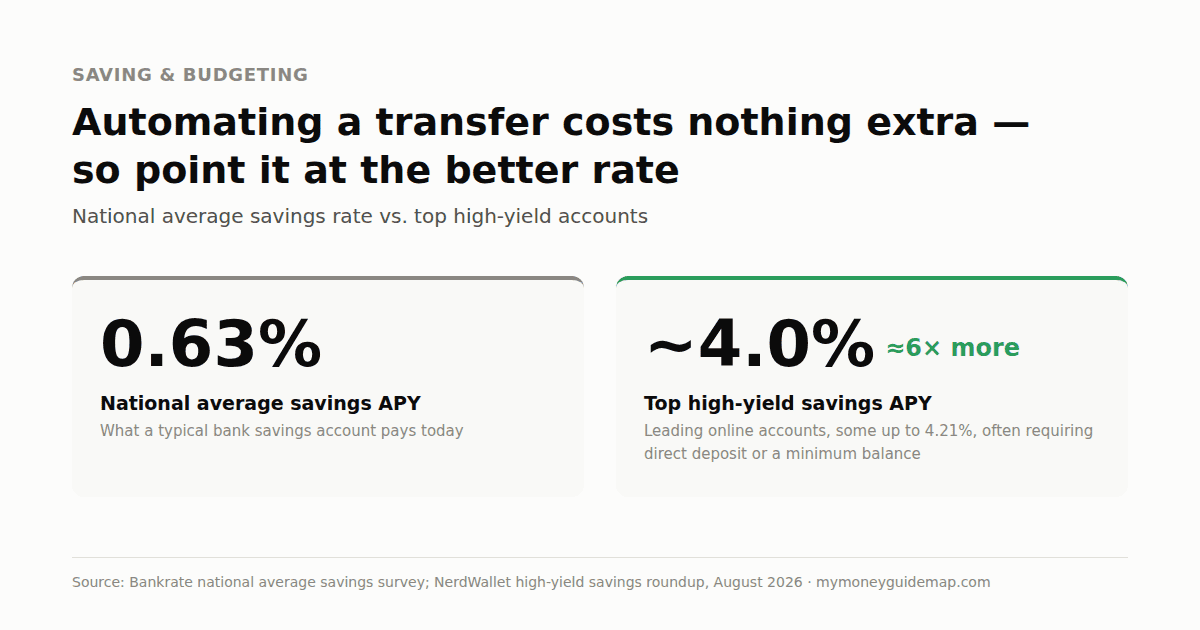
Automating a transfer into a checking-adjacent savings account earning close to nothing defeats part of the purpose. As of late August 2026, Bankrate’s survey puts the national average savings account rate at just 0.63% APY, while top high-yield savings accounts (HYSAs) are paying close to 4% APY — roughly six times more for holding the exact same dollars.
The mechanics of automating a transfer are the same whether the destination account pays 0.63% or roughly 4% — so it costs nothing extra to point the automation at the better rate. Several online banks are currently advertising rates north of 4% APY, typically tied to a linked checking account, direct deposit, or a minimum balance. If you haven’t checked your own savings account’s APY recently, it’s worth a look before you set anything up.
Automation Isn’t a Full Strategy on Its Own
Automatic transfers work best once you know roughly what you’re automating toward. If you don’t yet have a cushion for unplanned expenses, that’s usually the first thing automation should build — see how much an emergency fund actually needs to be before deciding on a monthly target. Past that, the same “set it and forget it” logic extends naturally to contributing to a Roth IRA, most of which support their own recurring automatic contributions directly from a bank account.
Automation doesn’t replace checking in on your finances entirely — you’ll still want to revisit the amount periodically as your income or expenses change, and confirm your bank isn’t quietly dropping a promotional rate back down to something closer to the national average. But it replaces the part that was never sustainable to begin with: relying on remembering to do it manually, every month, indefinitely.
The Actual Takeaway
The fastest way to save more isn’t a better budget spreadsheet — it’s removing yourself from the process. If you take nothing else from this, that’s really how to automate your savings without overhauling your whole budget: split your direct deposit or schedule a recurring transfer, point it at an account actually paying a competitive rate, start with an amount you won’t notice missing, and let the gap between what you earn and what you see in checking do the rest.
5 thoughts on “How to Automate Your Savings”