We’ve mentioned “the emergency fund” in a couple of earlier posts without ever actually answering the obvious follow-up: emergency fund, how much is enough, exactly? It’s one of those pieces of financial advice that gets repeated constantly but rarely explained — so let’s actually get into the number.
The Standard Advice: 3 to 6 Months
The most common guideline, echoed across pretty much every major personal finance source, is to keep three to six months of living expenses in your emergency fund. NerdWallet frames it plainly: “a good rule of thumb is to have enough to cover three to six months’ worth of living expenses,” though they’re quick to note you might need more if your income is less predictable — freelancers, seasonal workers, or anyone whose job would be genuinely hard to replace.
Worth clarifying up front: this is three to six months of expenses, not income. If your monthly take-home pay is $4,500 but your actual essential spending — rent, utilities, groceries, insurance, minimum debt payments — comes to $3,000, your target is $9,000 to $18,000, not $13,500 to $27,000. That distinction alone changes the number a lot for most people.
Why So Many People Don’t Have One
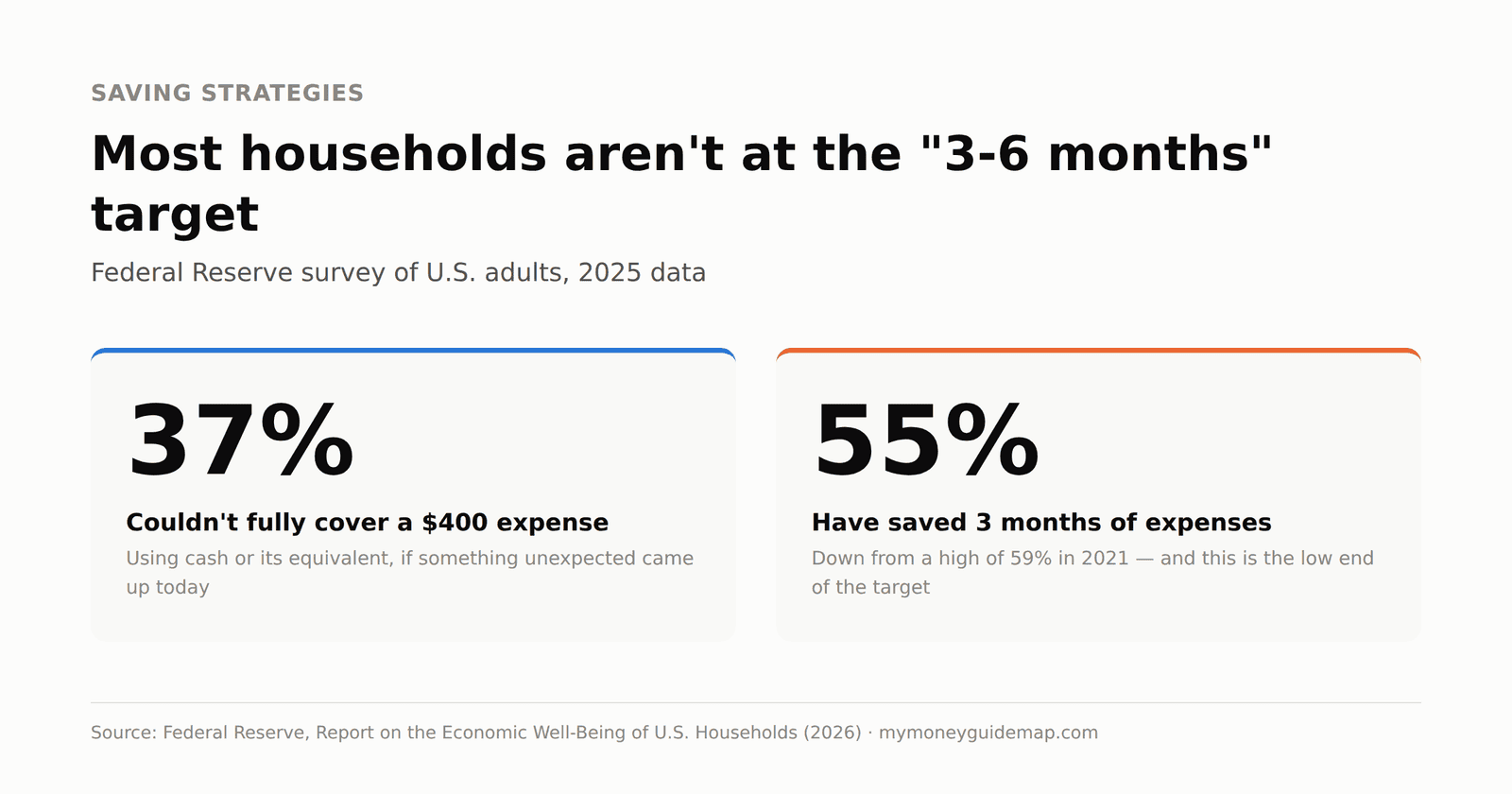
This isn’t just a hypothetical gap. The Federal Reserve’s 2026 report on the economic well-being of U.S. households found that 37% of adults wouldn’t be able to fully cover a $400 unexpected expense using cash or its equivalent — 12% said they couldn’t cover it by any means at all. On the savings side, only 55% of adults reported having set aside enough for three months of expenses, a figure that’s actually down from 59% in 2021.
If you’re closer to the $400 end of that spectrum than the six-months end, you’re not an outlier — you’re most of the country. The 3-6 month target is a destination, not a starting requirement.
What Actually Changes the Number for You
The 3-6 month range exists because “enough” isn’t the same for everyone. A two-income household where both people have stable, easily replaceable jobs can usually lean toward the lower end — if one income disappears, the other is still covering a meaningful share of expenses. A single-income household, a freelancer with irregular pay, or someone in a specialized field that would take months to find a comparable role generally has a stronger case for leaning toward six months or beyond.
Dependents matter too, and so does how much flexibility exists in your monthly spending. Someone with a mortgage, kids, and mostly fixed expenses has less room to cut back quickly in a real emergency than someone renting alone with a mostly flexible budget — which means the fixed-expense household often needs a bigger cushion to buy the same amount of breathing room.
Where to Actually Keep It
This part trips people up almost as often as the target number does. An emergency fund needs to be liquid and safe, which rules out anything where the value could be down when you need it most — that’s not what an index fund is built for, for instance, even though it’s a reasonable place for money you won’t touch for years. A high-yield savings account is the more common home for it: FDIC-insured, accessible within a day or two, and at least earning something close to a real interest rate while it sits there waiting.
Building It When 3-6 Months Feels Impossible
If the full target feels miles away, that’s normal, and it’s not a reason to wait to start. A lot of people find it more workable to aim for a smaller first milestone — one month of expenses, or even a flat $1,000-$2,000 buffer — before worrying about the full six-month version. That smaller cushion alone covers the most common “emergencies” (a car repair, a broken appliance, an unexpected medical bill) without derailing the rest of your budget, even before you’ve hit the bigger number.
A Few Things That Trip People Up
Treating the emergency fund like a savings account for everything is a common one — a vacation or a holiday gift budget isn’t an emergency, and raiding the fund for planned expenses defeats the purpose of having it. On the flip side, some people overfund it well past six months “just in case,” which isn’t really any safer, it’s just money that could be growing somewhere else sitting idle instead. And building it once isn’t the end of the job — rent goes up, expenses shift, and a fund sized for your budget two years ago might not actually cover you today.
Emergency Fund How Much Is Enough? The Quick Recap
If you want one number to start with: figure out your real monthly essential expenses, multiply by three, and treat that as the first real target — with six months as the version to grow into if your income is less predictable or you’re the sole earner in your household. It won’t feel like enough until it’s tested, and hopefully it never has to be. But having gone through the math once beats guessing at it during an actual emergency, which is usually the worst possible time to be doing arithmetic.
7 thoughts on “Emergency Fund: How Much Is Enough?”