If you’ve ever had a “surprise” expense that wasn’t actually a surprise at all — your car’s registration renewal, a friend’s wedding, the holidays showing up every December like clockwork — you’ve already run into the exact problem a sinking fund solves. What is a sinking fund, in plain terms? It’s the tool built specifically for that gap between knowing something’s coming and actually having the cash ready when it lands.
What Is a Sinking Fund, Exactly
A sinking fund is a way of saving a little bit each month toward a specific expense you can see coming, so the full cost is already sitting there when the bill arrives instead of hitting your checking account all at once. Ramsey Solutions frames the distinction simply: a sinking fund is for the known, an emergency fund is for the unknown. Car repairs from an accident are what your emergency fund is for; a car’s annual registration renewal, which happens on a schedule you already know, is exactly what a sinking fund covers.
It’s also worth separating the fund from the account it lives in. A savings account is just where the money physically sits — a sinking fund is the method, the earmarking of a portion of that balance for one specific purpose. You can run several sinking funds out of a single high-yield savings account, as long as you’re tracking what portion belongs to what goal.
The Math Is Just Division
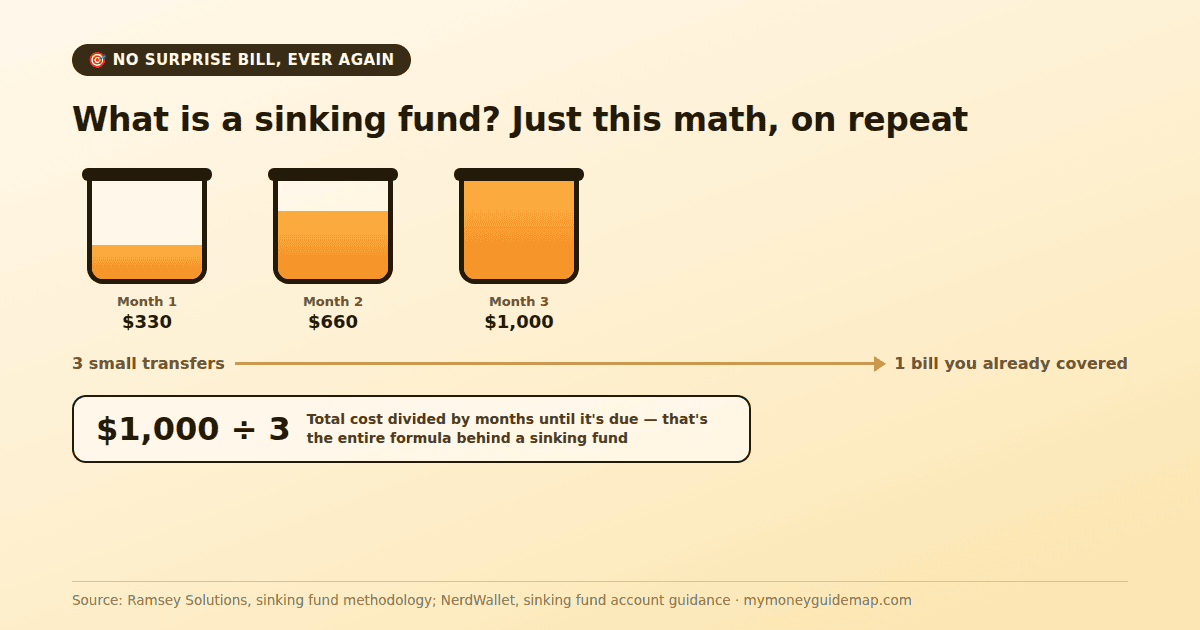
Setting one up doesn’t require a spreadsheet degree. Take the total amount you’ll need and divide it by the number of months you have before you need it. Ramsey’s own example: if you want $1,000 ready for the holidays by December and you’re starting in September, that’s three months out, so roughly $330 a month gets you there. A car that typically needs new tires around year four, at a cost you can estimate from a quick search, can be broken into a small monthly contribution starting well before the tread wears down.
The further out you start, the smaller the monthly hit. This is really the only reason sinking funds work as well as they do — spreading a $1,200 expense over ten months feels almost invisible, while covering it in one lump sum from a single paycheck rarely does.
What People Actually Use Them For
So what is a sinking fund actually good for, in practice? The usual candidates are the expenses that are large, irregular, and completely predictable in hindsight: holiday gifts, vacations, car maintenance and eventual replacement, home repairs, annual insurance premiums, veterinary checkups, and events like weddings. None of these are surprises in the way a burst pipe or a job loss is — they’re just expenses that don’t happen monthly, which makes them easy to forget about until they show up.
Setting One Up Without Overcomplicating It
Actually setting up what is a sinking fund in practice comes down to picking a home for the money and automating the deposit. The simplest version of this is a labeled savings account per goal, though most banks now let you create sub-accounts or “buckets” inside one account, which avoids opening five separate accounts for five separate goals. NerdWallet recommends parking these funds somewhere that’s “easy to access and free of any minimums or fees” — a plain high-yield savings account does the job without needing anything more specialized. A good way to find your first few candidates is by looking back at last year’s spending for whatever expense caught you off guard or pushed you toward a credit card, since that’s usually a clear sign it belongs in a sinking fund going forward.
Either way, the mechanism that actually makes a sinking fund work is the same one that makes any savings goal work: automating the transfer so the monthly contribution happens on payday without you having to remember it or decide to do it again each month.
It’s worth resisting the urge to lump every irregular expense into one giant “miscellaneous” fund. A single combined bucket makes it hard to know if you’re actually on track for the wedding you’re attending in June versus the car repair you’re expecting in March — keeping them separate, even just as labeled sub-accounts, keeps the math honest for each individual goal.
How Many Sinking Funds Should You Actually Have
There’s no fixed number, but the answer to what is a sinking fund good for starts to break down once you’re juggling a dozen separate buckets for every conceivable expense. Most people land somewhere between three and five active sinking funds at any given time — enough to cover the categories that genuinely recur (holidays, car maintenance, an annual premium or two) without turning your budget into a spreadsheet you dread opening.
A reasonable way to prioritize is by certainty and timing: fund the expense you’re most sure is coming and coming soonest first, then add the next one once that contribution feels manageable inside your budget. Trying to start five sinking funds simultaneously on a tight budget usually means underfunding all of them, which defeats the purpose — a sinking fund that’s short by half when the bill arrives still leaves you scrambling for the difference.
It’s also fine to let a sinking fund go dormant once its expense is paid and restart it the following year rather than keeping every bucket permanently active. A car maintenance fund that empties out every spring doesn’t need monthly contributions through the summer if nothing’s due until next spring — pause it, and redirect that money toward whichever goal is next in line.
Where This Fits With Everything Else
Understanding what is a sinking fund also means understanding what it isn’t: it isn’t a replacement for an emergency fund, and it’s not a substitute for retirement savings either — it sits alongside both, handling the middle category of expenses that are too big for a monthly budget line but too predictable to count as an emergency. If you’re still building your emergency fund, that typically comes first, since sinking funds are for goals you can delay slightly if money gets tight, whereas an emergency fund exists precisely for the moments when it can’t wait.
The Actual Takeaway
What is a sinking fund worth, in the end? It turns “I’ll figure it out when the bill comes” into a number you already know and a monthly amount you’re already setting aside. Pick one upcoming expense you know is coming, divide the cost by the months you have left, and start moving that amount automatically — it’s a small habit that removes an entire category of financial stress before it happens.
2 thoughts on “What Is a Sinking Fund?”