If you’ve ever looked at your bank statement and genuinely couldn’t explain where a chunk of last month’s money went, envelope budgeting is built around a very specific fix for that. What is envelope budgeting supposed to solve? Making it physically impossible to overspend in the categories that keep getting away from you.
What Is Envelope Budgeting, at Its Core
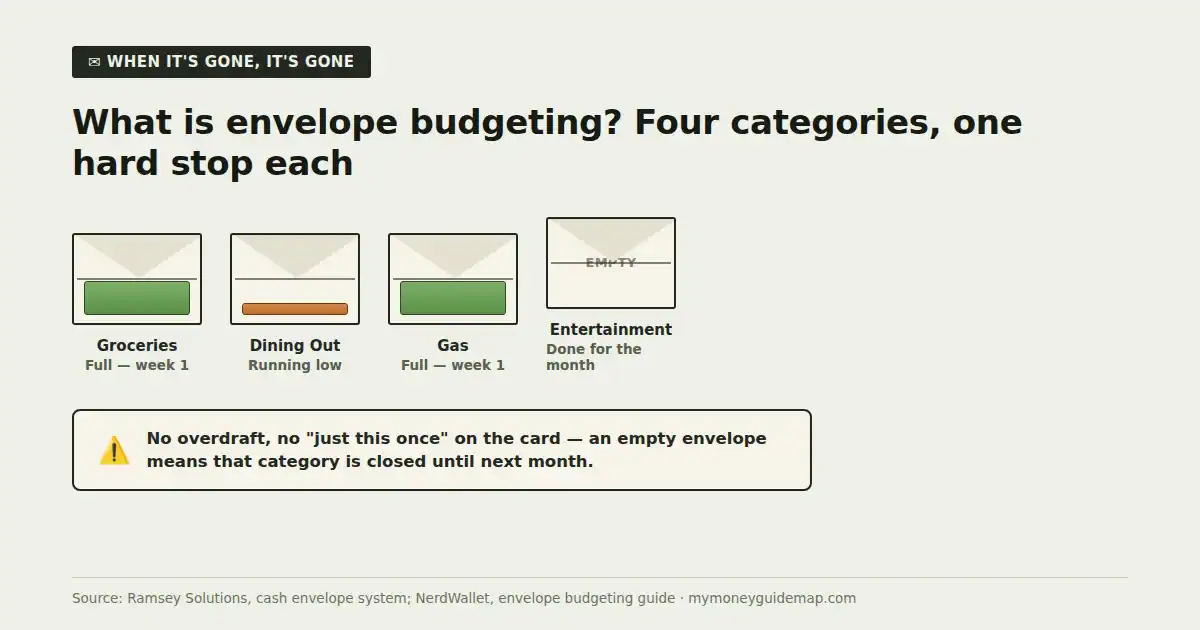
Envelope budgeting means withdrawing cash for certain spending categories and physically dividing it into labeled envelopes — groceries, gas, dining out, entertainment — then spending only what’s in the envelope for that category until the next paycheck. Ramsey Solutions puts the appeal bluntly: “When the money’s gone, it’s gone. It makes overspending nearly impossible.” There’s no overdraft, no “I’ll just put it on the card this once” — once an envelope is empty, spending in that category stops until it’s refilled.
The system doesn’t cover every dollar you spend. Fixed bills like rent, utilities, and loan payments typically stay on autopay outside the envelopes, since those amounts don’t fluctuate month to month. Envelope budgeting is really aimed at the flexible, judgment-call categories — the ones where a bad week can quietly turn into a bad month.
Setting It Up
The process starts with a normal budget: list your income and your expenses, ideally accounting for every dollar somewhere, similar to zero-based budgeting. If you’re already sorting expenses into broader buckets like the 50/30/20 rule’s “wants” category, envelopes are really just a stricter, cash-based way of enforcing that same limit category by category rather than as one lump sum. From there, pick out the categories where you actually tend to overspend rather than assigning envelopes to everything. Groceries, restaurants, gas, personal care, and entertainment are the categories that show up most often, since these are the ones people typically pay for in smaller, frequent amounts where it’s easy to lose track.
Once you know the categories and the amounts, withdraw the cash and physically split it into envelopes labeled for each one. From that point, the rule is simple: spend only what’s in the relevant envelope, and when it’s empty, that category is done for the month regardless of how many days are left.
Why What Is Envelope Budgeting About Really Comes Down to Cash
This isn’t just an aesthetic preference for cash over cards. Paying with physical bills creates an immediate, visible sense of your balance shrinking that a card swipe doesn’t — you feel an envelope getting lighter in a way you never feel a card balance changing. That psychological friction is really the entire mechanism behind why this system works for people who’ve struggled with overspending on cards specifically. It’s not about cash being inherently better; it’s about making the cost of spending impossible to ignore in the moment.
Knowing What Is Envelope Budgeting Best Suited For
Like most budgeting systems, this one works better for some people than others, which is worth being upfront about before you withdraw a month’s worth of cash and label ten envelopes. It tends to click fastest for people who’ve already tried tracking spending in an app and found that seeing a number after the fact doesn’t change behavior in the moment the way handing over cash does.
Who It’s Not a Good Fit For
Envelope budgeting asks a lot logistically, and it’s worth being honest about who it doesn’t suit. If you rarely carry cash, do most of your shopping online, or don’t have easy access to a bank branch or ATM without fees, physically withdrawing and redistributing cash every month becomes its own source of friction. Frequent online purchases in particular don’t fit a physical envelope at all, since there’s no cash to hand over in a checkout flow that happens entirely on a screen.
For anyone in that position, NerdWallet notes that digital versions of the same idea have become common, using budgeting apps that mimic the envelope structure — separate spending “buckets” per category — without requiring actual cash. The underlying logic stays identical: cap what a category can spend and stop when it hits zero. Only the medium changes.
The Actual Takeaway
So, what is envelope budgeting good for in the end? Not every spending category or every person, but for the specific problem of categories that quietly bleed money — takeout, impulse buys at the grocery store, the “just this once” purchases that add up — it removes the decision entirely by removing the money before the decision can happen. Whether that means literal cash in an envelope or a digital bucket that hits zero the same way, the mechanism is the same: once it’s gone, it’s gone, and that’s exactly the point.
1 thought on “What Is Envelope Budgeting?”