If the idea of investing a lump sum right before the market dips has ever kept you from investing at all, dollar-cost averaging is the strategy built to take that particular fear out of the equation — not by predicting the market, but by refusing to bet on any single moment in it.
Dollar-Cost Averaging, the Basic Idea
Dollar-cost averaging means investing a fixed dollar amount on a regular schedule, regardless of whether prices are up, down, or flat that week. Instead of trying to time one perfect entry point, you buy in smaller, consistent chunks over time, which means you naturally buy more shares when prices are low and fewer shares when prices are high.
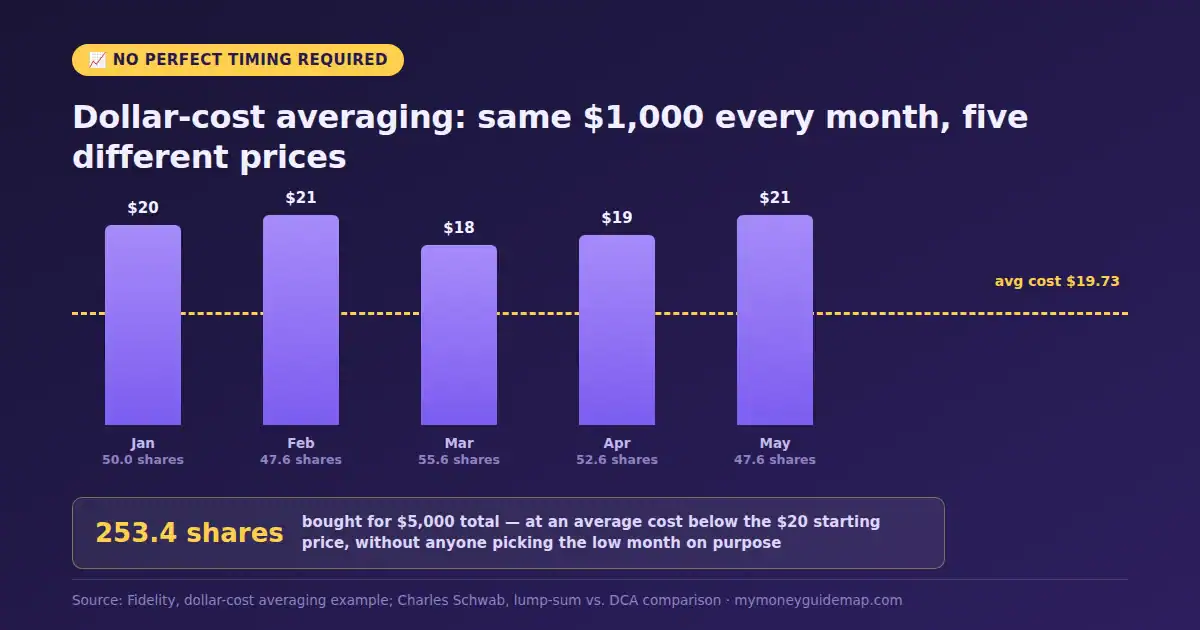
Fidelity walks through a clean example: investing $1,000 a month for five months, as the share price moves from $20 to $21 to $18 to $19 and back to $21, ends up buying roughly 253 shares at an average cost of $19.73 each — a lower average than the $20 price you started at. Nobody had to guess that March would be the cheapest month. The schedule did the work by default.
What It’s Actually Protecting You From
The real target of dollar-cost averaging isn’t market timing exactly — it’s investor psychology. Watching a lump sum drop in value the week after you invest it is a specific kind of bad feeling that causes a lot of people to panic-sell or avoid investing again for months. Spreading purchases out doesn’t eliminate volatility, but it removes the singular, painful moment of “I invested everything right before it fell,” since any one bad week only affects a fraction of your total contributions.
The Trade-Off You’re Making
Dollar-cost averaging isn’t free, though. Charles Schwab notes plainly that over long stretches of time, it tends to produce lower returns than investing a lump sum all at once — which makes sense once you think about it: markets rise more often than they fall, so money sitting on the sidelines waiting for its turn to be invested is money not participating in that upward drift. If you already have a large sum ready to invest and a long time horizon, investing it all at once has historically outperformed spreading it out, on average.
Where dollar-cost averaging earns its keep is less about beating a lump sum mathematically and more about being the strategy people can actually stick to. A perfect plan you abandon after one bad month is worth less than a decent plan you follow for years.
You’re Probably Already Doing It
Here’s the part that surprises people: if you’ve ever contributed to a 401(k) through payroll deductions or set up a recurring transfer into a Roth IRA, you’ve already been dollar-cost averaging without necessarily calling it that. Every paycheck that automatically buys into your retirement account is doing exactly what the strategy describes — fixed amount, regular schedule, price be damned. The same automation that makes saving easier is quietly doing the same job for investing.
Who It’s Not Ideal For
If you’re sitting on a genuine lump sum — an inheritance, a bonus, proceeds from a sale — and you have a long investing horizon and a stomach for short-term volatility, spreading that money out over many months isn’t necessarily the better move mathematically, even though it might feel safer emotionally. It’s also not a strategy that fixes a bad underlying investment; averaging into something that keeps declining for fundamental reasons just means averaging down into a loser more slowly.
The Actual Takeaway
Dollar-cost averaging trades a shot at slightly higher average returns for a strategy that’s far easier to actually follow through on, which for most people investing out of a regular paycheck rather than a windfall is close to a moot trade-off anyway — you’re dollar-cost averaging by necessity, not by choice. The real decision isn’t whether to use it; for most people it’s already happening automatically. The decision is whether to notice it’s working and let it keep running.