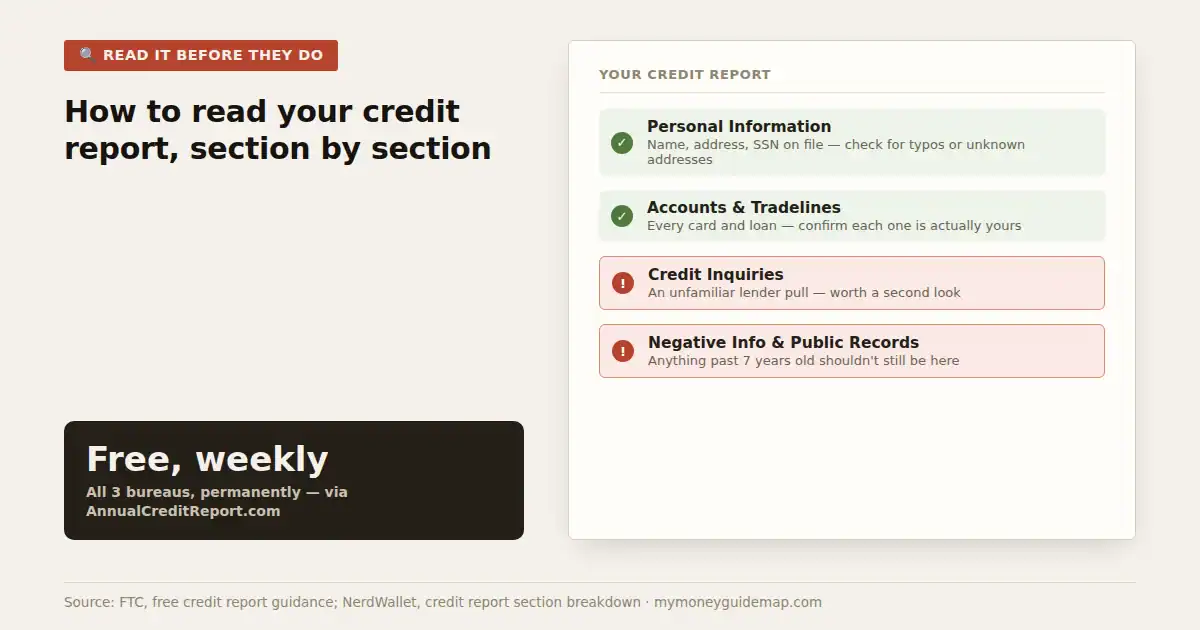
Most people have never actually opened their own credit report. They know their score, maybe, but the report itself — the raw document your score gets calculated from — tends to sit there unread, which is exactly how errors and outdated information quietly stick around for years without anyone catching them.
Learning how to read your credit report starts with actually getting your hands on it, since none of the sections below matter until you’ve pulled the real document.
Getting the Report Itself
AnnualCreditReport.com is the only source the FTC officially endorses for free credit reports, and it’s worth using directly rather than a lookalike site that tries to upsell you on credit monitoring. What used to be an annual allowance became a permanent weekly one after the pandemic-era extension stuck around: you can now pull your report from each of the three bureaus — Equifax, Experian, and TransUnion — once a week, for free, indefinitely. There’s no real excuse not to check at least occasionally, especially before applying for anything like a mortgage or auto loan.
The Personal Information Section
This is the least interesting part of the report and also the easiest to skim past, but it’s worth a genuine look. It lists the name, addresses, Social Security number, and birthdate the bureau has on file for you. An address you never lived at or a name variation you never used isn’t just a clerical curiosity — it can be an early sign that someone else’s information has gotten mixed into your file, or worse, a sign of identity theft.
Accounts and Tradelines
If there’s one section that actually teaches you how to read your credit report, it’s this one: every credit card, loan, and line of credit reporting to that bureau, along with the payment history attached to each one. NerdWallet’s breakdown frames the check simply — for every account listed, confirm it actually belongs to you, that you authorized opening it, and that the payment history matches what you remember paying. This section is also where credit utilization gets calculated from, since it shows the balance and limit on every revolving account side by side.
An account you don’t recognize here isn’t automatically a red flag, since old accounts sometimes report under a different name than the one you remember, but it’s worth chasing down rather than assuming it’s fine.
Credit Inquiries
Every time a lender pulls your credit file, it gets logged here. Inquiries you don’t recognize are worth a second look — not because they’re necessarily fraud, but because unfamiliar inquiries are one of the more common early signs that someone applied for credit in your name without your knowledge.
Negative Information and Public Records
This is usually the section you’ll be most anxious about once you actually sit down and learn how to read your credit report in full, and for good reason — it’s where late payments, collections, and any public record like a bankruptcy show up. The detail worth knowing: most negative information ages off your report after seven years, with bankruptcy being the main exception. If you spot something negative that’s older than that window and still showing up, that alone is grounds for a dispute.
How to Read Your Credit Report for Errors Worth Disputing
Not every unfamiliar detail is worth a formal dispute, but the FTC is clear that the core standard is whether the information is accurate, complete, and up to date. An account that isn’t yours, a payment marked late that you actually paid on time, a balance that’s wrong, or negative information past its seven-year window are all legitimate reasons to dispute. The process runs through both the credit bureau reporting the error and the business that supplied the information in the first place — the bureau is required to investigate, and information it can’t verify has to come off the report.
The Actual Takeaway
Knowing how to read your credit report is really about knowing where the raw material your score gets built from actually lives, which makes it worth more attention than most people give it. Pulling it — free, weekly, straight from AnnualCreditReport.com — and actually reading through the personal information, accounts, inquiries, and negative-information sections takes maybe fifteen minutes, and it’s the only way to catch an error, an outdated mark, or early signs of identity theft before they quietly cost you a better rate on something you actually need.
2 thoughts on “How to Read Your Credit Report”