If you’ve been keeping your credit card balances near zero and still can’t figure out why your score isn’t higher, or the opposite — you’re carrying a balance and wondering exactly how much it’s costing you — the answer usually comes down to one number most people have never calculated for themselves. What is credit utilization, in plain terms? It’s simply how much of your available credit you’re actually using at any given moment.
What Is Credit Utilization, Calculated
Credit utilization is the percentage of your available revolving credit you’re actually using, and Bankrate defines the calculation as your total balances divided by your total credit limits. If you’re carrying $2,000 across cards with a combined $15,000 in limits, your utilization is 13%. It applies across all your revolving accounts together, not just one card in isolation.
This single number carries more weight than most people realize. Utilization falls under the “amounts owed” category, which makes up 30% of your FICO score — the second-biggest factor after payment history. Two people with identical payment records can end up with meaningfully different scores purely because one is running a card near its limit and the other isn’t.
Where the Actual Thresholds Fall
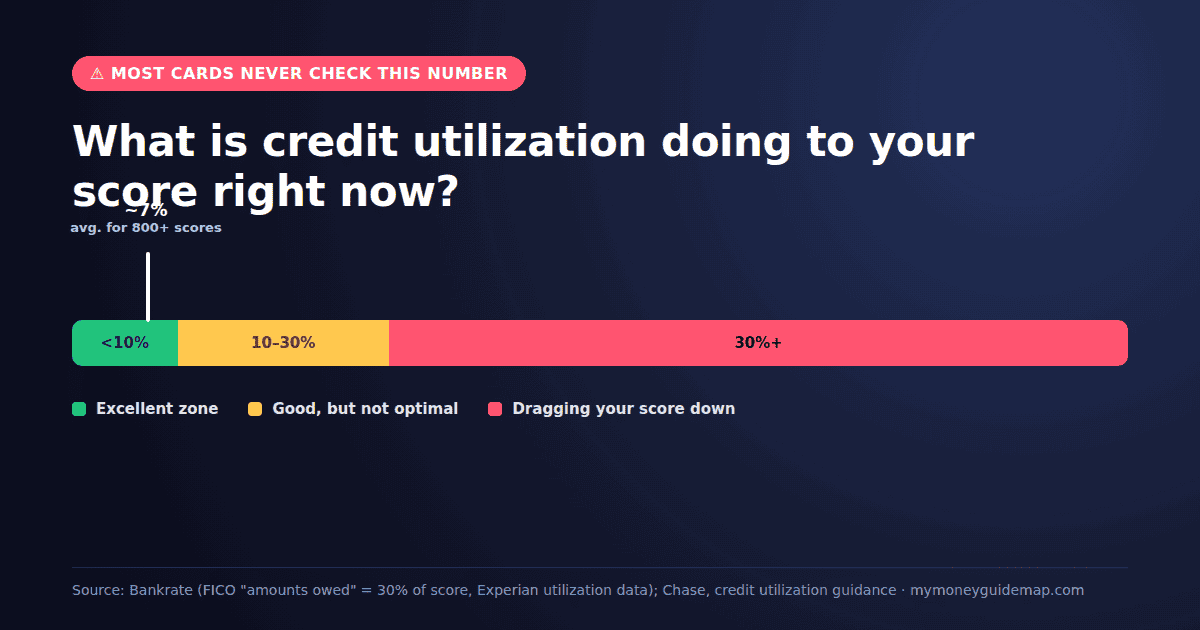
So what is credit utilization considered “good” versus merely acceptable? Most guidance lands in a similar place: keeping your credit utilization under 30% is the widely cited baseline for good credit, but the people with the strongest scores tend to run noticeably lower than that. Chase notes that cardholders who keep utilization under 10% on each individual card tend to land in the 800-plus, exceptional range, and separately, Experian data cited by Bankrate shows people in that same 800-850 tier averaging just over 7% utilization.
Worth noting: this isn’t a case where lower is unconditionally better all the way to zero. A card sitting at 0% utilization for long stretches can read as inactive rather than responsibly managed, so a small amount of regular, paid-off usage is generally preferable to letting a card go completely untouched.
Per-Card Utilization Matters Too, Not Just the Total
It’s possible to have a comfortable overall utilization rate while one specific card is maxed out, and that imbalance can still work against you — lenders and scoring models look at individual card utilization as well as the combined figure. If you’ve got one card near its limit and others sitting mostly unused, moving some of that balance around (or simply paying down the maxed card first) can help even if your blended number already looks fine on paper.
How to Actually Bring It Down
If you’re now wondering what is credit utilization worth doing about right away, the good news is it doesn’t require one dramatic move. The most direct fix is paying down balances, but it’s not the only lever. Requesting a credit limit increase on an existing card — without adding new spending — instantly lowers your utilization by expanding the denominator in that calculation. Keeping older cards open matters for the same reason: closing a card removes its limit from your total available credit, which can push your utilization up even if your balances haven’t changed at all. Opening a new card is another way to add available credit, though it comes with a hard inquiry that can ding your score slightly in the short term, so it’s more of a longer-term move than a quick fix.
None of these tricks matter much if the underlying balance keeps climbing, though — utilization is ultimately a symptom of how much you’re carrying relative to what’s available, not something to game around a growing balance.
Where This Fits With the Rest of Your Credit Picture
Utilization moves faster than almost any other factor in your score, since it updates whenever your statement balance is reported, unlike something like length of credit history, which only changes with time. That makes it one of the more responsive levers if you’re trying to move from a fair-to-good score into a stronger range — a few months of lower balances can move the needle noticeably faster than most other credit-building strategies. It’s also worth reading alongside how the rest of your FICO score is actually built, since utilization is only one piece of a five-factor formula, not the whole picture.
The Actual Takeaway
So, what is credit utilization worth to you in practice? It’s one of the few credit factors you have near-immediate control over. Check where you actually stand — total balances divided by total limits, and per card too — and if you’re running above 30%, closing that gap is one of the more reliable ways to see real score movement in a matter of months rather than years.