Somewhere along the way, “good credit score” turned into one of those phrases everyone uses and almost nobody defines. What is a good credit score, actually, in numbers? It depends slightly on who you ask, but there’s a widely used standard that most lenders reference, and it’s worth knowing exactly where the lines are drawn.
The FICO Score Ranges
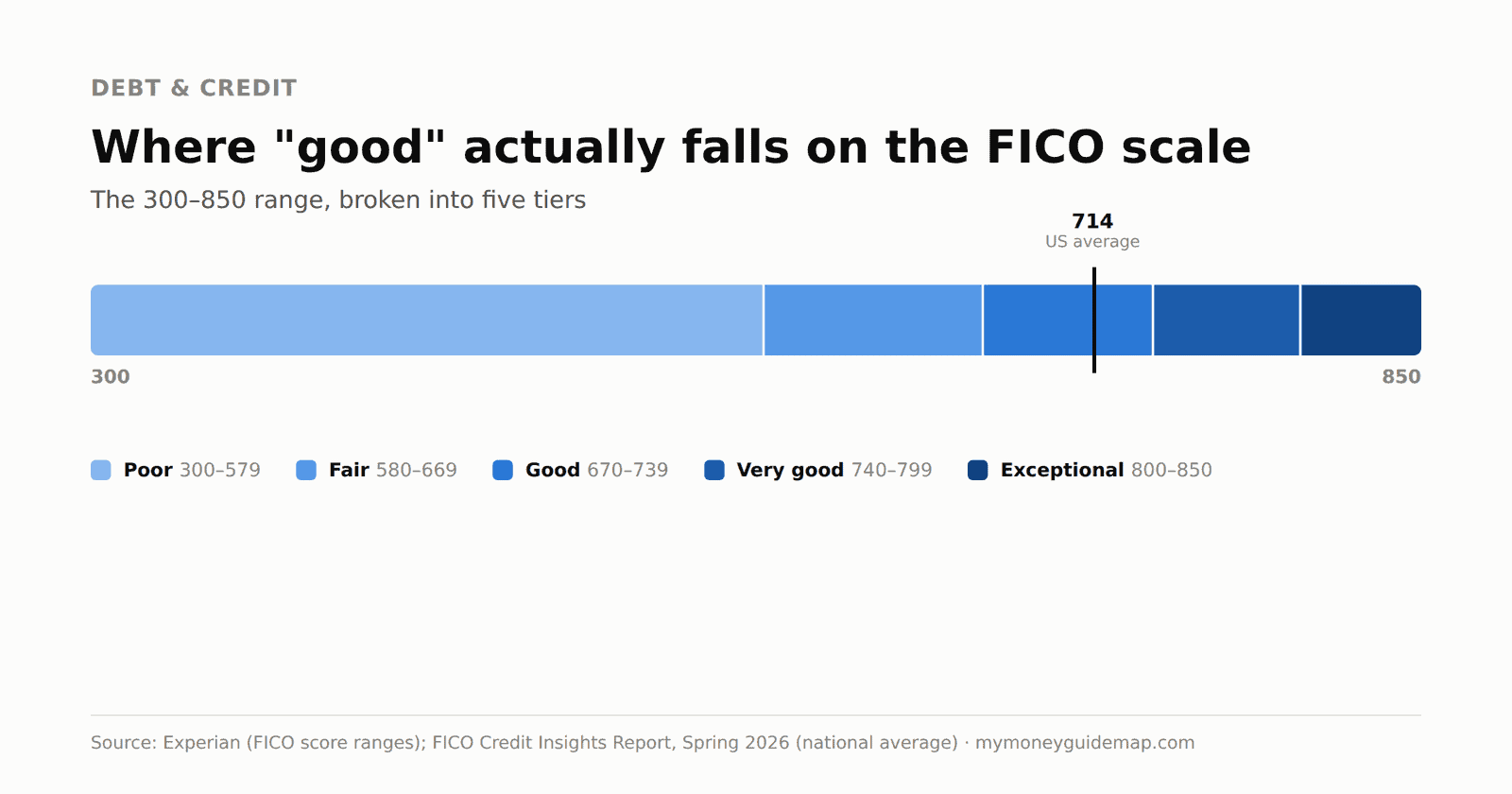
Using the standard 300-850 FICO scale, Experian breaks the ranges down into five tiers: 300-579 is considered poor, 580-669 is fair, 670-739 is good, 740-799 is very good, and 800-850 is exceptional.
“Good,” in other words, isn’t the top of the scale — it’s the middle tier, the point where most mainstream lenders start treating you as a normal, low-risk borrower rather than someone who needs extra scrutiny or a higher rate to offset their risk. You don’t need to be near-perfect to get decent terms on most everyday credit products; you just need to clear that 670 line consistently.
Where the Average American Actually Falls
According to FICO’s own Credit Insights Report, the national average FICO Score sits at 714 as of spring 2026 — solidly in the “good” tier, though it slipped 2 points over the prior year, which FICO attributed mainly to resumed student loan delinquency reporting and a modest uptick in mortgage delinquencies. At the same time, a record 48.1% of consumers now have scores of 750 or higher, and Experian’s data shows 71% of Americans are sitting at “good” or better.
So if your score is somewhere in the high 600s to low 700s, you’re not behind — you’re roughly in line with where most of the country actually is, even if it doesn’t feel that way scrolling through personal finance content online that tends to spotlight the 800-plus crowd.
What Counts as “Good Enough” Actually Depends on What You’re Applying For
Here’s where the ranges get a little less tidy in practice: different products have different real thresholds. A standard credit card might approve you comfortably in the “good” range. A mortgage lender chasing the best available rate is often looking for “very good” or higher, since even a modest rate difference compounds into real money over a 30-year loan. Auto lenders vary a lot by whether you’re financing through a dealer or a bank, and some subprime auto lenders will work with scores well into “fair” territory, just at a steeper rate.
There’s no single number that unlocks everything at once — it’s more accurate to think of your score as sliding you into better or worse pricing tiers for whatever you’re applying for, with the exact cutoffs set by each lender rather than by FICO itself.
Why the Range Matters More Than the Exact Number
A score of 705 and a score of 715 are functionally almost the same to most lenders — both comfortably “good,” both likely to see similar offers. But a score of 668 and a score of 672 can mean meaningfully different outcomes, purely because one sits just under the “good” line and the other just clears it. The factors behind these numbers — payment history and utilization especially — matter more day to day than obsessively tracking single-point movements, since it’s really the tier you’re sitting in, not the exact digit, that lenders act on.
The Actual Takeaway
If you’re wondering whether your score is “good,” the honest answer is: check where it falls against the five tiers above, and remember that “good” starts at 670, not 800. Most people chasing credit improvement don’t need to reach exceptional — they need to clear whatever threshold the specific loan or card they want actually requires, which is usually a lot closer than the internet’s obsession with perfect scores makes it feel.
4 thoughts on “What Is a Good Credit Score?”