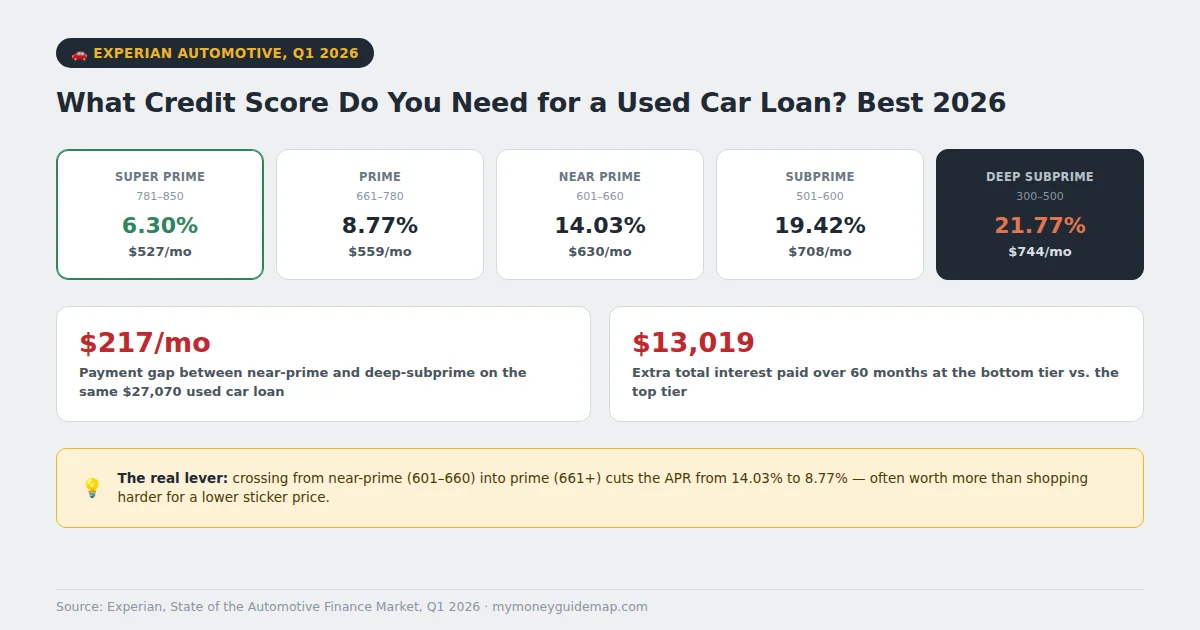
What credit score do you need for a used car loan? The honest answer is that it depends entirely on which tier you land in, and the gap between tiers is bigger than most shoppers expect. According to Experian’s State of the Automotive Finance Market report for the first quarter of 2026, someone with super-prime credit pays a used-car APR of 6.30%, while someone in deep subprime territory pays 21.77% on the exact same loan — more than three times as much interest for the same car.
What Credit Score Do You Need for a Used Car Loan, Tier by Tier?
Here’s what those tiers actually look like, using Experian’s Q1 2026 average amount financed for a used vehicle ($27,070) spread over a 60-month loan so every row is comparing the same car:
| Credit Tier | FICO Score | Used Car APR | Monthly Payment* |
|---|---|---|---|
| Super Prime | 781–850 | 6.30% | $527 |
| Prime | 661–780 | 8.77% | $559 |
| Near Prime | 601–660 | 14.03% | $630 |
| Subprime | 501–600 | 19.42% | $708 |
| Deep Subprime | 300–500 | 21.77% | $744 |
*Payments assume a $27,070 loan over 60 months, Experian’s reported national average for a used vehicle. Experian’s own average loan term runs closer to 68 months, which lowers the monthly number but stretches out how long you’re paying that rate.
The dollar gap is the part most people underestimate. A near-prime buyer pays about $630 a month, while a deep-subprime buyer financing the identical car pays $744 — a $217 difference every single month, or roughly $13,000 more in total interest paid out over the life of the loan. That’s real money that has nothing to do with the car itself and everything to do with the three digits on a credit report.
Where Do You Actually Fall?
Most people don’t know their tier until a dealer runs their credit, which is the worst possible time to find out. If you’re not sure where you stand, our breakdown of what actually counts as a good credit score walks through the same FICO ranges in more detail — checking that before you ever set foot on a lot means you already know roughly which row of the table above applies to you, instead of finding out in the finance office.
It’s also worth remembering these are national averages, not guarantees, so the honest answer to what credit score do you need for a used car loan always comes with an “it depends” attached. Two people with the same 640 credit score can get noticeably different used-car rates depending on their income documentation, down payment, and which lender they’re comparing against — a credit union will frequently beat a dealer’s in-house financing at the exact same credit tier — Bankrate’s own rate tracking notes that credit unions and online lenders are typically cheaper than dealerships and their financing partners, for exactly this reason.
What You Can Actually Do With This
If you’re sitting near the top of one tier and the bottom of the next, the math above is worth pausing over before you buy. Someone at a 655 (near-prime) paying down a credit card balance or clearing a small collection could realistically cross into the 661+ prime tier in a few months, and the jump from 14.03% to 8.77% APR is worth far more than most people would guess — on that same $27,070 loan, it’s the difference between $630 and $559 a month, every month, for five years.
For anyone who needs a car now and can’t wait out a score improvement, the better move isn’t chasing the lowest advertised rate at one dealership — it’s getting preapproved through a bank or credit union before you shop, so you’re negotiating from a known rate instead of accepting whatever number the finance office offers. So really, what credit score do you need for a used car loan comes down to less “what’s the minimum” and more “how much is each tier costing me, and is closing that gap worth waiting a month or two.”
Whatever tier the table above puts you in, that’s the number that should shape how you shop, not the sticker price of the car. A cheaper car financed in a worse tier can easily cost more in total interest than a slightly pricier one financed a tier or two higher — the credit score, not the price tag, is usually the bigger lever.