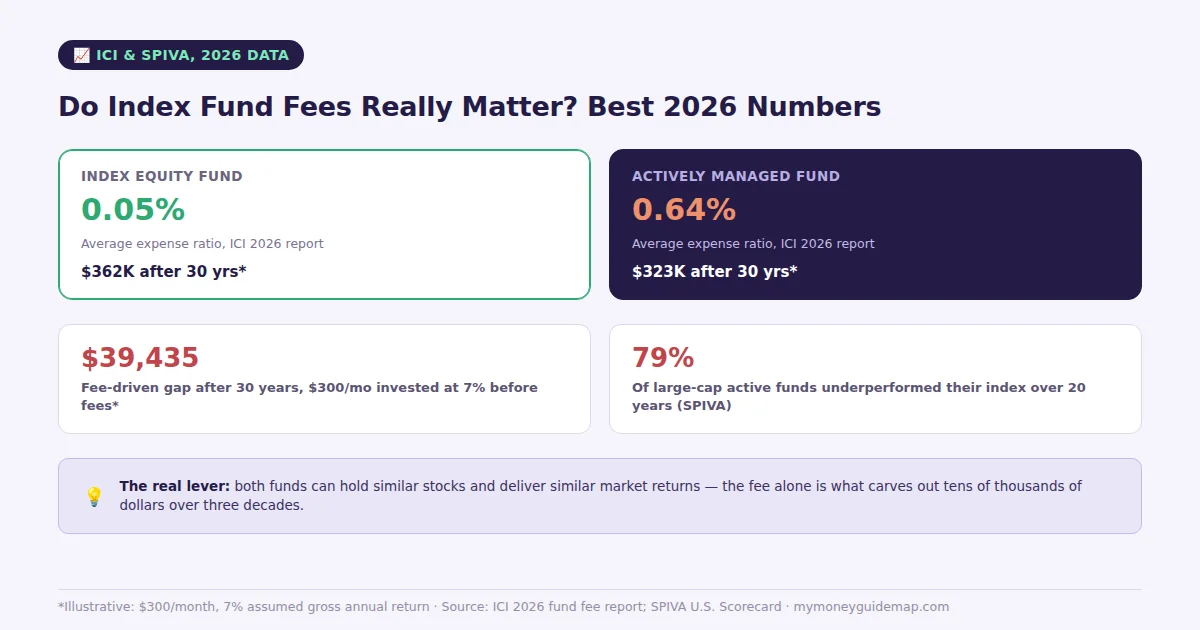
Do index fund fees really matter, or is a 0.5-percentage-point difference too small to worry about? According to the Investment Company Institute’s 2026 report on fund expenses, the average index equity mutual fund now charges just 0.05% a year, while the average actively managed equity fund charges 0.64% — a gap that looks tiny as a percentage and turns out to be anything but tiny in dollars.
Do Index Fund Fees Really Matter Over 30 Years of Investing?
Run the math on someone investing $300 a month for 30 years, assuming a 7% average annual return before fees. At the index fund’s 0.05% fee, that account grows to roughly $362,000. At the actively managed fund’s 0.64% fee, the same contributions and the same market return only grow to about $323,000 — a gap of nearly $39,000, created entirely by the fee, not by picking better or worse investments.
That’s the part most beginners miss: both funds could hold similar stocks and deliver similar raw market performance, and the fee alone would still carve out tens of thousands of dollars over three decades, because it compounds against you every single year, the same way your returns compound for you.
Why the Gap Is Bigger Than the Percentage Suggests
A 0.59-percentage-point fee difference sounds small next to a 7% return, but expense ratios are charged on your entire balance every year, not just on your annual contribution. As the account grows, 0.64% of $300,000 is a much bigger drag in real dollars than 0.64% of the $10,000 you started with — which is exactly why the gap between index and active fees widens the longer money stays invested, rather than staying flat.
This is also why our explanation of what an index fund actually is is worth revisiting before picking specific funds: an index fund’s low cost isn’t a marketing feature, it’s a structural result of simply tracking a market benchmark instead of paying a team of managers to pick stocks.
When a Higher Fee Might Still Be Worth Paying
None of this means every actively managed fund is a bad choice or that do index fund fees really matter equally in every account. Inside a 401(k), you’re often choosing from a limited fund lineup your employer picked, and an actively managed option might genuinely be the best or only choice available in a specific category, like an international small-cap fund. The real question isn’t “index always wins” — it’s whether an actively managed fund’s performance, after its fee, has actually beaten a comparable index option over long stretches of time, not just a good year or two. Most haven’t: S&P Dow Jones Indices’ SPIVA scorecard found that 79% of large-cap U.S. equity funds underperformed their index over the 20-year period through 2025, a track record that’s exactly why the ICI’s data keeps showing money flowing toward lower-cost options year after year.
What This Means for Your Own Accounts
If you’re not sure what you’re currently paying, checking your fund’s expense ratio takes less time than most people expect — it’s listed on the fund’s own summary page, usually as a single percentage, or right inside your brokerage or 401(k) app under the fund’s details. Target-date retirement funds, the default option in a lot of 401(k) plans, are worth a specific look: some run close to the 0.05% index-fund end of the range, while others quietly charge 0.5% or more for what’s still largely a mix of index holdings underneath.
So do index fund fees really matter enough to check today? For any money you’re planning to leave invested for a decade or more, the honest answer is yes: a fee difference that looks like a rounding error on paper is the single biggest controllable cost in long-term investing, and unlike market returns, it’s one number you actually get to choose.
1 thought on “Do Index Fund Fees Really Matter? Best 2026 Numbers”