If choosing investments feels like the part of retirement saving you keep putting off, a target-date fund is built to be the one decision that replaces all the others — you pick a single fund named for the year you plan to retire, and everything else it holds and how it shifts over time is handled for you.
A target-date fund is a single mutual fund or exchange-traded fund that holds a mix of stocks, bonds, and other assets calibrated to a specific future retirement year, then automatically rebalances that mix to grow more conservative as the years pass. Someone planning to retire around 2055 buys a fund labeled 2055; someone retiring around 2030 buys one labeled 2030. Instead of choosing and rebalancing a dozen individual holdings by hand, one purchase does the whole job.
How a Target-Date Fund’s Glide Path Actually Shifts Your Money
The mechanism behind that shift is called a glide path, and it’s the entire reason this kind of fund can be a decades-long decision made once. A fund aimed at 2055 might hold close to 90% stocks today, favoring growth while retirement is still far off, then gradually sell down that stock allocation in favor of bonds and cash equivalents year after year without the investor lifting a finger.
Industry-wide, the average target-date fund lands at retirement holding about 44% of its assets in stocks rather than going to zero, since a freshly retired investor may still need that money to grow for another two or three decades. Across all of them combined, the typical portfolio breaks down to roughly 42% domestic stocks, 29% international stocks, 24% domestic bonds, and 5% other holdings, though the exact mix depends heavily on how far the target date still is.
This approach has become the default rather than a niche option. These funds held roughly $4.8 trillion in assets as of 2025, and at Vanguard specifically, 61% of participants had their entire account invested in a single target-date fund by year-end 2025, with close to two-thirds of all new plan contributions flowing into one. A big part of that growth is structural: when an employer automatically enrolls new hires into a 401(k), the plan has to pick a default investment for the money, and this is by far the most common choice, which is why so many people end up holding one without ever actively selecting it.
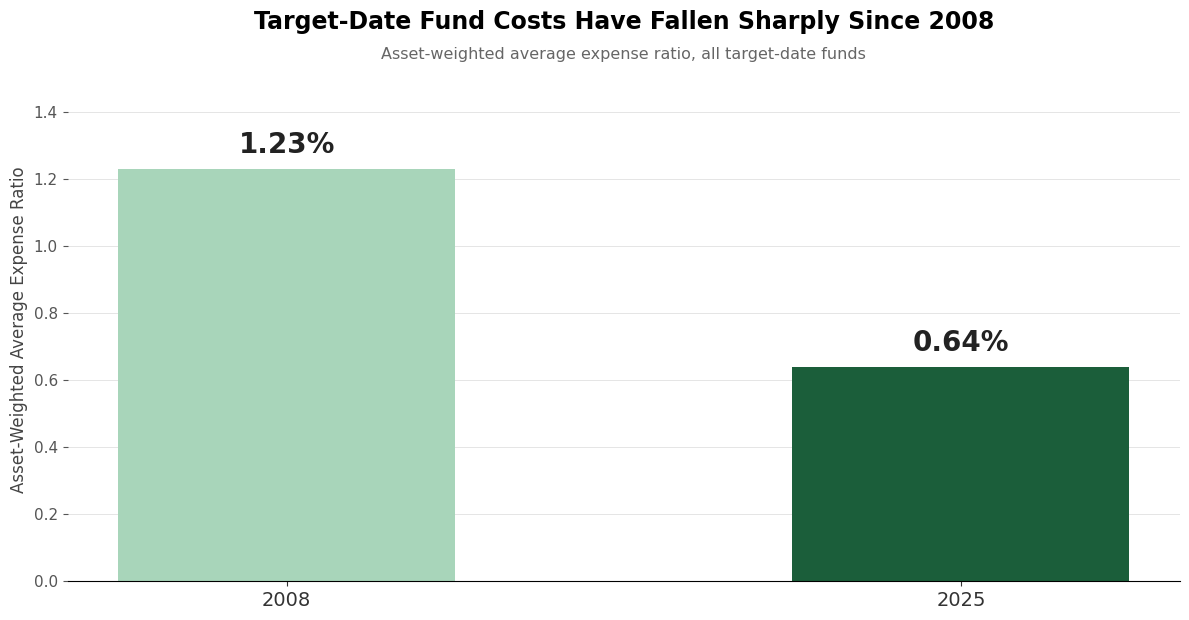
Cost is the other half of the story, and it’s moved sharply in savers’ favor. The simple average expense ratio across the category fell from 0.67% in 2008 to 0.27% in 2025, while the asset-weighted average — which reflects what the typical dollar actually pays, since it’s pulled down by the largest, cheapest options — dropped from 1.23% to 0.64% over the same stretch.
On a $50,000 balance, that difference between a fund charging 1.2% and one charging 0.3% works out to roughly $450 a year in fees, money that would otherwise stay invested and compound. Not every fund in this category is priced the same way, so it’s worth checking the expense ratio the same way you’d check it on any index fund before assuming the default option is the cheap option.
The tradeoff for that simplicity is a lack of customization. A target-date fund can’t account for a pension, a rental property, a spouse’s separate retirement accounts, or a risk tolerance that doesn’t match your birth year, since it’s built for an average investor retiring in an average year, not your specific balance sheet. It also means giving up control over the stock-to-bond ratio at any given moment — during a market downturn, the glide path won’t shift to cash unless the schedule itself calls for it, which is by design rather than an oversight, since reacting to short-term drops is exactly the behavior that tends to hurt long-term returns.
For most people in the accumulation years, though, the evidence points toward that hands-off design working in their favor rather than against it. Investors who hold one of these funds trade four to five times less often than other participants in the same plans, and less trading has historically correlated with better long-term outcomes, since it removes the temptation to sell during a downturn or chase whatever performed best last year.
If you’re deciding between this kind of fund and building your own mix, our guide on whether index fund fees really matter walks through how to evaluate the expense ratio on any fund — including the one your 401(k) may have already defaulted you into.
The simplest way to know whether your target-date fund is doing its job is checking two things once a year: whether the expense ratio is still competitive, and whether the fund’s target year still roughly matches when you actually plan to retire. Past that, the entire design is meant to require nothing further from you — which, for most retirement savers, was always the point.