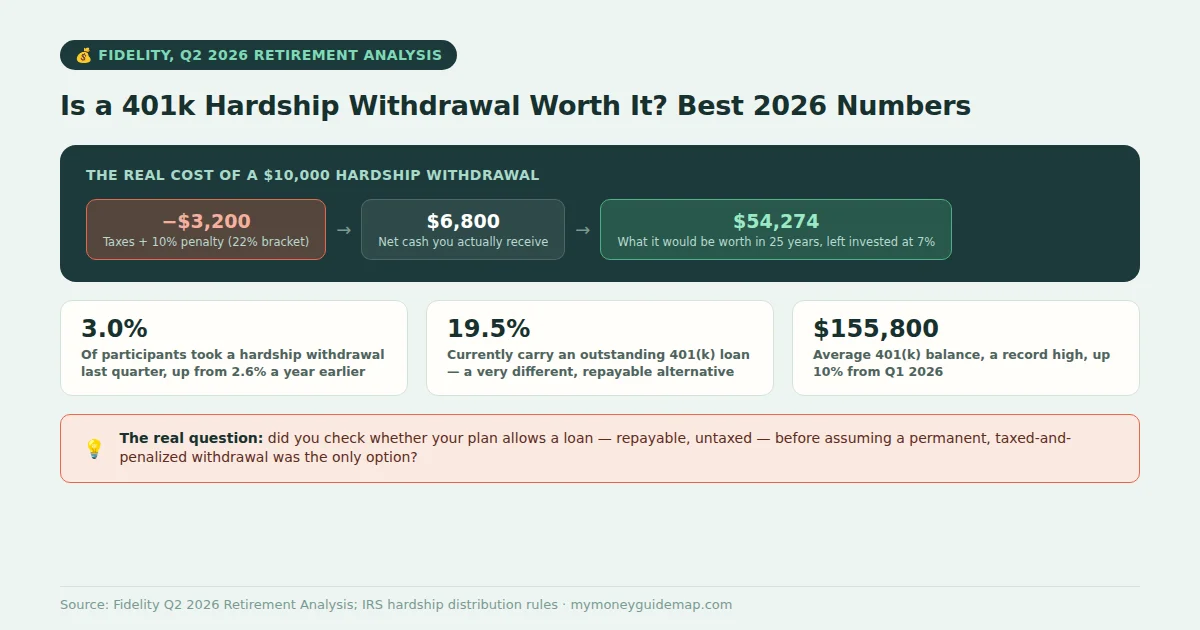
Is a 401k hardship withdrawal worth it, or is the paperwork hiding a much bigger cost than the balance you see on the screen? Fidelity’s Q2 2026 retirement analysis found average account balances at a record high — $155,800 in the average 401(k), up 10% from the first quarter — but a growing share of savers are still pulling money out early: 3% of participants took a hardship withdrawal last quarter, up from 2.6% a year earlier.
Is a 401k Hardship Withdrawal Worth It Once You See the Real Cost?
Pull $10,000 out as a hardship withdrawal and taxes plus the 10% early-withdrawal penalty take roughly $3,200 of it before you ever see the money, assuming a 22% tax bracket — leaving about $6,800 in your pocket. That’s the visible cost. The bigger one is invisible: that same $10,000, left invested for 25 years at a 7% average return, would have grown to about $54,274. So the real price of a hardship withdrawal isn’t the $3,200 taken today — it’s closer to $47,000 in lost future growth, compared to the $6,800 you actually walk away with.
Hardship Withdrawal vs. 401(k) Loan: A Very Different Trade-Off
Fidelity’s same report found 19.5% of participants currently carry an outstanding 401(k) loan, with about 2.8% taking out a new one that quarter — and the math on a loan looks nothing like a hardship withdrawal. A loan gets repaid with interest back into your own account and isn’t taxed as income if you stay employed and keep up payments, while a hardship withdrawal is permanent, fully taxed, and penalized on top. That single difference is why so much of the “is a 401k hardship withdrawal worth it” question really comes down to one earlier question: did you check whether a loan was even on the table before assuming a withdrawal was the only path? Our breakdown of when a 401(k) loan does and doesn’t make sense is worth reading before assuming the hardship route is the only option — plenty of plans let you borrow against the same balance instead of withdrawing it outright.
When a Hardship Withdrawal Might Still Make Sense
None of this means a hardship withdrawal is always the wrong move. The IRS only allows them for a specific list of “immediate and heavy” financial needs — things like preventing eviction or foreclosure, certain unreimbursed medical expenses, or funeral costs — and if the alternative is losing your home or going without necessary care, the roughly $47,000 opportunity cost is a real number, but it isn’t the only number that matters. The point isn’t that a hardship withdrawal is never justified; it’s that most people approving the paperwork never see the 25-year version of the math, only the tax-and-penalty version in front of them that day.
What to Check Before You Pull the Trigger
Is a 401k hardship withdrawal worth it for your specific situation? Start by asking whether your plan allows a loan instead — most large-employer 401(k)s do, and a loan avoids both the immediate tax hit and the early-withdrawal penalty entirely. If a loan genuinely isn’t available or repayment isn’t realistic given your income, a hardship withdrawal is still better than, say, high-interest credit card debt or a payday loan for the same emergency. It’s also worth checking whether your plan even requires “hardship” status at all — some now allow a smaller, no-questions-asked emergency withdrawal for a true short-term need, which can be a gentler option than the full hardship-distribution process.
The mistake isn’t taking a hardship withdrawal when you truly need one — it’s treating it as routine, the way a growing share of savers now seem to, without running the numbers on what those dollars would have become if they’d stayed invested.