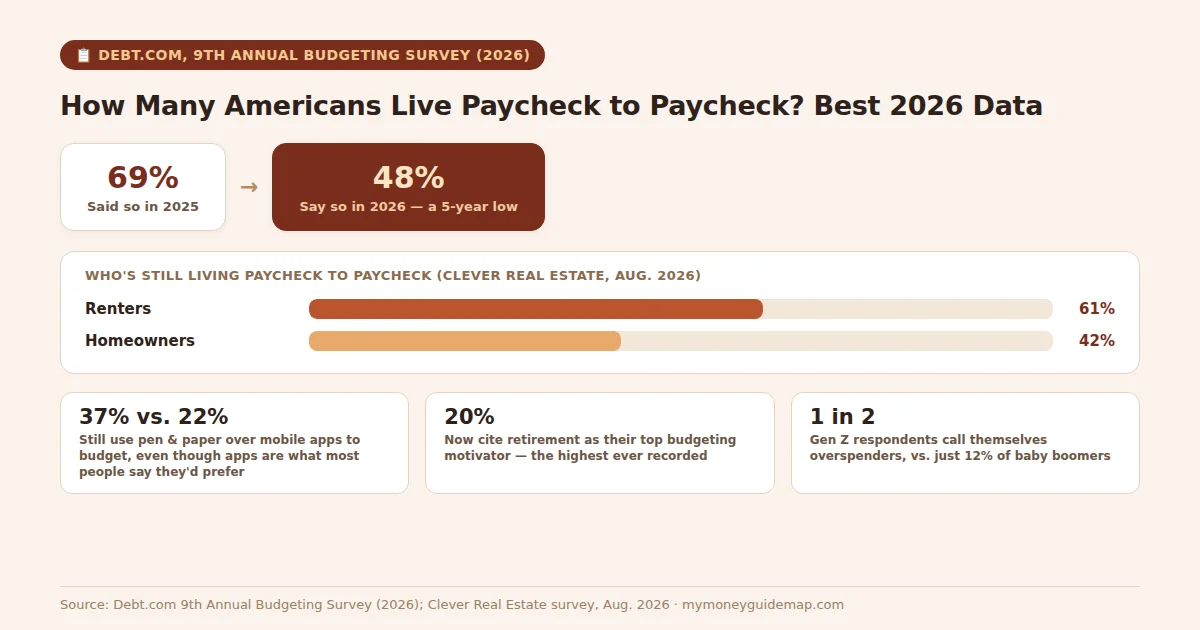
How many Americans live paycheck to paycheck in 2026? Debt.com’s ninth annual budgeting survey, released this summer, found the number has dropped sharply: 48% of Americans now say they’re living paycheck to paycheck, down 21 percentage points from 69% just a year earlier — the lowest share the survey has recorded in five years of tracking.
How Many Americans Live Paycheck to Paycheck Right Now, and Why the Number Fell
That 21-point drop is the kind of shift that’s easy to misread as “everyone’s fine now.” It isn’t. Asking how many Americans live paycheck to paycheck only tells part of the story if you stop at the headline number — nearly half the country is still, in the words of Debt.com’s chairman, “one missed paycheck away from a financial crisis.” What did change is what’s driving people to budget in the first place: retirement is now the single biggest budgeting motivator, cited by 20% of respondents — the highest that answer has ever scored in the survey’s history — while inflation as a motivator slipped from 31% to 23%. Fewer people are budgeting purely out of panic over rising prices, and more are budgeting because they’re finally thinking past next month.
Recovery Isn’t the Same for Everyone
A separate survey from Clever Real Estate, released in late August 2026, adds a layer the Debt.com numbers don’t capture on their own: how much housing status changes the answer to how many Americans live paycheck to paycheck.
| Group | Living paycheck to paycheck | Source |
|---|---|---|
| Americans overall | 48% | Debt.com, July 2026 |
| Homeowners | 42% | Clever Real Estate, Aug. 2026 |
| Non-homeowners (renters) | 61% | Clever Real Estate, Aug. 2026 |
These are two different surveys asking the question slightly differently, so the exact percentages shouldn’t be stacked directly against each other — but the pattern both point to is the same: paycheck-to-paycheck living isn’t an equally distributed problem. Renters are carrying a meaningfully heavier share of it than homeowners, and the same Clever Real Estate data found generational gaps just as wide, with roughly half of Gen Z respondents describing themselves as overspenders compared with only 12% of baby boomers.
The Tool Most People Actually Use Isn’t the One They Want
Debt.com’s survey also turned up a mismatch worth knowing before you assume you need new software to fix a paycheck-to-paycheck squeeze. Pen and paper is still the single most-used budgeting method at 37%, ahead of spreadsheets at 27% and mobile apps at 22% — even though apps are what people say they’d actually prefer to switch to, at 38%. In other words, the tool doing the most real-world budgeting work right now is the cheapest, lowest-tech one available. Our guide to beginner-friendly budgeting apps is a good next stop if you’re ready to make that switch, but the survey is a reminder that the method matters less than actually doing it consistently — 85% of Americans say they budget at all, and 88% of that group say it’s actively helped them manage or avoid debt.
What This Means If You’re Still Living Paycheck to Paycheck
If you’re part of the 48% (or the 61% of renters, or wherever your own number lands), the most useful way to answer how many Americans live paycheck to paycheck this year isn’t the headline percentage on its own — it’s that budgeting itself, in whatever form you’ll actually stick with, is doing real work for the people using it. The households edging out of paycheck-to-paycheck living aren’t necessarily earning dramatically more; a nine-point rise in retirement-focused budgeting suggests a shift toward thinking further ahead rather than just patching this month’s gap. That shift is available with a notebook and a pen just as much as it is with an app, which may be the most encouraging part of this year’s numbers.