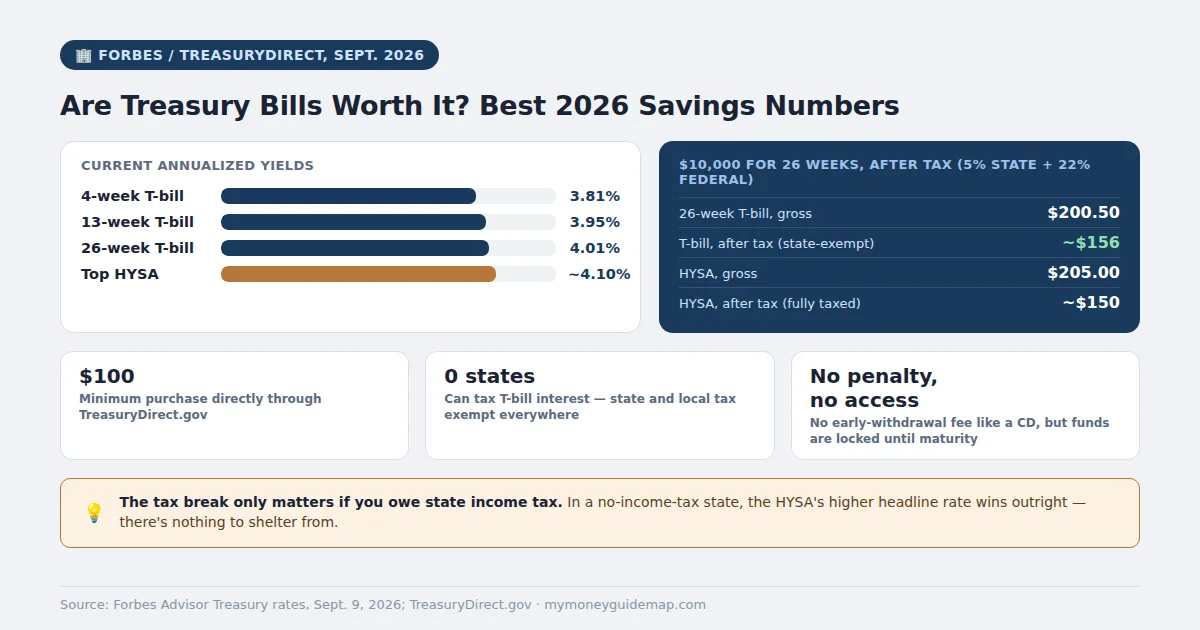
Are treasury bills worth it right now, or is a high-yield savings account still the simpler choice? As of September 9, 2026, the 4-week T-bill yields 3.81%, the 13-week yields 3.95%, and the 26-week yields 4.01% — all a touch below the roughly 4.10% top high-yield savings accounts are currently paying. On the surface, that makes T-bills look like the worse deal. The full picture depends on one thing most rate-comparison articles skip entirely: taxes.
Are Treasury Bills Worth It Once You Count the Tax Break?
Treasury bill interest is exempt from state and local income tax, while a high-yield savings account’s interest is fully taxable at both the federal and state level. That single difference changes the comparison for a lot of savers. Put $10,000 into a 26-week T-bill at 4.01% and you’d earn about $200.50 in interest before tax. Put the same $10,000 into a savings account at 4.10% for the same six months and you’d earn about $205.00. The savings account earns more before tax — but if you’re in a state with a 5% income tax and the 22% federal bracket, the T-bill’s after-tax return comes out to roughly $156 versus the savings account’s roughly $150, because the T-bill only loses money to the federal government. That gap flips back the other way if you live somewhere with no state income tax, like Texas or Florida — there, the savings account’s higher headline rate wins outright since there’s no state tax to shelter from in the first place. The higher your state’s tax rate, the bigger the T-bill’s advantage gets: in a state like California, where the top marginal rate runs close to 9.3% on top of the same 22% federal bracket, that same $10,000 HYSA balance would net closer to $140 after tax, widening the gap to roughly $16 in the T-bill’s favor for the same six months — real money on a modest sum, and proportionally more on a larger emergency fund.
| Term | Current yield | Where the interest is taxed |
|---|---|---|
| 4-week T-bill | 3.81% | Federal only |
| 13-week T-bill | 3.95% | Federal only |
| 26-week T-bill | 4.01% | Federal only |
| Top HYSA (for comparison) | ~4.10% | Federal + state |
What You Give Up for That Tax Break
T-bills aren’t a drop-in replacement for a savings account, and the trade-offs matter as much as the rate. You buy them directly through TreasuryDirect.gov (or a brokerage) in minimums of $100, and your money is genuinely locked in until the bill matures — there’s no early-withdrawal penalty in the way a CD has one, but there’s also no “just log in and transfer it out” option if an emergency comes up mid-term. You can sell early on the secondary market, but you’re at the mercy of where rates have moved since you bought, which could mean a loss. A high-yield savings account, by contrast, stays instantly liquid the entire time, which is exactly why our HYSA vs. CD comparison treats liquidity as its own separate question from rate — the same logic applies here.
How You’d Actually Buy One
Buying a T-bill is less complicated than the tax discussion makes it sound. You can open a free TreasuryDirect.gov account directly with the government — no fees, no minimum balance to maintain — and bid on 4-week and 13-week bills at auction every week, with 26-week bills auctioned roughly every four weeks. The minimum purchase is $100, in $100 increments, and you can set up automatic reinvestment so a maturing bill rolls straight into a new one without you having to log back in each time. If you’d rather not manage a separate TreasuryDirect account, most major brokerages — Fidelity, Schwab, and Vanguard among them — let you buy the same T-bills inside a regular taxable brokerage account or an IRA, often with a slightly easier interface than the government’s own site.
Who Are Treasury Bills Worth It For?
Are treasury bills worth it for your specific situation comes down to two questions: what state you live in, and whether you can commit the money for the full term without needing it back early. If you’re in a high-tax state and have cash you genuinely won’t need for 4 to 26 weeks, the after-tax math can tip in the T-bill’s favor even at a slightly lower headline rate. If you’re in a no-income-tax state, or you might need the money on short notice, a high-yield savings account’s combination of a competitive rate and full liquidity is hard to beat. Neither answer is universally right — the honest version of “are treasury bills worth it” is that it depends on your state tax bracket and how firmly you can commit the cash, not on which product has the bigger number attached to it.