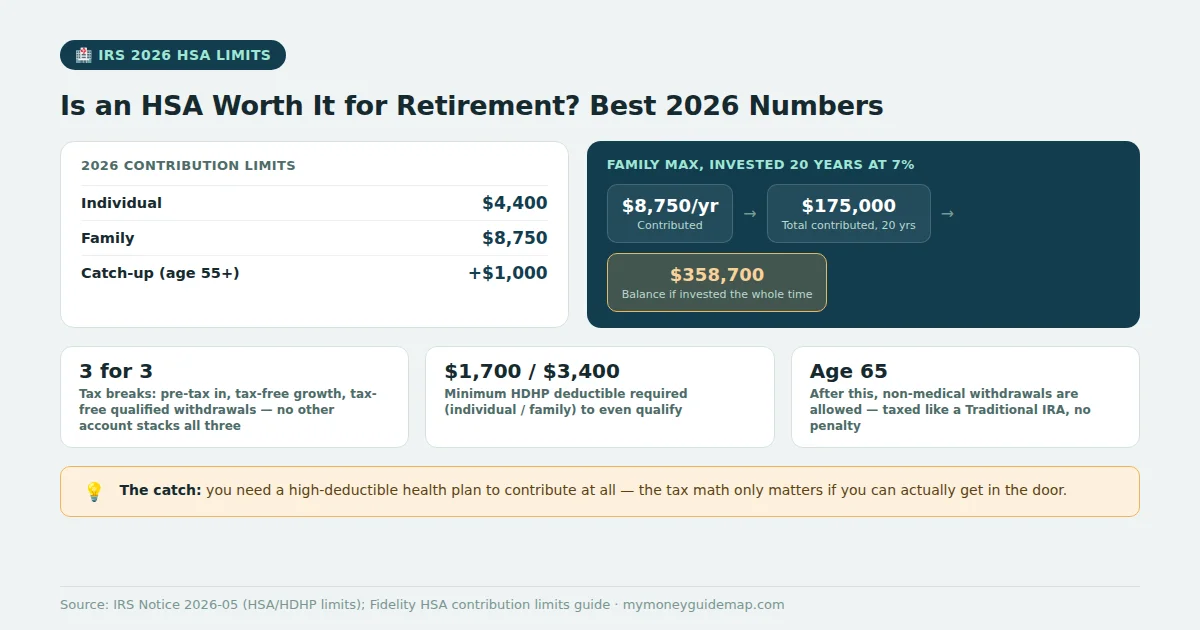
Is an HSA worth it for retirement, or is it really just a checking account for doctor bills? The IRS’s newly announced 2026 limits let individuals contribute $4,400 to a health savings account and families contribute $8,750, plus an extra $1,000 catch-up for anyone 55 or older — and unlike a Flexible Spending Account, every dollar rolls over year to year and can be invested, which is exactly what turns an HSA into a genuine retirement tool rather than a use-it-or-lose-it medical fund.
Is an HSA Worth It for Retirement Once You Count All Three Tax Breaks?
No other account gives you this combination: contributions go in pre-tax (or tax-deductible if made outside payroll), the balance grows tax-free while it’s invested, and withdrawals for qualified medical expenses come out tax-free too. A Traditional 401(k) only gets you the first two of those; a Roth IRA only gets you the last two. The HSA is the only account that stacks all three, which is why financial planners sometimes call it the closest thing to a perfect retirement account available to ordinary savers.
| Account | Contributions | Growth | Qualified withdrawals |
|---|---|---|---|
| HSA | Tax-free | Tax-free | Tax-free (medical) |
| Traditional 401(k)/IRA | Tax-free | Tax-free | Taxed as income |
| Roth IRA | Taxed upfront | Tax-free | Tax-free |
The Retirement Math: What Maxing It Out Actually Looks Like
The clearest way to answer is an HSA worth it for retirement is to run the actual numbers. Contribute the 2026 family maximum of $8,750 a year for 20 years, invest it at a 7% average return, and you’d end up with roughly $358,700 — against $175,000 actually contributed, meaning investment growth alone would account for nearly $183,700 of that balance. Contribute the individual max of $4,400 a year over the same 20 years and you’d land closer to $180,400. And this is money that was never taxed going in, growing without being taxed along the way, and — as long as it eventually goes toward medical costs, which are close to a certainty in retirement — never taxed coming back out either. After age 65, the rules loosen further: you can withdraw HSA funds for any reason, not just medical ones, and simply pay ordinary income tax on the non-medical portion, the same way you would with a Traditional IRA. That turns any leftover balance into a backup retirement account rather than money you’re stuck trying to spend on prescriptions.
The Catch: You Need the Right Health Plan First
Before deciding is an HSA worth it for retirement in your case, know that an HSA isn’t available to everyone. You have to be enrolled in a high-deductible health plan (HDHP) to contribute — for 2026, that means a plan with at least a $1,700 individual or $3,400 family deductible, and out-of-pocket maximums capped at $8,500 individual or $17,000 family. If your employer only offers a low-deductible PPO, you’re not eligible to open or fund an HSA at all, no matter how appealing the triple tax break looks on paper. It’s also worth being honest that not everyone can afford to treat their HSA as an investment account in the first place — if you’re the type of person who needs the money for actual medical bills as they come up, that’s still a completely legitimate way to use it; the retirement angle is an option for people who can afford to pay medical costs out of pocket now and let the account grow untouched.
Is an HSA Worth It for Retirement in Your Situation?
If you already have access to an HDHP and can afford to cover current medical expenses without dipping into the account, the answer leans strongly toward yes — an HSA is worth using as a supplemental retirement account precisely because so few savers max it out this way, even though the tax treatment beats a 401(k) or Roth IRA on paper. If you can’t currently afford an HDHP’s higher deductible, or you know you’ll need to tap the account for near-term medical costs, that’s a completely reasonable reason to treat it as what it was originally designed to be: a way to pay for healthcare, not a retirement fund in disguise. Our breakdown of Roth IRAs is a good next read if the tax-free-growth part of this appealed to you but the HDHP requirement doesn’t work for your situation.
1 thought on “Is an HSA Worth It for Retirement? Best 2026 Numbers”