If your open enrollment packet just landed in your inbox and you’re staring at a health plan menu wondering whether the high-deductible option is worth it this year, the 2027 HSA contribution limits the IRS released back in May are the number that actually matters here — more than the premium difference most people fixate on first.
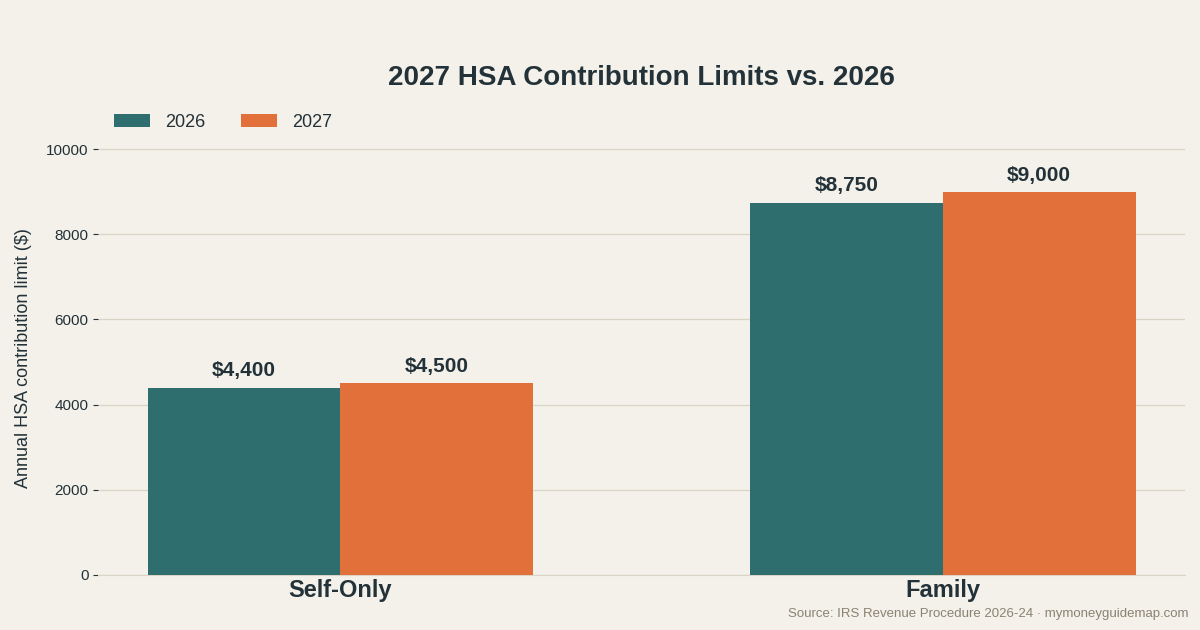
The IRS confirmed the new 2027 HSA contribution limits in Revenue Procedure 2026-24 on May 29, 2026: the self-only contribution limit rises to $4,500 and the family limit rises to $9,000, both increases of roughly 2-3% over this year. The 55-and-up catch-up contribution stays at $1,000, where it’s been fixed by law since 2009 — Congress, not the IRS, would have to change that number, and nothing currently pending would.
The 2027 HSA Contribution Limits, Side by Side With 2026
Self-only HSA contribution limit: $4,400 in 2026, rising to $4,500 in 2027. Family HSA contribution limit: $8,750 in 2026, rising to $9,000 in 2027. Minimum HDHP deductible: $1,700 self-only / $3,400 family in 2026, rising to $1,750 self-only / $3,500 family in 2027. Maximum out-of-pocket: $8,500 self-only / $17,000 family in 2026, rising to $8,700 self-only / $17,400 family in 2027. Catch-up contribution (age 55+): unchanged at $1,000 both years.
What most coverage of the 2027 HSA contribution limits skips is what the increase is actually worth in dollars, not just percentage terms. A family that maxes out the new $9,000 limit and sits in a 22% federal bracket saves about $1,980 in income tax the year they contribute, before the money has done anything else. That’s on top of the payroll-tax savings if it’s funded through payroll deduction, and on top of whatever the balance earns if it’s invested rather than left in cash.
That upfront deduction is only the first of three tax breaks an HSA carries — the balance also grows tax-free while invested and comes out tax-free for qualified medical expenses at any age, a combination no other account type gets. We’ve run the longer-term version of that math elsewhere on this site; the point that matters for this year’s open enrollment is simpler: every dollar of the new 2027 HSA contribution limits you actually use is a dollar that never gets taxed at all, going in or coming out.
None of that works, though, if the account sits empty because the deductible feels too high to stomach in a bad year. The 2027 HDHP minimum deductibles above are just the eligibility floor for these limits to apply at all, not a target — plenty of HDHP plans set deductibles well above the minimum, and it’s worth checking your specific plan’s actual deductible and out-of-pocket max during enrollment rather than assuming the IRS floor applies to you.
One detail that trips people up when they first hit the new 2027 HSA contribution limits: the cap is an aggregate number, not just what comes out of your own paycheck. If your employer seeds the account with $500 as part of the benefits package, or contributes toward a wellness incentive, that amount counts against your $4,500 or $9,000 limit the same as anything you elect yourself. It’s worth checking your specific employer’s contribution before setting your own payroll deduction, so you don’t accidentally over-contribute and trigger the 6% excise tax the IRS charges on excess HSA contributions each year they aren’t corrected.
FSA elections are part of the same open enrollment decision, and this is where 2027 gets murkier: unlike HSA limits, the IRS typically doesn’t announce the following year’s FSA contribution cap until sometime in October or November, so anyone enrolling right now is working from the 2026 figure ($3,400) until that update lands. The use-it-or-lose-it clock on FSA money is also a real reason some people choose an HSA-eligible plan instead once they’ve compared the two side by side, since unspent HSA balances simply roll over and keep growing rather than expiring at year-end.
This isn’t the right move for everyone. If a high-deductible plan would leave you skipping care because you can’t cover the deductible out of pocket, the lower premium and higher contribution limit aren’t worth the risk — a richer PPO plan with a lower deductible is the more honest choice regardless of what it does to your HSA eligibility. It also doesn’t make sense to prioritize maxing an HSA before you’ve captured a full employer 401(k) match, since that match is an immediate guaranteed return no investment strategy can beat.
For anyone who has already decided an HSA fits their situation and wants the fuller case for treating it as a retirement account rather than a medical checking account, our earlier piece on whether an HSA is worth it for retirement walks through the Medicare-era withdrawal rules and the receipt-saving strategy that makes this work in practice.
The practical takeaway for this open enrollment season is simple: check what your specific plan actually costs against the new 2027 HSA contribution limits, decide whether the deductible is one you could genuinely absorb in a rough year, and if the math works, treat the contribution as a line item in your budget from the first paycheck of 2027 rather than something you get around to later.