If you’ve ever hit January staring at a credit card bill you don’t remember creating, a holiday budget 2026 plan is probably the thing that was missing last year. Most people don’t overspend on one big purchase — they overspend in a dozen small ones spread across two months, and none of it gets tracked until the statement arrives. Setting an actual holiday budget 2026 number now, while there are still several weeks of paychecks left, is the difference between a season you plan for and one you absorb the cost of in January.
The numbers back this up in an uncomfortable way. The Penny Hoarder’s August 2026 survey of 1,000 U.S. adults found that people are planning to spend an average of $818 this season, with 26% expecting to cross $1,000. But plans and reality rarely match: the National Retail Federation’s own tally of last year’s actual spending came in at $890.49 per person — meaning the average shopper already blew past their own mental number by roughly $70 before December even ended. That gap between what people intend to spend and what they actually spend is the entire reason a real, written holiday budget matters more than a vague target in your head.
The debt side of that survey is worse than the spending side. Fifty-three percent of people already carry a credit card balance heading into this season, and 17% are still paying off debt from the 2025 holidays specifically. A third of shoppers plan to lean on buy now, pay later plans to cover the gap. None of that is a personal failing — it’s what happens when a big, predictable annual expense gets treated like a surprise every single year.
Building a Realistic Holiday Budget 2026 Number
The fix isn’t complicated, but it does require picking an actual dollar figure instead of “I’ll be careful this year.” Ramsey Solutions calls this kind of planned, recurring expense a sinking fund — money set aside a little at a time for something you know is coming, rather than a shock you absorb in one month. As Ramsey puts it, sinking funds work for “things you can’t or don’t want to pay for in a single month’s budget, like… Christmas gifts,” and the mechanics are simple: pick the total, divide it by the weeks or months you have left, and treat that number like any other bill.
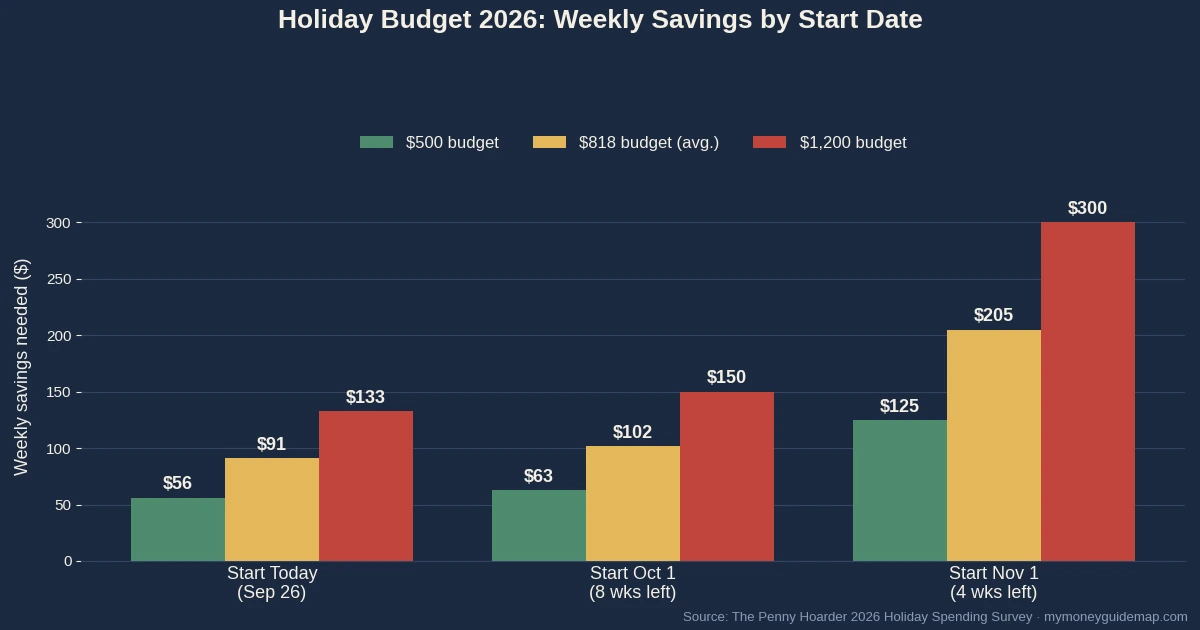
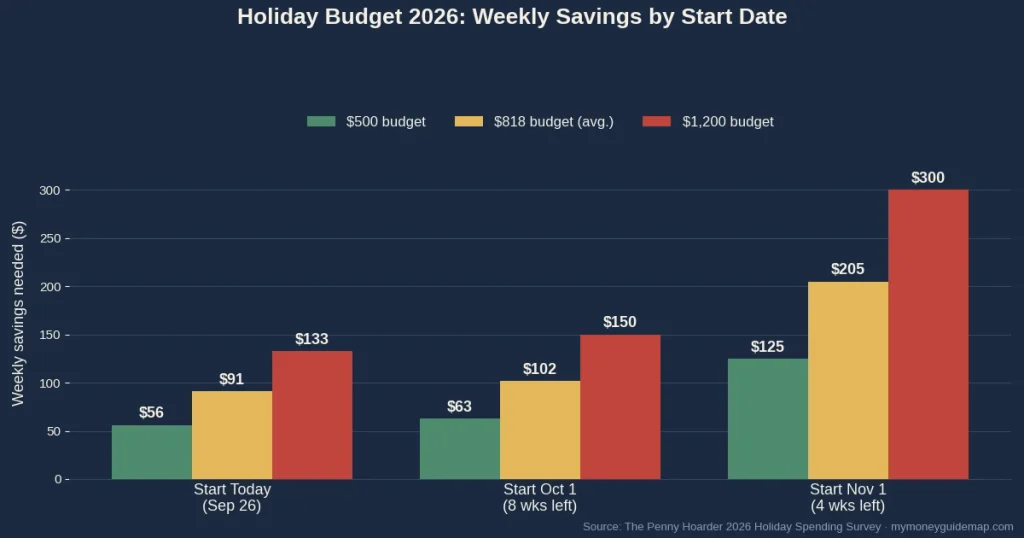
Today is late September, which puts most of the country roughly nine weeks out from Christmas — later than the ideal start, but still early enough that a holiday budget 2026 plan stays manageable at a normal weekly amount. Here’s what that looks like at three different budget levels, assuming a start today versus waiting until October or November:
Starting today (about 9 weeks left): a $500 budget needs roughly $56 a week, an $818 budget (the current national average) needs about $91 a week, and a $1,200 budget needs about $133 a week.
Starting October 1 (about 8 weeks left): those same targets climb to about $63, $102, and $150 a week.
Starting November 1 (about 4 weeks left): the same budgets require about $125, $205, and $300 a week — which is exactly why the survey data shows so many people sliding into BNPL and credit card debt. Waiting even three extra weeks roughly doubles the weekly pressure.
The account matters as much as the number. Keeping this money mixed in with your regular checking account defeats the purpose, because it just looks like spare cash the next time you’re at checkout. A separate savings account — ideally one that’s slightly annoying to transfer out of — keeps the holiday money mentally and physically separate from everyday spending. If moving money into a separate account still doesn’t stop you from dipping into it, the cash-based version of this same idea, covered in our piece on cash stuffing, adds enough friction to make a real difference for people who overspend digitally more than they do with cash in hand.
If you’re one of the 17% still carrying debt from last year’s holidays, layering a fresh holiday budget 2026 sinking fund on top of that balance without a plan usually backfires. Figure out the interest rate on that existing balance first — if it’s a credit card sitting above 20%, paying that down generally beats the guaranteed-but-small return of parking new savings in a high-yield account, even a good one. In that case, a smaller holiday budget funded partly by cutting back this year, rather than a full separate sinking fund, is the more honest math.
The spending side of a holiday budget 2026 plan deserves as much attention as the saving side. The 77% of shoppers in the Penny Hoarder survey who said they’d adjust their approach this year mostly described the same handful of tactics: trimming the gift list, setting a per-person cap instead of buying until it feels like enough, and leaning on homemade or shared-experience gifts for adult family members instead of individual purchases. None of that requires announcing a “no gifts” policy — it just requires deciding the rule before December instead of during it, when social pressure and store displays make every decision feel urgent.
This approach also isn’t for everyone. Someone who’s already debt-free, keeps a comfortable buffer in checking, and doesn’t tend to overspend in November and December doesn’t need a dedicated account and a weekly transfer schedule — a general awareness of the total and a monthly budget line is enough. Sinking funds solve a specific problem: irregular, predictable expenses that catch people off guard when they’re not planned for in advance. If that’s not your pattern, the extra structure is just overhead.
None of this requires spreadsheets or a finance degree. A real holiday budget 2026 plan requires picking a number this week instead of in December, moving a fixed amount out of reach every payday, and treating the holidays as the recurring expense they actually are rather than a surprise that shows up on schedule every single year.