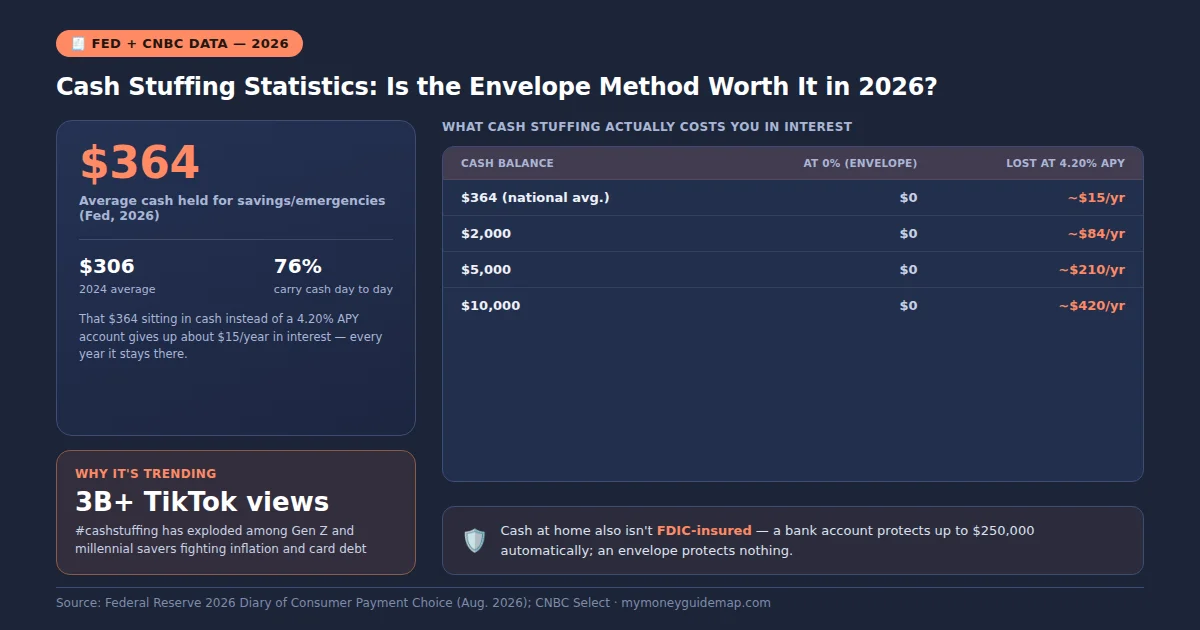
Cash stuffing has racked up more than 3 billion combined TikTok views under hashtags like #cashstuffing, and new Federal Reserve data shows the trend is more than a passing fad: the average American now sets aside $364 in cash specifically for savings and emergencies, up from $306 just two years earlier. That’s real, measurable growth — and it’s worth pairing with the real cost of doing it, which most guides to this method skip entirely.
What Is Cash Stuffing, and Why Is It Growing in 2026?
It’s the TikTok-era name for the old envelope budgeting method: you withdraw your paycheck (or a portion of it) in cash, divide it into labeled envelopes for categories like groceries, gas, and fun money, and stop spending in a category once its envelope is empty. The Fed’s 2026 Diary of Consumer Payment Choice found that 76% of consumers carry cash day to day and 45% now hold extra cash specifically for savings or emergencies — both up from prior years, with that emergency-cash figure climbing from $306 to $364 year over year. The appeal is real: physically running out of money in an envelope creates friction that a declining balance on a screen doesn’t, and that friction is genuinely effective at curbing impulse spending for a lot of people. It’s also why the practice has spread so far beyond its original TikTok audience of Gen Z and millennial savers dealing with inflation and credit card debt.
The Real Cost of Cash Stuffing: What You Give Up in Interest
Here’s the gap in almost every guide to this method: none of them run the math using a current 2026 rate. At today’s best high-yield savings rates (around 4.20% APY), the Fed’s own $364 average balance would earn about $15 a year sitting in a savings account instead of an envelope — not huge on its own, but it scales fast. Someone keeping $2,000 in envelopes gives up roughly $84 a year in interest; at $5,000, it’s about $210 a year, every year, for as long as the money sits in cash instead of an account. None of that is a one-time cost — it compounds the longer the habit continues, which is exactly the detail that gets left out of most “how to start” posts on this topic.
The Other Real Risk: No FDIC Insurance, and a Guilt-Spending Pattern
Money sitting in envelopes at home isn’t covered by FDIC insurance the way a bank account is — a fire, flood, or theft wipes it out with no recourse, unlike the $250,000 in per-account protection a savings account carries automatically. There’s also a more subtle behavioral finding worth knowing: a widely cited analysis of more than 118,000 transactions found that shoppers tend to reach for cash specifically for purchases they feel guilty about, which cuts against the idea that this approach is purely a discipline tool — for some spending categories, it can function more like a way to avoid a paper trail than a way to control spending. That’s worth sitting with honestly before assuming the friction is purely working in your favor.
Is Cash Stuffing Worth It in 2026?
The honest answer is that this method works best as a hybrid, not an all-cash system. The friction benefit is real for categories where you’re genuinely prone to overspending — dining out, entertainment, impulse shopping — so keeping those specific envelopes in cash still makes sense. But there’s no friction benefit to keeping your actual savings goals in cash, and that’s where the lost-interest math above matters most: money earmarked for an emergency fund or a future purchase should sit somewhere it can grow, not in an envelope earning nothing. If manually tracking envelopes isn’t sustainable for you long-term, How to Automate Your Savings covers a lower-effort way to get the same “out of sight” discipline without giving up interest entirely.
Cash stuffing isn’t the debt-free miracle some viral clips suggest, and it isn’t the wasteful fad some finance influencers dismiss it as either — it’s a real behavioral tool with a real, calculable cost, and the smartest version of it in 2026 keeps the envelopes for spending categories while letting savings earn something.
1 thought on “Cash Stuffing: Best 2026 Numbers”