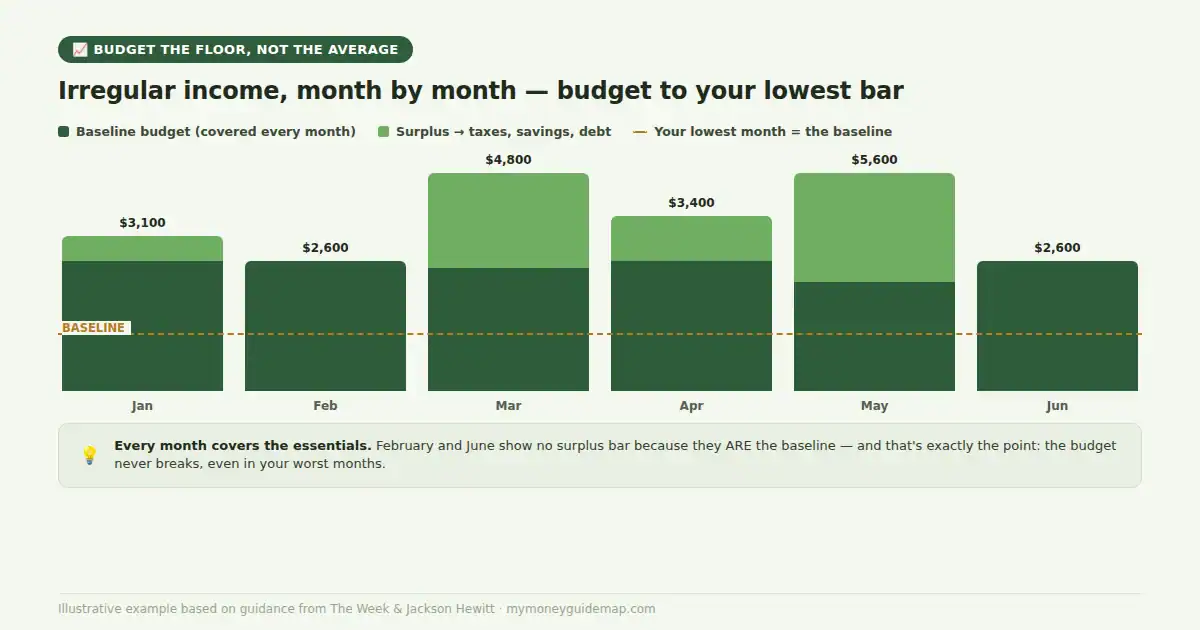
How to budget with an irregular income is a genuinely different question than how to budget on a steady paycheck, and most popular budgeting advice quietly assumes you’ll never have to answer it. If you’re one of the roughly 36% of US workers who freelance, contract, or do gig work in some form, and a paycheck-based budget has never quite worked for you, you’re not doing anything wrong — you just need a system built for income that moves instead of income that’s fixed.
Build Your Budget Around Your Lowest Month, Not Your Average
This is the single biggest mindset shift. Instead of averaging your last six months of income and budgeting against that number, build your budget around your worst-earning month instead — the logic being that it’s far easier to adjust upward in a good month than to scramble downward in a bad one. Anything you earn above that baseline becomes surplus you get to assign on purpose, rather than income you’ve already mentally spent before it shows up. This one change is most of how to budget with an irregular income successfully, and everything else below builds on it.
Give Every Dollar a Job
The next piece of how to budget with an irregular income is what you do once the money actually arrives. Once you know your baseline, zero-sum budgeting becomes a natural fit — every dollar that comes in gets assigned a specific purpose before you spend any of it: rent, groceries, debt payments, and a set contribution toward retirement all get named first. On months where income comes in above your baseline, the surplus doesn’t just sit there waiting to become lifestyle inflation — it gets assigned too, typically split between savings, taxes, and paying down debt faster. This structure matters more with irregular income than with a steady paycheck, precisely because there’s no automatic guardrail stopping a good month from quietly disappearing.
Set Aside Taxes Before You Touch the Rest
If you’re self-employed, freelance, or otherwise a 1099 worker, nobody is withholding taxes from what you’re paid — that responsibility is entirely yours, and skipping it is the single most common way irregular-income budgets fall apart. The standard guidance is to move 25% to 30% of every single payment into a separate account earmarked only for federal, state, and self-employment taxes, before the rest of the money touches your regular budget at all. Treat that transfer as non-negotiable and automatic, not a step you get to when things feel comfortable — quarterly estimated tax payments come due whether or not you’ve set the money aside.
Build a Bigger Emergency Fund Than Usual
The standard three-to-six-months-of-expenses emergency fund advice still applies, but irregular income is exactly the situation where you want to lean toward the higher end of that range, or even beyond it. A slow month for a salaried employee is stressful; a slow month (or three) for someone with irregular income is a direct income gap, not just tighter spending. Treat every above-baseline month as an opportunity to keep building that cushion, even after you’ve technically “finished” it — the goal is a fund that can absorb a genuinely bad stretch, not just a single rough month.
The Bottom Line
How to budget with an irregular income really comes down to four habits: budget against your worst month, assign every dollar a job as it arrives, pull taxes out before you spend anything else, and keep a bigger emergency fund than someone with a steady paycheck would need. None of these require predicting your income, which is the part that trips most people up — they just require a system that works whether next month is your best one yet or your slowest one in a year. If you haven’t built that baseline emergency fund yet, start with a plan for how much you actually need, then work backward from there.