It’s one of the most anxiety-inducing questions in personal finance, and also one of the hardest to answer honestly: how much should you have in savings by age, compared to everyone else your age? The short version is that the “average” number you’ll see quoted almost everywhere is badly misleading, and the number that actually matters isn’t tied to your age at all — it’s tied to your own monthly expenses.
What the Average American Actually Has Saved, by Age
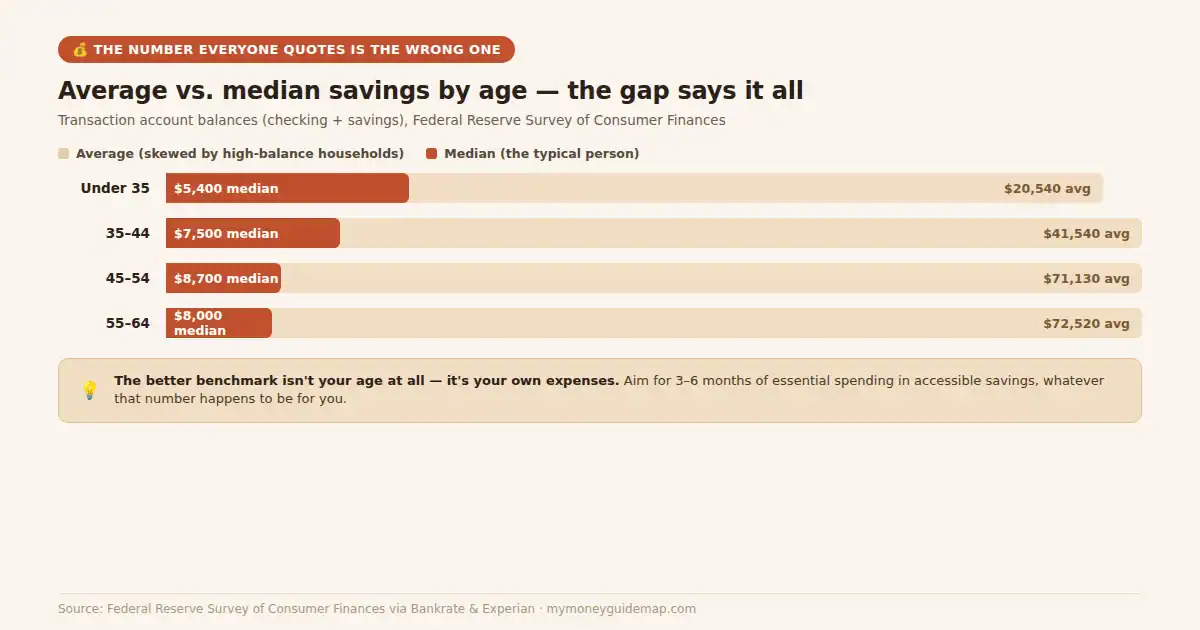
According to the Federal Reserve’s Survey of Consumer Finances, the median American holds about $8,000 in transaction accounts (checking and savings combined), and that figure climbs steadily with age. By the numbers: under-35s have a median of roughly $5,400, ages 35-44 sit around $7,500, ages 45-54 reach about $8,700, and the median doesn’t peak until ages 65-74 at around $13,400. If you’re wondering how much should you have in savings by age relative to these figures, the honest answer is that most people have far less saved than the headlines suggest.
Why the “Average” Number Is Misleading
Here’s where it gets interesting: the average balance for the same age groups is dramatically higher than the median — under-35s average $20,540 versus a $5,400 median, and 45-54-year-olds average $71,130 versus an $8,700 median. That massive gap exists because a small number of very high-balance households pull the average way up, while the typical person’s actual savings looks much smaller. The median is the more honest comparison point if you’re trying to figure out where you genuinely stand next to other people your age, rather than next to a number skewed by outliers.
A Better Benchmark: Months of Expenses, Not a Dollar Target
Comparing yourself to an age-based dollar figure is arguably the wrong exercise in the first place, because your target should scale with your own cost of living, not a national average. The standard guidance is to keep three to six months of essential expenses in accessible savings as an emergency fund — for someone spending the national average of roughly $6,080 a month, that works out to somewhere between $18,240 and $36,480. That range will look completely different for someone with lower fixed costs or someone supporting a family, which is exactly why “how much should you have in savings by age” is a less useful question than “how many months of my own expenses do I actually have covered.”
How Much Should You Have in Savings, Realistically?
If a specific dollar figure still feels more useful than a percentage of expenses, here’s a workable way to think about it: start with one month of expenses as your first milestone, treat three months as the point where a job loss or major repair stops being a crisis, and treat six months as genuinely comfortable. Only about 46% of US adults currently have enough saved to cover three months of expenses, so reaching even that first milestone already puts you ahead of roughly half the country. It’s also worth separating this from retirement savings entirely — guidelines like “have 1x your salary saved by 30” are about long-term 401(k) and IRA balances, not liquid cash, and mixing the two targets together is a common source of unnecessary panic.
The Bottom Line
How much should you have in savings by age, then? Less than you probably think, if you’re comparing yourself to the median instead of the average — and the real target isn’t your age at all, it’s your own monthly expenses times three to six. If you haven’t started, an emergency fund held in a high-yield savings account is the right place to build that number, one automated transfer at a time.