Round-up savings apps have been pitched for over a decade as the easiest way to save money without noticing it — round every purchase up to the nearest dollar, and let the spare change quietly build into real savings. The math behind that pitch is worth checking before deciding whether it’s worth downloading another app, or paying a monthly fee, for money you could just as easily set aside yourself.
How Much Do Round-Up Savings Apps Actually Add Up To?
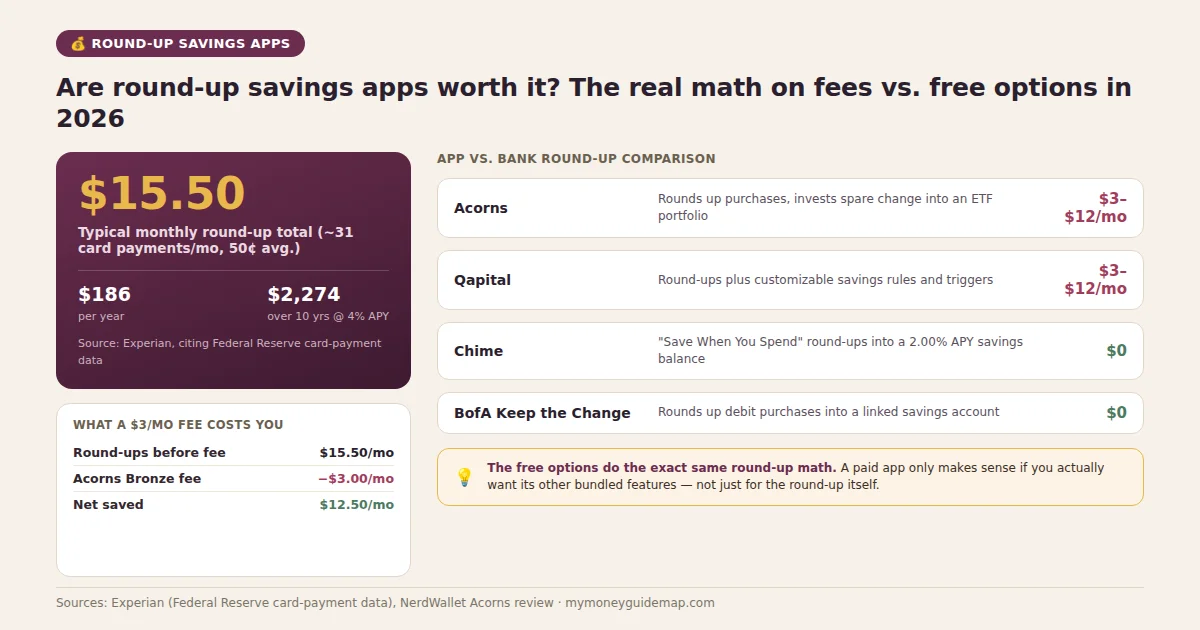
The Federal Reserve puts the average U.S. consumer at about 31 card payments a month. If those purchases round up by an average of 50 cents each — a reasonable middle-of-the-road estimate, since some rounds are just a penny and others nearly a dollar — that works out to roughly $15.50 a month, or about $186 over a full year. Left in an account earning a conservative 4% APY and compounding for 10 years, that same habit grows to somewhere around $2,274, without a single deliberate transfer. That’s the appeal in a nutshell: round-up savings apps turn spending you were already going to do into savings you weren’t planning on.
Do the Fees Eat Into That Math?
Here’s where the pitch gets more complicated, because several of the popular round-up savings apps charge a monthly subscription just to run the feature, and that subscription comes straight out of the same spare change it’s supposed to be growing.
| App | Monthly Fee | How It Works |
| Acorns | $3-$12/mo | Rounds up purchases, invests spare change into an ETF portfolio |
| Qapital | $3-$12/mo | Round-ups plus customizable savings rules and triggers |
| Chime | $0 | “Save When You Spend” rounds up debit purchases into a 2.00% APY savings balance |
| BofA Keep the Change | $0 | Rounds up debit purchases into a linked savings account, no app or fee required |
At Acorns’ cheapest tier, that $3 monthly fee quietly eats about 19% of a typical $15.50-a-month round-up total before you’ve earned a dime of growth on it. Acorns’ own pricing page lists three tiers — $3, $6, and $12 a month — and the math only gets tougher at the higher tiers unless you’re also using the retirement account or other bundled features enough to justify the cost. Qapital runs a similar $3-to-$12 range for its own customizable rules. Free options like Chime’s round-up feature, which pairs with a 2.00% APY savings balance, or a bank’s own version such as Bank of America’s long-running Keep the Change program, don’t have this problem at all: every cent of the round-up goes straight into savings, because there’s no subscription taking a cut first.
Who These Apps Are (and Aren’t) Worth It For
If you’re going to use a round-up feature at all, the free versions are worth turning on for almost anyone — it’s money you’d otherwise never notice, with no downside, and no fee working against the balance while it grows. The paid apps make more sense specifically for people who also want the other features bundled in, like Acorns’ automatic ETF investing or retirement account, rather than paying $3 to $12 a month purely for the round-up mechanic itself, which a free bank feature already does for nothing. It’s also worth being honest about scale: round-up savings apps are a nice supplement, not a replacement, for an actual savings plan. If you’ve already set up a fixed automatic transfer on payday, the $15.50 or so a month from round-ups is a small addition on top of that habit, not a substitute for it — and if you haven’t set up that kind of transfer yet, it’s worth doing before worrying about spare change at all.
The most useful way to think about round-up savings apps is as a floor, not a strategy — a small, effortless amount that adds up over years but was never going to fund a real goal on its own. For anyone who hasn’t automated savings in a more deliberate way yet, building that habit first tends to move the needle far more than any spare-change feature will, with round-ups simply layered on top once the bigger habit is already in place.