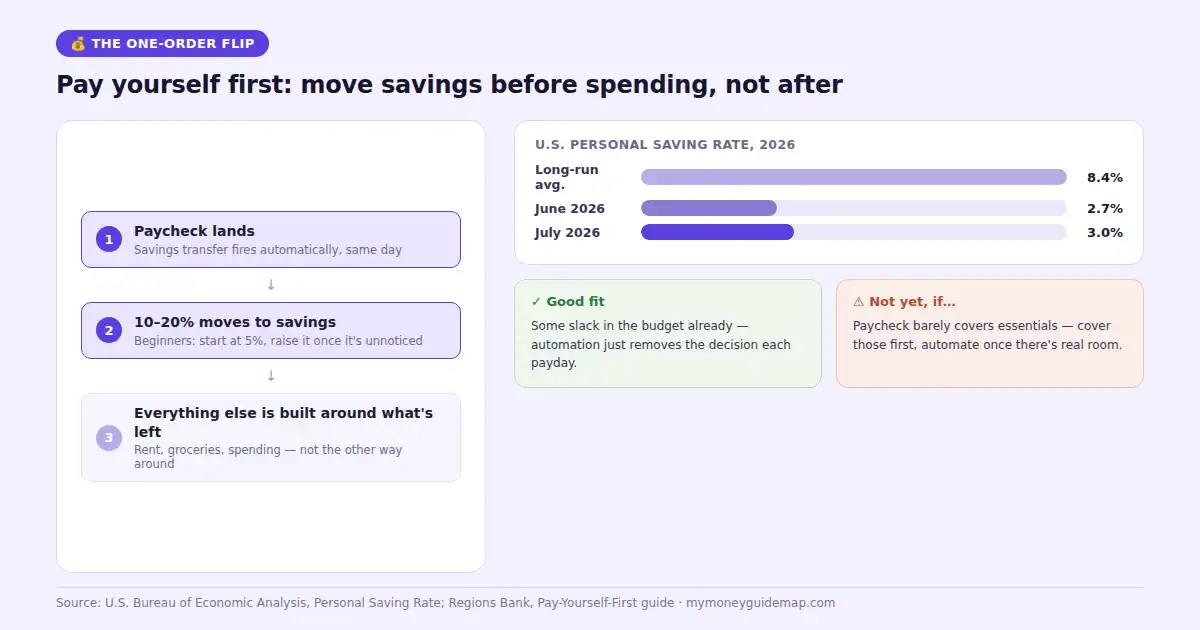
Pay yourself first is the budgeting method built around a single flip in order: you move money into savings the moment you’re paid, before rent, groceries, or anything else touches the account. It sounds like a small change, but it solves a problem most budgets never fix — there’s rarely anything left over to save once the spending happens first. The timing makes this worth revisiting right now: the U.S. personal saving rate sat at just 3.0% in July 2026, according to the Bureau of Economic Analysis, well below the 8.4% long-run average since 1959. Most people aren’t failing to save because they don’t want to — they’re saving whatever’s left, and lately there’s less and less left.
Pay Yourself First Changes the Order, Not Just the Habit
The mechanics are simple enough that they barely qualify as a system. A fixed amount or percentage moves out of checking the day you’re paid, usually through a standing transfer or a split direct deposit, and it goes straight into savings before you see the balance and start planning around it. Everything else — rent, groceries, the rest of your spending — gets built around whatever’s left, instead of savings being whatever survives the month.
That’s the real difference from a method like the 50/30/20 rule, which still asks you to track categories and hope discipline holds through the month. Pay yourself first skips the tracking and the willpower test entirely by moving the money before it’s a decision. A common starting point is 10% to 20% of take-home pay, though most guides suggest beginners start around 5% and raise it gradually once the transfer stops feeling noticeable — treating it as a bill you already know how to pay, rather than a fresh negotiation with yourself every payday.
Why the Timing Matters More This Year
Part of why pay yourself first is worth setting up now rather than someday is what the national numbers have been doing. The personal saving rate climbed from 2.7% in June to 3.0% in July 2026, a small improvement, but still far under the 8.4% average the country has kept since 1959 — and nowhere near the 8-12% rates typical in the 1960s and 1970s. Some of the gap is structural: the shift from pensions to individual 401(k)s put more of the saving decision directly on households, and a bigger share of income now goes to housing before anything else gets considered.
None of that is really an individual failing, but it does mean the automatic version of saving matters more than it used to. When there’s less room in a typical budget, the version of saving that depends on remembering, or on there being something left at month’s end, is the version most likely to quietly stop happening.
Picking a Number That Actually Sticks
The percentage matters less than picking one that survives contact with a real paycheck. Setting up a 20% transfer that gets reversed or paused within a month teaches the opposite lesson from the one pay yourself first is supposed to teach — that saving is optional and negotiable. Starting at 5%, or even a flat $25 a week, and letting it run untouched for a few months before raising it tends to build the habit that actually lasts.
Pay yourself first isn’t the right starting move for everyone, though. If a paycheck barely covers rent, utilities, and food as it is, automating a transfer before those bills are covered can just turn a tight month into a missed payment — for that situation, covering true essentials first and adding an automatic savings transfer once there’s real breathing room makes more sense than following the standard 10-20% guidance from day one.
For most people carrying a bit of slack in the budget already, though, the appeal is exactly that it removes the decision. Pairing it with a fully automated savings setup — where the transfer, the account, and the amount are all decided once — turns saving into something that simply happens on payday, rather than something to get to once everything else is handled.
4 thoughts on “Pay Yourself First: Best 2026 Budgeting Method”