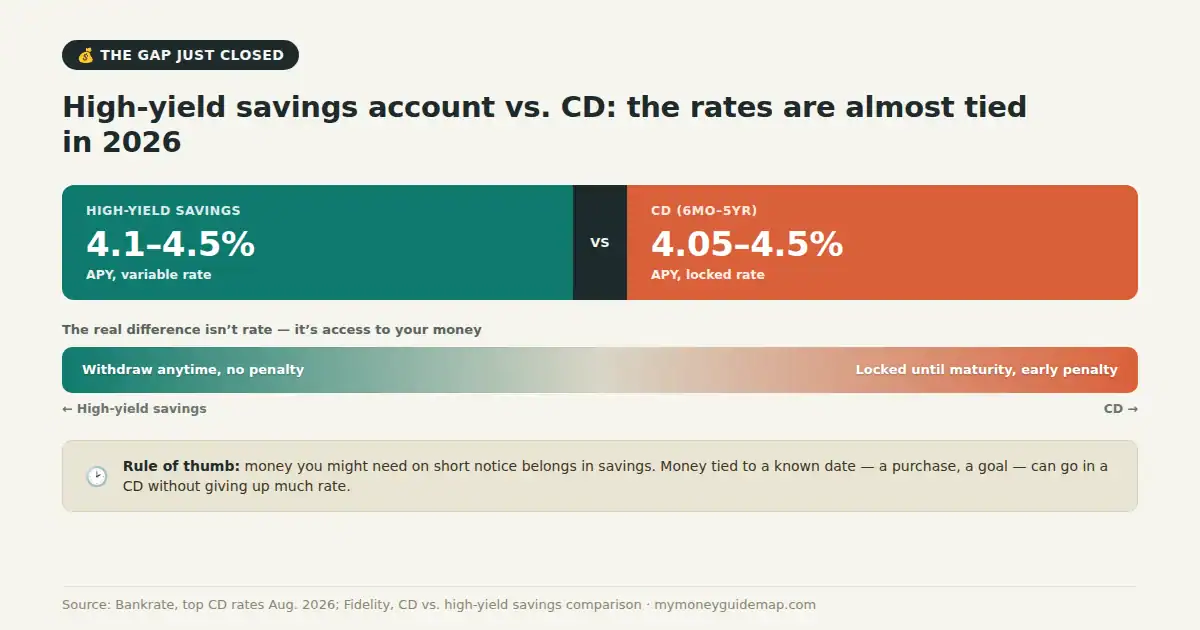
For years, the answer to high-yield savings account vs CD was simple: CDs paid more, but you gave up access to your money to get it. That trade-off has quietly disappeared. In August 2026, the top CD rates and the top high-yield savings rates are landing in almost the same range — both clustering around 4% to 4.5% APY — which means the old logic (“lock it up for a better rate”) doesn’t really hold anymore. The decision now comes down to something else entirely.
The Rates Are Nearly Identical in 2026
Bankrate’s current tracking puts the best 6-month CDs around 4.05%–4.15% APY, 1-year CDs near 4.20%–4.30%, and 5-year CDs topping out around 4.35%–4.50% at the highest-paying banks. Meanwhile, the best high-yield savings accounts right now are paying in a very similar 4.1%–4.5% APY range. When the two products pay roughly the same, high-yield savings account vs CD stops being a math problem and becomes a question of what you actually need the money to do.
The Real Difference: How Much You Can Touch Your Money
This is where the two products actually diverge. A high-yield savings account lets you deposit and withdraw money whenever you want, with no penalty for taking cash out — some banks cap the number of withdrawals per month, but there’s no cost to access your own money. A CD locks your funds in for a fixed term, and pulling money out before maturity typically triggers an early withdrawal penalty, often worth several months of interest. If there’s any real chance you’ll need the money before the term ends, that penalty can erase the rate advantage a CD might have offered in the first place.
Fixed vs. Variable: Which Matters More Right Now
A CD’s rate is locked in the day you open it, so if rates drop over the following months or years, your CD keeps paying what you signed up for. A high-yield savings account’s rate is variable — the bank can lower it any time market rates fall. That makes a CD genuinely useful as a hedge if you think rates have peaked and want to lock in today’s number for a year or more, while a high-yield savings account leaves you exposed to future rate cuts but never locks you out of your own cash to get there.
FDIC Insurance Is a Non-Issue
Both account types carry the same protection at any federally insured bank: up to $250,000 per depositor, per account category. Neither one is safer than the other in that sense — the FDIC coverage is identical whether your money sits in a CD or a high-yield savings account, so insurance shouldn’t be a deciding factor either way.
High-Yield Savings Account vs CD: Which One Should You Actually Pick?
High-yield savings account vs CD really comes down to your timeline. If the money is your emergency fund or anything you might need on short notice, a high-yield savings account is the better fit — you keep full access and you’re not giving up much rate to get it in 2026’s market. If you have a specific expense on a known date — a wedding in 14 months, a car down payment next spring, a fund you’re deliberately trying not to touch — a CD with a matching term can make sense, especially if you want to lock in today’s rate before it potentially drops. Some beginners split the difference with a CD ladder, spreading money across CDs of different lengths so some portion is always coming due, which works a lot like a rolling version of a sinking fund with a fixed rate attached.
The Actual Takeaway
High-yield savings account vs CD used to be a trade-off between rate and access — pick the higher number, or pick the flexibility. In 2026, with both paying close to the same rate, that trade-off has mostly disappeared, and the real question is simply whether you might need the money before a fixed date. Money you can’t predict needing belongs in a high-yield savings account; money tied to a specific, known expense can go in a CD without much cost to your overall return.
4 thoughts on “High-Yield Savings Account vs. CD: Which Should You Choose?”