What is a CD ladder, and why do people bother splitting their money into pieces instead of just picking one certificate of deposit and being done with it? The short answer is that a single CD forces a trade-off you don’t actually have to make: lock your money away for years to get the best rate, or keep it short-term and settle for less. A ladder is the workaround, and it’s simpler than the name makes it sound.
Splitting the Money Is the Whole Trick
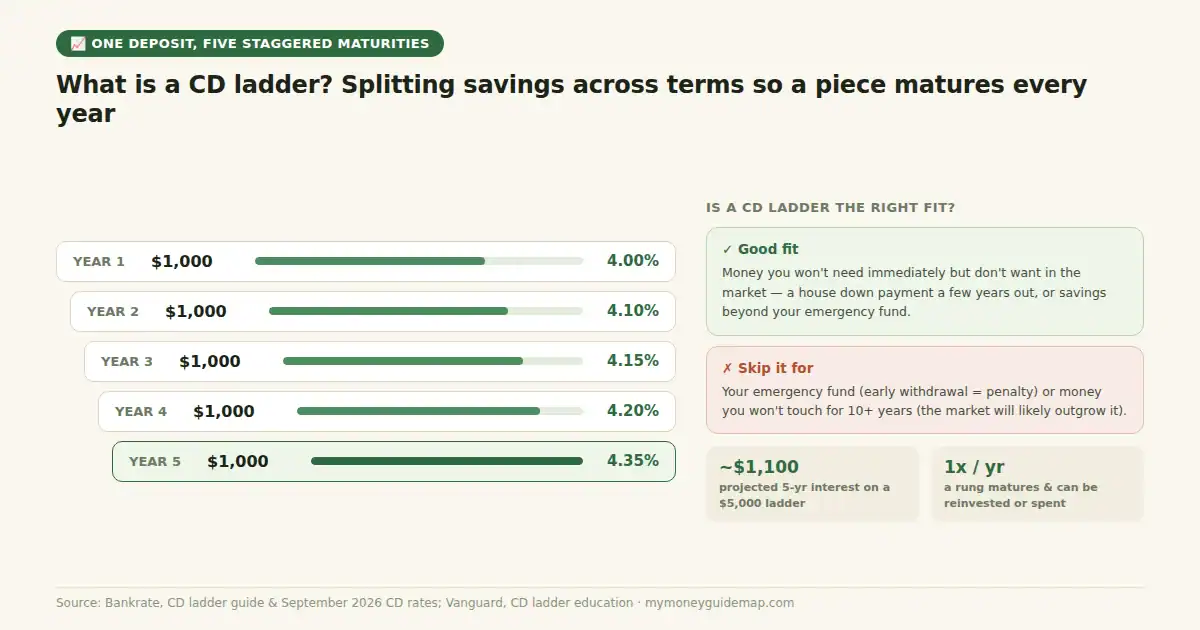
Instead of putting all your savings into one CD, you divide it across several with staggered maturity dates — a common structure spreads money evenly across one-, two-, three-, four-, and five-year terms, all opened on the same day. As of this September, rates actually reward the longer terms: one-year CDs are running around 4.00%, while five-year CDs are closer to 4.35–4.50% at the more competitive banks and credit unions. Every year, one rung of the ladder matures, and you either spend that money or roll it into a new five-year CD to keep the ladder going.
On $5,000, for example, that might mean $1,000 in each rung — roughly $40 in the one-year CD, working up to around $43–45 in the five-year one, based on current rates. What is a CD ladder worth over time compared to just picking the best short-term rate and re-shopping every year? Bankrate’s own projection puts the five-year gain from a laddered $5,000 at around $1,100 in interest, mostly because you’re not stuck re-guessing where rates will be every twelve months.
What a CD Ladder Actually Buys You
The point isn’t really the interest rate, even though that’s what gets mentioned first. What is a CD ladder solving that a single CD doesn’t? Access. With one long CD, your entire balance is locked up until it matures, and pulling money out early means an early-withdrawal penalty that can eat a chunk of the interest you’ve earned. A ladder means part of your money is always coming due within the next year, so you’re never more than several months away from being able to reach some of it without a penalty — while still holding pieces further out at the better long-term rates.
Where a Ladder Fits Next to a Savings Account
A CD ladder isn’t a replacement for an emergency fund, and it shouldn’t hold money you might need on short notice — Vanguard is direct about this, noting that anyone who needs quick, flexible access to cash is usually better off in a high-yield savings account instead. It’s also not for someone chasing real growth: money that won’t be touched for a decade or more will almost certainly do better in the market over that stretch than in any CD, ladder or not. Where a ladder actually earns its place is money you’re fairly sure you won’t need immediately, but also don’t want tied up in the market — a house down payment two or three years out, or just a low-risk home for savings beyond what an emergency fund already covers.
Building one takes a bit more setup than opening a single account: you’re managing three to five CDs instead of one, and each maturity date is a small decision point where it’s worth rate-shopping again rather than letting the bank auto-renew you into whatever it’s offering that week, which is often lower than what’s available elsewhere. That extra bit of upkeep is really what is a CD ladder trading for the higher blended rate — a little more attention, in exchange for not settling for either all-short or all-long. If you’re still deciding between locking money into CDs at all versus keeping it fully liquid, comparing a high-yield savings account against a CD first is worth doing before you build out a whole ladder.