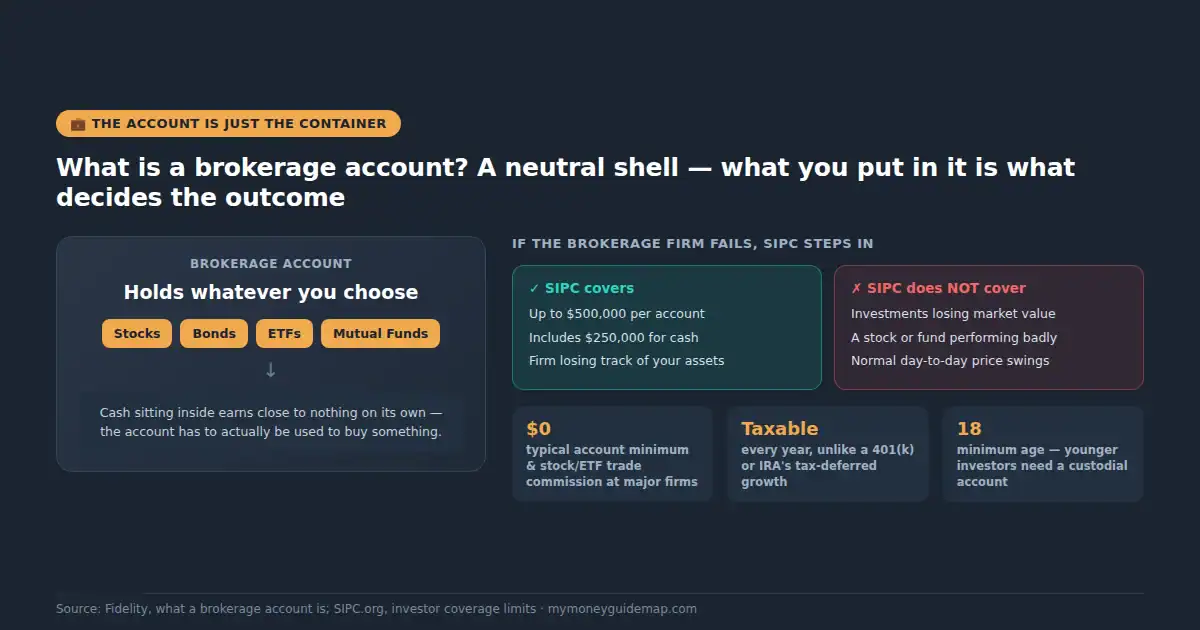
What is a brokerage account, once you strip away the jargon? It’s an account that lets you buy and sell investments — stocks, bonds, mutual funds, ETFs — the same way a checking account lets you move cash around, except what you’re moving is ownership in companies and funds instead of dollars sitting still. If you’ve already opened a Roth IRA or a 401(k), a lot of this will feel familiar, because a brokerage account works the same way underneath. It’s just not tied to any retirement rules.
The Money Doesn’t Grow Just Because It’s Sitting There
Here’s the part that trips up a lot of first-time investors: opening the account and funding it aren’t the same thing as investing. A brokerage account is really just the container — cash sitting inside one earns close to nothing until you actually use it to buy something. Most major firms have dropped their account minimums to $0 and their stock and ETF trade commissions to $0 as well, so the barrier to buying your first share is lower than it’s ever been. The friction now is deciding what to buy, not finding the money to start.
So What Is a Brokerage Account Actually Protecting You From?
A question almost everyone asks before funding one: what happens if the brokerage firm itself goes under? SIPC coverage protects up to $500,000 per account if the firm fails, including a $250,000 limit on uninvested cash — but that protection only kicks in if the firm loses track of your assets. It does nothing if your investments simply drop in value, which is a normal, expected part of investing and not something any insurance covers.
Taxable Now, Which Is a Trade-Off, Not a Flaw
A standard brokerage account is a taxable account, and that’s the biggest thing separating it from a 401(k) or an IRA. You pay tax each year on dividends and on any gains you actually realize, and there’s no tax-deferred growth working quietly in the background the way there is in a retirement account. What you get in exchange is real flexibility: no contribution limits, no early-withdrawal penalties, and the ability to touch the money whenever you actually need it.
That trade-off is also why a brokerage account is a poor starting point if your employer offers a 401(k) match — funding a taxable account before you’ve captured free matching money is a common, avoidable mistake. It’s a much better fit for a goal that’s still years off but doesn’t belong locked inside a retirement account, like a future home down payment or general long-term investing beyond what a 401(k) or IRA already covers.
One Account Type Isn’t Automatically the Right One
What is a brokerage account once ownership enters the picture? Partly a matter of whose name is on it. An individual account has one owner and is the default most people start with. A joint account is shared, usually with a spouse, and splits ownership between both people. A custodial account lets a parent invest on behalf of a child, though anything put into it legally belongs to that child once they turn 18 — money moved in can’t be pulled back out for other purposes later. None of these change how the investing itself works; they just decide who legally controls the money.
Opening one takes a few minutes online: you’ll need to be 18, or have a parent set up a custodial version if you’re younger, then verify your identity and link a bank account to fund it. From there, what is a brokerage account really comes down to what you do with it. The account itself is neutral — it’s the decisions made inside it that decide the outcome, not the account structure. If retirement accounts still feel like the more confusing half of this picture, seeing how a Roth IRA actually works is a natural next stop before deciding how to split new money between the two.
2 thoughts on “What Is a Brokerage Account? A Beginner’s Guide”