You check your credit app, see a number like 757, and it tells you almost nothing on its own. Is that good? Great? Barely passable? FICO score ranges are what turn a random three-digit number into something you can actually act on — and once you know which band you’re in, the rest of your credit decisions get a lot clearer.
The Five FICO Score Ranges
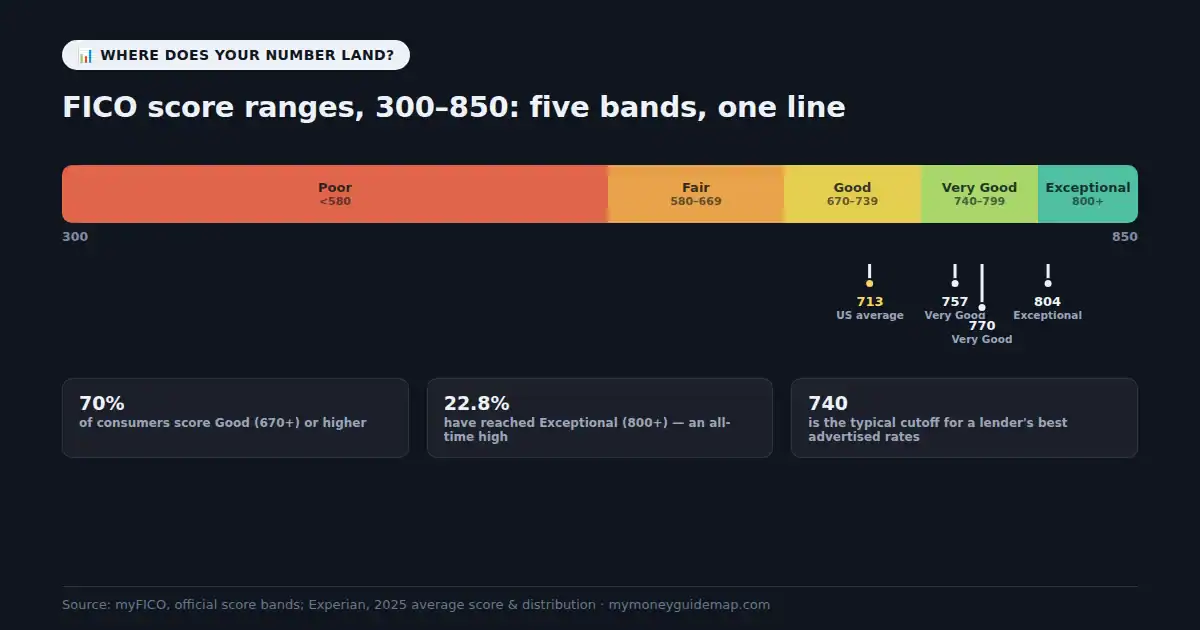
Every FICO score runs from 300 to 850, and myFICO breaks that span into five bands: below 580 is Poor, 580–669 is Fair, 670–739 is Good, 740–799 is Very Good, and 800 and above is Exceptional. These FICO score ranges aren’t arbitrary — lenders use them as shorthand for risk, and the band you land in shapes which rates and approvals you’re likely to see, long before anyone looks at the rest of your application.
What a Score Like 757 or 804 Actually Puts You In
Numbers only mean something once you place them on the scale. A 757 lands solidly in the Very Good range — comfortably above the 740 cutoff, with room to spare before Exceptional. A 770 sits in that same Very Good band, closer to the top. A 776 is still Very Good, just a few points from crossing into Exceptional territory at 800. An 804, on the other hand, clears that line entirely and sits in the Exceptional range, the top tier FICO score ranges have to offer. None of these differences change your reality dramatically — but knowing exactly where your number falls tells you whether you’re near a threshold worth pushing past, or already past it.
Where the Average American Actually Falls
Experian reports the average FICO Score in the U.S. was 713 as of its most recent data — which puts the typical American just barely into the Good range, not Very Good. The full breakdown: 14.7% of people are in Poor, 14.9% in Fair, 20.1% in Good, 27.5% in Very Good, and 22.8% in Exceptional. That means roughly 70% of consumers have a Good FICO score or better, but fewer than a quarter have cracked Exceptional — so if your score is sitting anywhere in Very Good, you’re already ahead of most people, even if it doesn’t feel that way next to an 804.
Does It Matter Whether You’re at 757 vs. 804?
Once you’re solidly inside Very Good or Exceptional, the FICO score ranges matter less than you’d think for everyday borrowing. Most lenders reserve their best advertised rates for anything roughly 740 and up, so the practical difference between a 757 and an 804 is often small — both tend to clear the bar for top-tier pricing on things like credit cards and auto loans. The gap matters more at the edges: moving from Fair into Good, or from Good into Very Good, is where you typically see real, noticeable improvement in the rates and approvals you’re offered. Chasing the last 30 or 40 points once you’re already in Very Good territory has diminishing returns compared to getting there in the first place.
How to Move From One Range to the Next
The fastest lever most people can pull is credit utilization — how much of your available credit you’re actually using — since it responds within a billing cycle or two, unlike payment history, which takes months to show real movement. Paying down balances before your statement closes, rather than just by the due date, is often enough to nudge a score from one FICO score range into the next within a couple of months. If you’re not sure which factors are actually driving your number, it’s worth understanding how credit scores work before you start trying to optimize it.
The Actual Takeaway
FICO score ranges turn an abstract number into something you can actually use: below 580 is Poor, 580–669 is Fair, 670–739 is Good, 740–799 is Very Good, and 800+ is Exceptional. A 757 or a 770 already puts you ahead of most borrowers in Very Good territory, and an 804 crosses into the top tier entirely — but once you’re past 740 or so, the practical difference between individual scores shrinks fast. The bigger wins come from moving between bands, not from chasing the last few points inside one.