If you’ve heard people talk about Roth IRAs like they’re some kind of financial cheat code, there’s a reason — it’s one of the few accounts where the government basically agrees to never tax your investment growth again, as long as you play by a few rules. What is a Roth IRA, in plain terms? It’s a retirement account you fund with money you’ve already paid taxes on, so that everything it earns from that point forward can come out tax-free in retirement.
How It’s Different From a Traditional IRA
The core difference comes down to when you pay the tax. With a traditional IRA, your contributions are often tax-deductible now, but you’ll owe income tax on withdrawals in retirement. A Roth IRA flips that — you get no upfront deduction, but qualified withdrawals in retirement, including all the growth your investments generated over the years, come out completely tax-free.
Which one is “better” really depends on whether you expect to be in a higher or lower tax bracket in retirement than you are today, which nobody can know for certain — it’s part of why a lot of people end up using both.
The 2026 Contribution and Income Limits
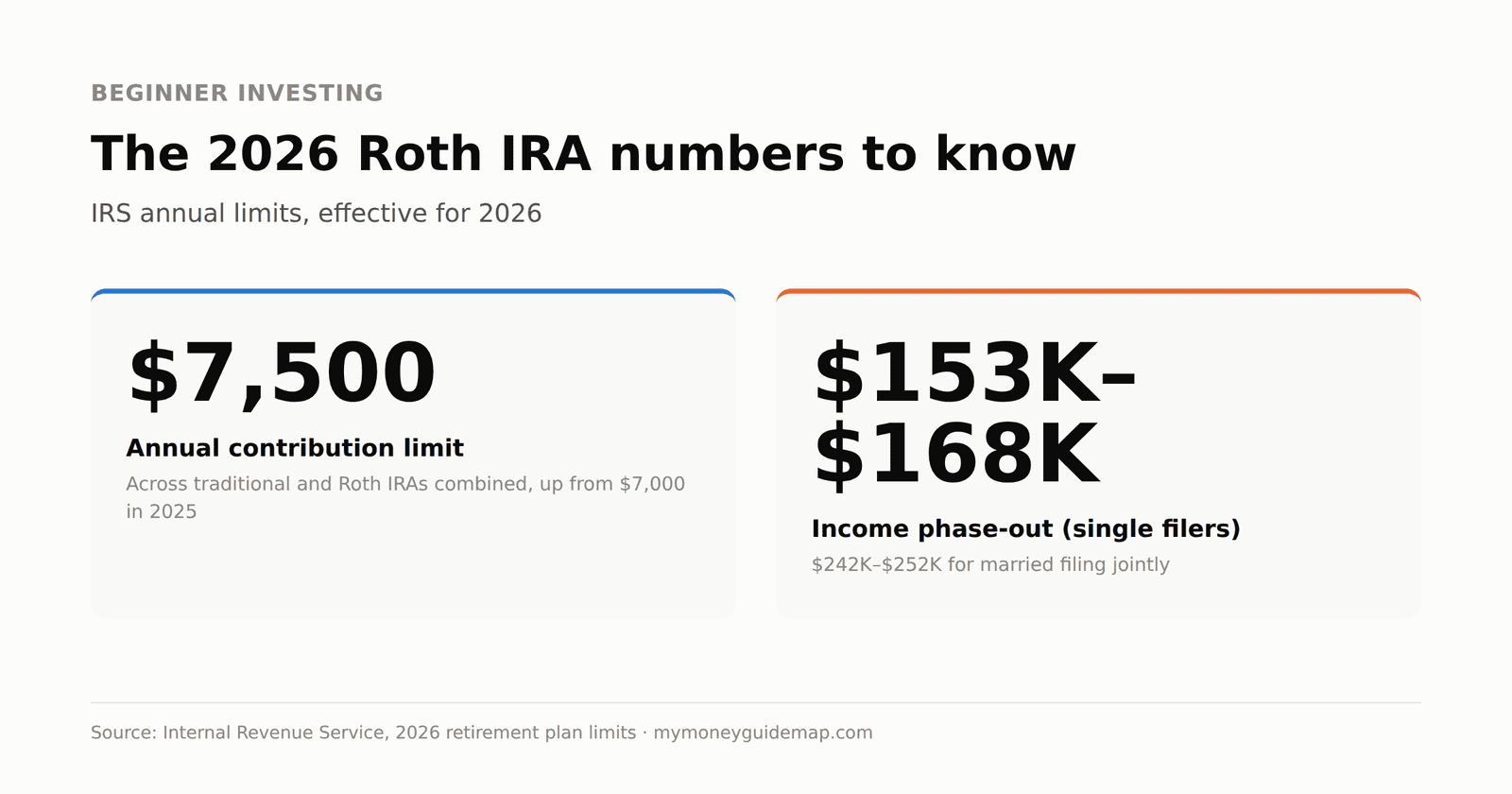
For 2026, the IRS increased the IRA contribution limit to $7,500, up from $7,000 the year before. That limit applies across your traditional and Roth IRAs combined — it’s not $7,500 in each separately.
Roth IRAs also come with an income ceiling, which traditional IRAs don’t have. For 2026, the ability to contribute directly starts phasing out at $153,000 and disappears entirely at $168,000 for single filers and heads of household, and phases out between $242,000 and $252,000 for married couples filing jointly.
Who Can’t Contribute Directly
If your income is above those thresholds, you can’t put money into a Roth IRA the normal way. Some higher earners use a workaround known as a “backdoor Roth” — contributing to a traditional IRA and then converting it — but that involves its own tax rules and isn’t something to attempt without understanding the mechanics first, since it’s easy to get wrong in a way that creates an unexpected tax bill.
Why People Like It for Retirement
Beyond the tax-free growth, a Roth IRA has a few features that make it genuinely flexible compared to other retirement accounts. Your original contributions — not the earnings, just what you put in — can generally be withdrawn at any time without taxes or penalties, since you already paid tax on that money going in. And unlike a traditional IRA, the IRS doesn’t require the original account owner to take required minimum distributions at any age, so the money can keep growing tax-free for as long as you want to leave it there.
None of that makes it a substitute for other savings, though. A Roth IRA is an investment account, not a bank account — money contributed typically goes into something like an index fund or other securities, similar to what we covered when explaining index funds, so its value moves with the market rather than sitting still.
What It’s Not Good For
Because the account is meant for retirement, the earnings portion generally can’t be withdrawn early without taxes and a penalty, with a handful of specific exceptions. That makes it a poor substitute for money you might need on short notice — an emergency fund belongs somewhere liquid and stable, not tied up in an account built around not touching it for decades.
It’s also not going to help if your income is above the phase-out range and you’re not up for navigating a backdoor contribution, and it’s obviously not useful if you don’t have earned income at all, since IRAs generally require you to have taxable compensation to contribute in the first place.
The Bottom Line on What a Roth IRA Actually Does
A Roth IRA’s whole value proposition is trading a tax break you don’t get today for a much bigger one decades from now — assuming you follow the rules on income limits, contribution caps, and when you actually touch the money. None of this is a recommendation for your specific situation, since the traditional-versus-Roth decision depends on your own tax picture, but understanding the mechanics is the part that actually stays useful no matter which way you land.
3 thoughts on “What Is a Roth IRA?”