Direct Roth IRA contributions phase out once your income crosses a set line, but the backdoor Roth IRA gives high earners a legal way around that limit — contribute to a traditional IRA with after-tax money, then convert it to a Roth, with no income cap involved in the conversion step itself. It’s written into the tax code, not a loophole that could close without notice, which is why financial advisors routinely recommend it to clients who’ve earned their way out of a regular Roth.
Who Actually Needs the Backdoor Route
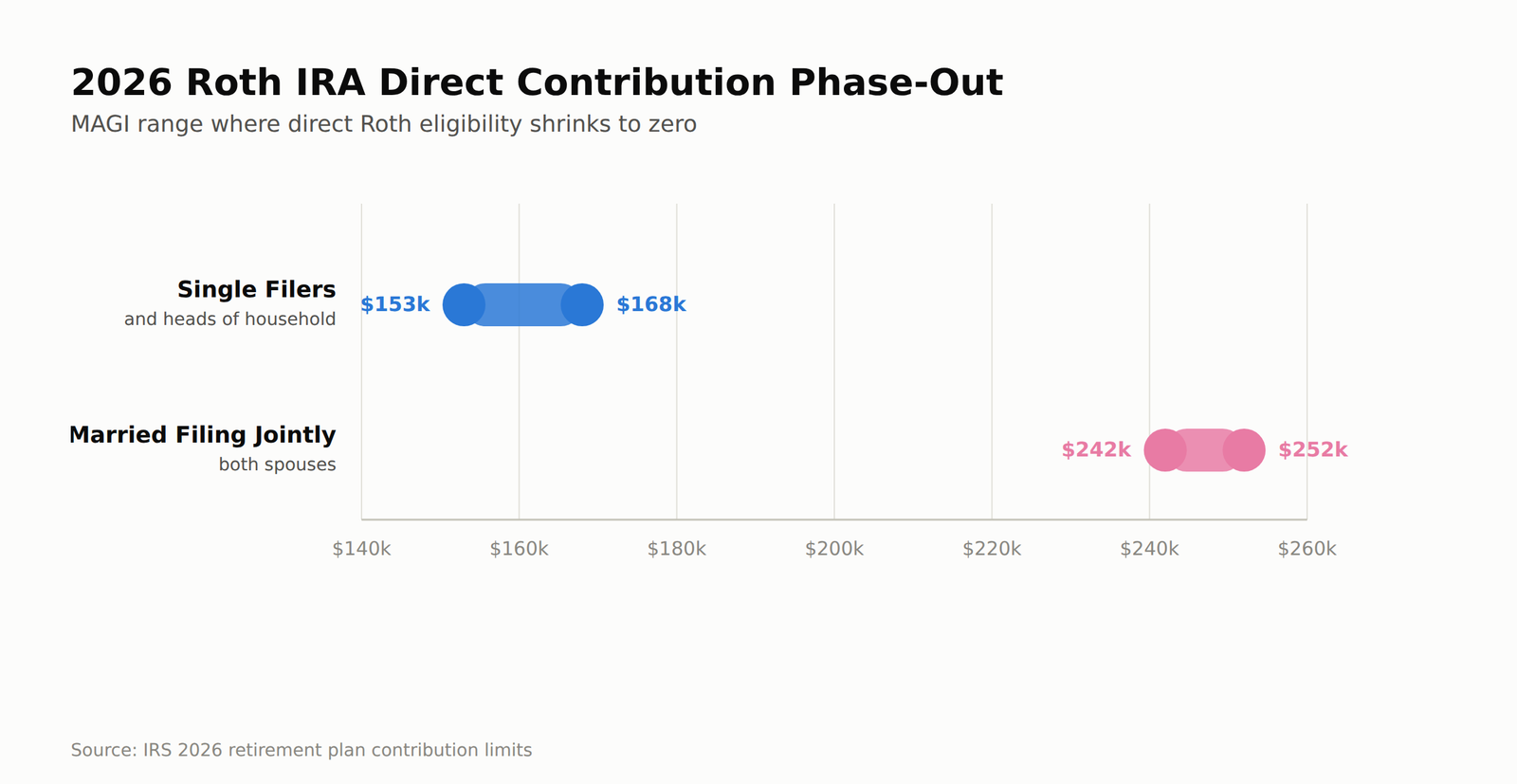
A Roth IRA lets earnings grow and come out tax-free in retirement, but direct contributions in 2026 phase out for single filers between $153,000 and $168,000 of modified adjusted gross income, and for married couples filing jointly between $242,000 and $252,000. Above those ceilings, the IRS doesn’t just shrink how much you’re allowed to contribute — it cuts off direct contributions entirely, which is the exact gap the backdoor method is built to close.
The 2026 contribution limit for IRAs, Roth or traditional, is $7,500 for anyone under 50, with an extra $1,100 catch-up allowed at 50 and older for a total of $8,600. None of that changes with the backdoor Roth IRA — it’s the same dollar cap as a regular Roth contribution, just funneled through two accounts instead of one.
How the Backdoor Roth IRA Works
The mechanics run in four steps: open or use an existing traditional IRA and make a nondeductible contribution up to the annual limit; let the deposit settle, which usually takes a few business days; convert the full balance to a Roth IRA, something the IRS permits with no waiting period required; and file Form 8606 with that year’s tax return to record the nondeductible basis, so the same money never gets taxed twice. Converting quickly, ideally within days of the contribution, keeps any investment growth in the traditional IRA close to zero, which matters because growth that happens before conversion is taxable income.
The Pro-Rata Rule Is Where Plans Go Wrong
The backdoor Roth IRA gets complicated fast for anyone who already holds money in a pre-tax traditional, SEP, or SIMPLE IRA, because the IRS’s pro-rata rule treats every one of those accounts as a single combined pool for tax purposes. Converting $7,500 in new after-tax money looks clean on its own, but if $92,500 of old pre-tax rollover money sits in the same person’s IRAs, the IRS treats the conversion as 92.5% taxable, not 0%, since the after-tax portion is only 7.5% of the combined total.
Avoiding that bill usually means clearing out pre-tax IRA balances before converting — rolling them into a current employer’s 401(k) or 403(b) plan removes them from the pro-rata calculation entirely, since that rule only counts IRA money, not workplace plan balances. The most common mistakes are converting too slowly and letting the account grow in the meantime, which turns the gains into taxable income; skipping Form 8606 and risking the IRS taxing the same contribution twice; and overlooking an old rollover IRA left untouched from a previous job, which is often the detail that triggers a surprise tax bill at filing time.
For someone deciding whether to run the backdoor Roth IRA process at all, it helps to understand what a Roth IRA actually buys compared with a traditional one — tax-free growth and withdrawals versus an upfront deduction — since that trade-off is exactly what the conversion step is paying for. Anyone with no existing pre-tax IRA balance and earned income above the phase-out range can usually run the strategy cleanly every year with little more than a spreadsheet and a reminder to convert promptly.