If your employer mentioned “enrolling in the 401(k)” during onboarding and you nodded along without fully knowing what you were signing up for, you’re in good company — a lot of people never get a plain answer to what is a 401k beyond “retirement thing at work.” It’s one of the most common ways Americans save for retirement, and it works a little differently from an account you’d open yourself, because your employer is involved too.
What Is a 401k, in Practice
A 401(k) is a retirement account offered through your job. You choose a percentage (or flat dollar amount) of each paycheck to contribute, and it’s deducted automatically before the money ever hits your checking account — similar in spirit to automating your savings, except the “automation” is built into your payroll itself. That money then goes into investments you select from a menu your employer’s plan offers, usually a set of mutual funds or target-date funds.
Most plans come in a traditional version, where contributions reduce your taxable income now and you pay tax on withdrawals in retirement, and increasingly also a Roth version, where you contribute after-tax dollars and withdrawals in retirement are tax-free — the same trade-off explained in how a Roth IRA works, just inside an employer-sponsored account instead of one you open on your own.
The Employer Match Is the Part Not to Skip
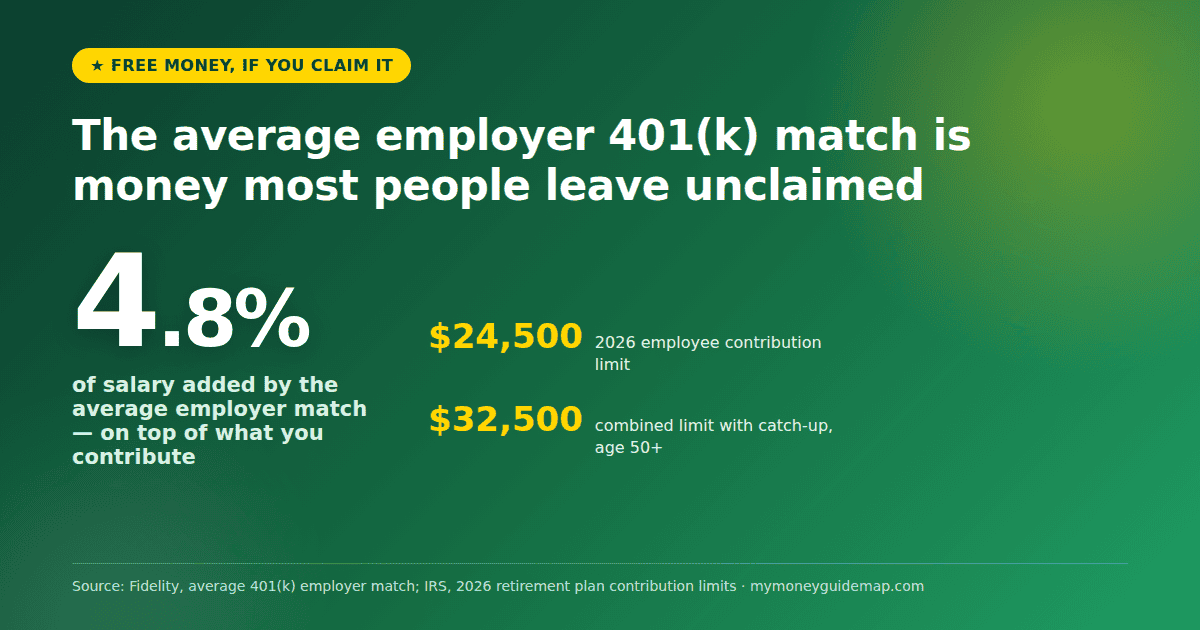
The feature that sets a 401(k) apart from an IRA is the employer match. Many companies will contribute additional money on top of what you put in, up to a certain percentage of your salary. According to Fidelity’s research, a common formula is a dollar-for-dollar match on the first 3% of pay you contribute, plus 50 cents on the dollar for the next 2% — meaning someone contributing 5% of their salary would get roughly 4% added on top from their employer. Fidelity’s data shows the average employer match runs around 4.8% of pay, though it varies noticeably by plan.
If your employer offers any match at all, contributing at least enough to get the full amount is usually treated as one of the closest things to free money available in personal finance — turning it down means leaving part of your compensation on the table. This match is really the whole answer to what is a 401k worth prioritizing over other places you could put that same paycheck dollar.
Vesting: Why the Match Isn’t Always Fully Yours Right Away
There’s a catch worth knowing about before you count on that match: vesting. Your own contributions are always 100% yours, no matter what. The employer’s match, though, can come with a vesting schedule — some plans require a few years of employment before you own 100% of the matched funds, and others phase in ownership gradually, such as 20% per year over five years. Leave before you’re fully vested, and you forfeit whatever portion hasn’t vested yet. It’s worth checking your specific plan’s vesting schedule rather than assuming the match is yours the moment it lands in your account.
The 2026 Contribution Limits
For 2026, the IRS raised the 401(k) employee contribution limit to $24,500, up from $23,500 in 2025. That figure is what you personally can contribute — employer match money doesn’t count against it. Workers age 50 and older can add a catch-up contribution, which rises to $8,000 for 2026, for a combined total of $32,500. There’s an even higher catch-up window for workers specifically aged 60 through 63, set at $11,250 instead of the standard $8,000, under a newer rule that phased in as part of SECURE 2.0.
These limits are considerably higher than the $7,500 combined cap on traditional and Roth IRAs for 2026, which is part of why a 401(k) is usually the bigger lever for retirement savings once the employer match is captured. Knowing what is a 401k contribution limit each year matters almost as much as knowing the match formula, since it caps how much of that tax advantage you’re able to use.
Where It Fits Alongside Other Accounts
A common approach is contributing enough to a 401(k) to get the full employer match first, since that’s effectively an immediate return no investment can reliably match, then deciding whether additional retirement savings should go into an IRA or back into the 401(k), depending on factors like the investment options and fees available in your specific plan versus what you could access on your own. A 401(k)’s fund menu is set by your employer, which sometimes means fewer choices and higher fees than you’d get picking your own investments elsewhere — worth a look before assuming maxing out the 401(k) beyond the match is automatically the better move.
The Actual Takeaway
So, what is a 401k once you separate the pieces? It’s a payroll-deducted retirement account, often with free money attached in the form of an employer match, subject to contribution limits that reset every year and a vesting schedule that determines when the match is truly yours. Checking your specific plan’s match formula and vesting rules takes a few minutes and is worth doing before deciding how much of your paycheck to direct there.
3 thoughts on “What Is a 401(k)?”