If building a down payment fund keeps getting harder instead of easier, the data backs that up. The typical first-time homebuyer is now 40 years old, up from 38 just the year before, according to the National Association of Realtors — a clear sign that getting the money together is taking people longer than it used to.
The number itself isn’t as large as most people assume, though. First-time buyers have put down a median of 6% to 9% of the purchase price since 2018, not the 20% long treated as the standard. On a median home price of roughly $415,000, a 7% down payment works out to about $29,000, plus closing costs — a real number, but a far smaller mountain than 20% down would be.
Where to Keep Your Down Payment Fund While You Save
A down payment fund needs to grow a little while staying completely safe, since losing any of it to a market downturn right before closing isn’t an option. A high-yield savings account, currently paying in the 4%-5% range at several online banks, is the standard home for this money — a short-term CD or money market account can work too, as long as the term doesn’t lock the cash up past your expected purchase date.
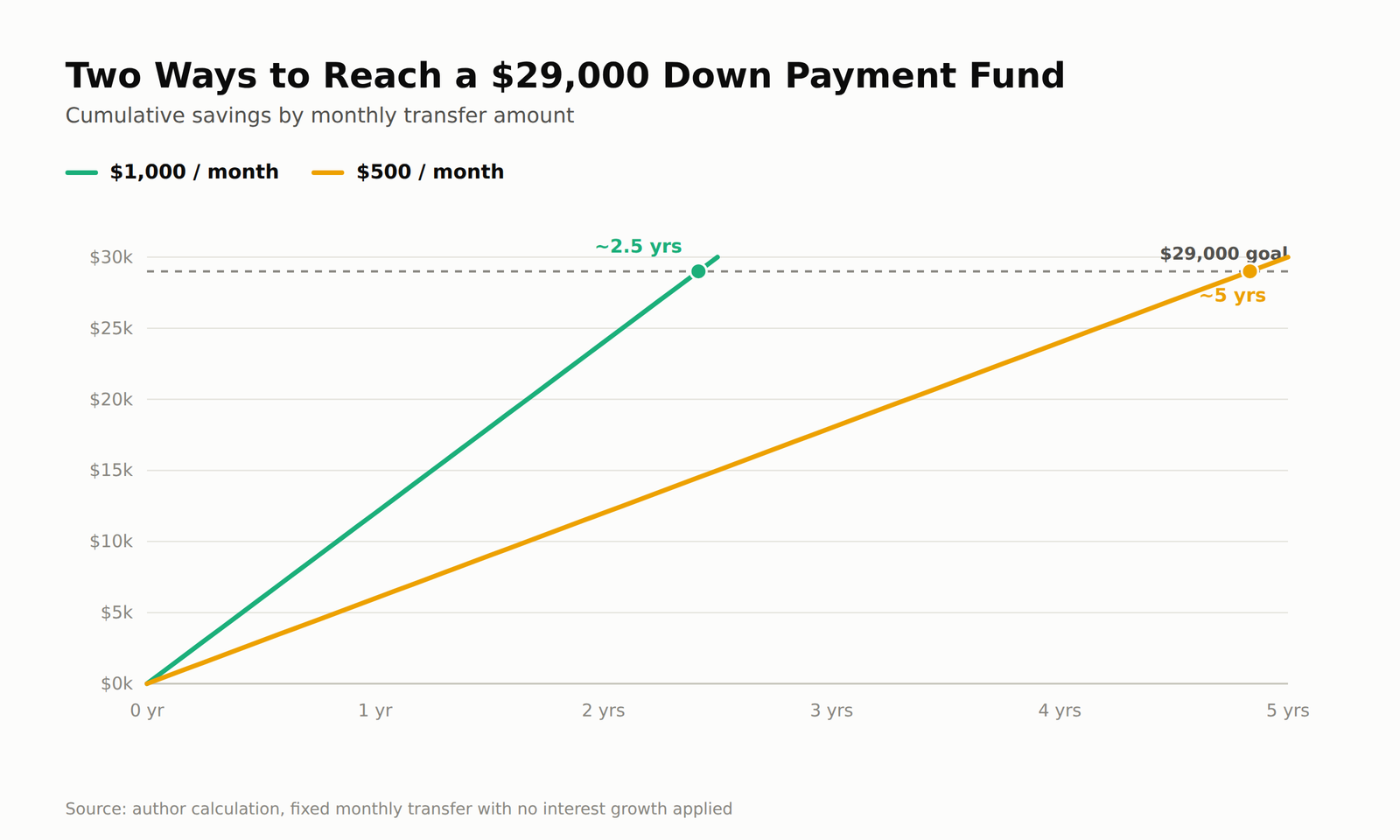
Automating a fixed transfer the day you get paid, before the money has a chance to get spent elsewhere, is what actually makes a down payment fund grow instead of staying an occasional good intention. A $500 monthly transfer gets a $29,000 target there in about five years; push that to $1,000 a month and the same goal takes roughly two and a half years, which is the kind of math worth running on your own numbers before picking a target move-in date.
A less obvious source worth knowing about is a Roth or Traditional IRA. Contributions (not earnings) can always be withdrawn tax- and penalty-free at any time, for any reason, and on top of that, the IRS allows up to $10,000 of IRA earnings to be withdrawn penalty-free for a first home purchase — $20,000 combined for a married couple, each spouse using their own limit.
The catch on a Roth is that the account needs to have been open at least five years before earnings qualify for this exception, and “first-time buyer” really just means not having owned a primary residence in the prior two years, not never having owned one at all. Treating an IRA as a backup rather than the main engine of a down payment fund still makes sense, since the money is doing real work toward retirement in the meantime.
Down payment assistance programs, run through state and local housing authorities rather than the federal government, are also worth checking before assuming the full amount has to come from savings alone. These typically take the form of a grant or a deferred, sometimes forgivable second loan, with eligibility usually tied to income limits and whether the home will be the buyer’s primary residence — worth a half hour of research even for buyers who don’t think of themselves as needing assistance.
Family gifts remain common, too, and lenders generally require a signed gift letter confirming the money doesn’t need to be repaid, so it doesn’t get mistaken for an undisclosed loan during underwriting. None of these sources need to be used alone — most real down payments end up as some mix of automated savings, a modest IRA contribution withdrawal, and occasionally a gift, rather than one single source covering the whole target.
Redirecting retirement contributions temporarily, dropping a 401(k) contribution rate for a year or two to speed up the down payment fund, is a real option some buyers use, though it comes with a real cost in lost employer match and compounding if the account offers one — worth doing deliberately and for a fixed window, not indefinitely.
Once a target number and a monthly contribution are both on paper, the rest is mostly patience: automate the transfer, let the high-yield account do its job, and treat the down payment fund the same way our guide on paying yourself first treats any other savings goal — as the first thing the paycheck covers, not the last.