If you have no credit history or a thin file, the two products everyone recommends are a credit builder loan and a secured credit card, and the honest answer to which one works faster is that they build your score in different ways, not at different speeds. The first is reported as an installment account, the second as revolving credit, and FICO weighs those two kinds of history differently — payment history alone accounts for 35% of your score, with the amount you owe worth another 30%.
How a Credit Builder Loan Builds Credit
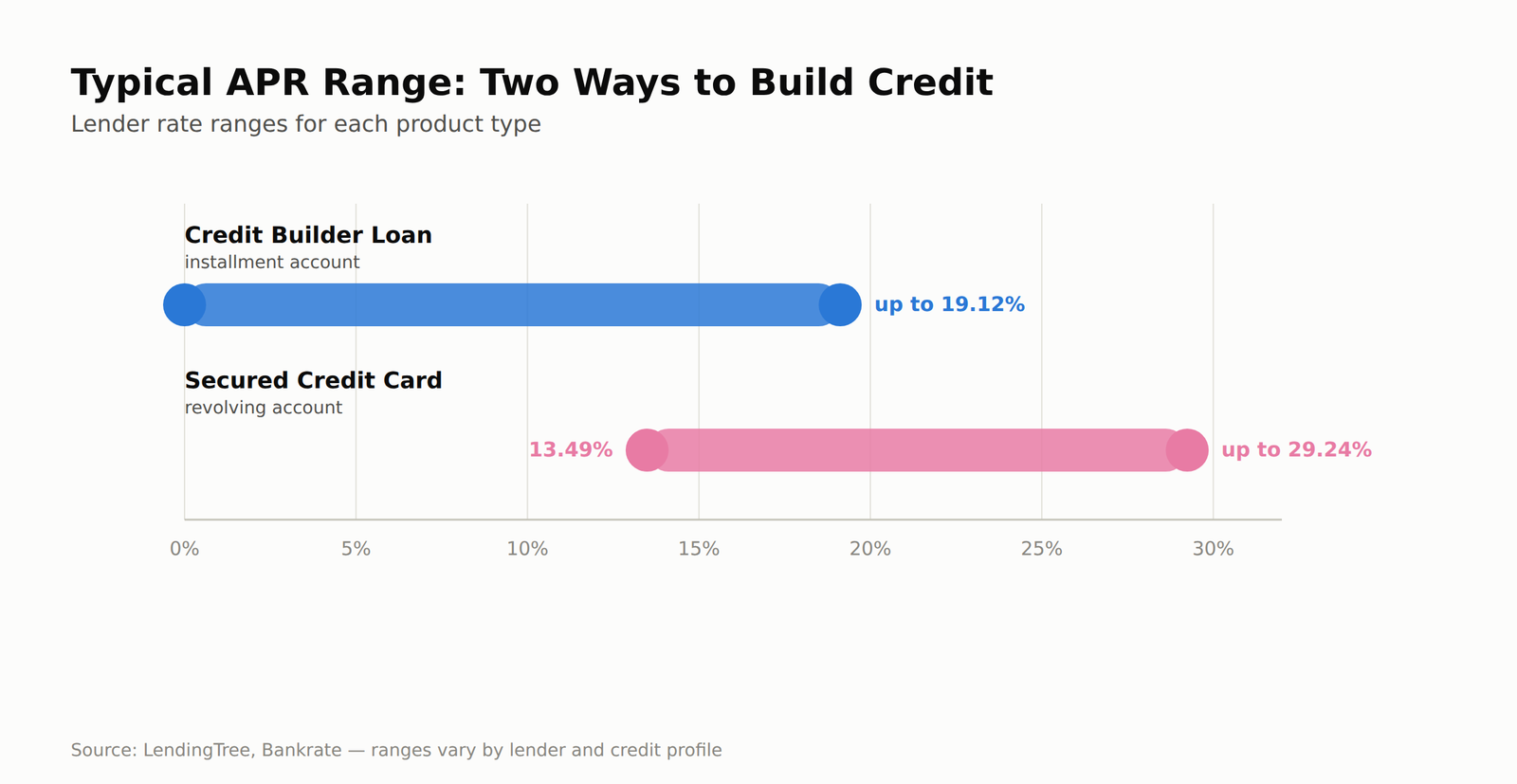
With a credit builder loan, the lender locks the loan amount — typically $300 to $1,000 — in a savings account or CD, and you make fixed monthly payments for 6 to 24 months before getting access to the money. Pricing varies a lot by lender: some, like Credit Karma’s offering, charge no interest and no fee at all, while DCU charges around 5% APR and BMO runs 10.80% to 19.12% plus a $75 processing fee. One widely cited finding is that borrowers with no other existing debt saw their credit score rise by roughly 60 points over the life of the loan.
How a Secured Credit Card Builds Credit
A secured card works differently — you put down a refundable deposit, usually starting around $200, which becomes your credit limit, and you can spend against it right away. Rates run high, typically 23% to 29% APR, though annual fees are often $0. Issuers commonly review the account for an unsecured upgrade after about six months of on-time payments, and refund the original deposit within 30 to 90 days of closing or graduating the account.
The real difference between these two products is which 30% of your score they touch. A secured card’s balance directly affects your credit utilization ratio, so keeping spending low relative to the limit (ideally under 10%) is what actually moves the needle month to month. That kind of loan doesn’t carry a utilization number at all, since there’s no revolving balance to manage — its contribution comes from on-time payment history and from adding a different account type to your credit mix, which is worth 10% of your score on its own.
That difference in mechanics is also what decides which option shows movement faster. A secured card can nudge a score within the first one or two statement cycles once low utilization and an on-time payment get reported, simply because utilization updates every billing cycle. A credit builder loan’s effect builds more gradually and shows up more fully near the end of its term, since the account is young for its entire duration and the lender doesn’t hand over the funds until the loan is paid off.
Using both at the same time, rather than picking one, is actually the stronger play for anyone starting from a thin file. A secured card plus a credit builder loan covers both the revolving and installment sides of credit mix simultaneously, and that combination is part of why some credit-building programs bundle the two products together instead of offering just one.
Cost should factor into the decision as much as speed does. A secured card charging 23%-29% APR only matters if a balance is carried past the due date, since paying in full each month avoids interest entirely — but for anyone worried about the temptation to carry a balance, a no-interest option from a lender like Credit Karma removes that risk completely, at the cost of not having spendable credit in hand.
Whichever product comes first, the fastest path to a usable score is the same either way: pay on time every month, keep any revolving balance low, and let the account season for at least six months before expecting a major jump. For the fuller picture of where a score starts and how the pieces fit together, our guide on how to build credit from scratch and our explainer on what credit utilization actually measures both cover the ground this comparison builds on.