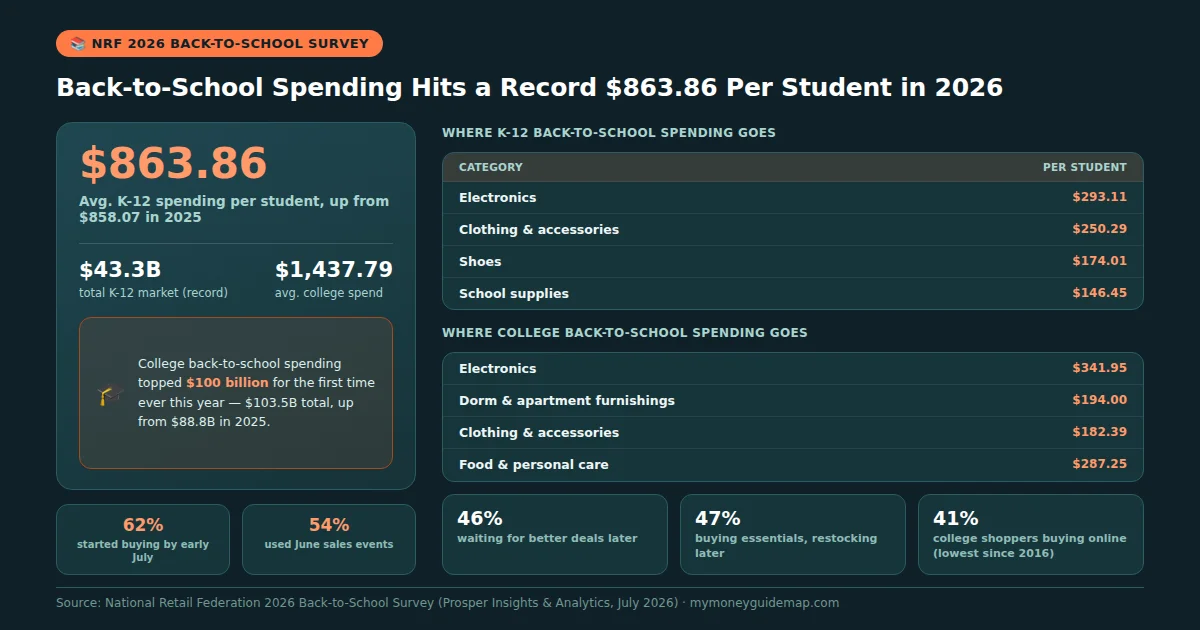
Back-to-school spending just hit a record high, and the numbers explain why so many families feel the pinch every August. The average household with kids in kindergarten through 12th grade expects to spend $863.86 per student this year, up from $858.07 in 2025, pushing total K-12 spending to $43.3 billion nationwide — a record, according to the National Retail Federation’s 2026 back-to-school survey. College households are spending even more: $1,437.79 per student, up from $1,325.85 last year, for a combined national total of $103.5 billion, the first time college-related back-to-school spending has ever topped $100 billion. The survey, run by Prosper Insights & Analytics on behalf of the NRF, polled 7,677 consumers between July 1 and July 8, 2026, with a margin of error of ±1.1 percentage points — a large enough sample that the year-over-year increase looks like a real trend rather than statistical noise.
Where the Back-to-School Spending Is Actually Going
The category breakdown shows this isn’t just inflation nudging up a single line item — it’s broad-based growth across nearly everything on the list. For K-12 families, electronics lead the way at $293.11 per student ($14.7 billion total), followed by clothing and accessories at $250.29, shoes at $174.01, and school supplies at $146.45. College households show a similar pattern with a bigger price tag: electronics at $341.95 per student, dorm and apartment furnishings at $194.00, clothing at $182.39, food at $153.91, and personal care items at $133.34. Electronics being the single largest category in both groups is a reminder that “school supplies” now means laptops and tablets as much as notebooks and pencils.
| Category | K-12 (per student) | College (per student) |
| Electronics | $293.11 | $341.95 |
| Clothing & accessories | $250.29 | $182.39 |
| Shoes | $174.01 | |
| School supplies / Dorm & furnishings | $146.45 | $194.00 |
How Families Are Timing Their Back-to-School Spending This Year
According to the NRF’s own release on this year’s survey, 62% of shoppers had already started buying by early July — down slightly from 67% in 2025, but still well above the 55% recorded in 2024. Among the shoppers who hadn’t finished at least half their list, 46% said they were deliberately waiting for better deals later in the season, 23% were spreading purchases across multiple trips to manage the total cost, and 47% planned to buy only the essentials up front and restock supplies gradually through the school year. Notably, 54% of shoppers said they specifically used June’s big sales events — Prime Day, Walmart deals, and Target’s Circle Deal Days — to knock out school-related purchases early, while online shopping’s share actually declined: just 50% of K-12 shoppers and only 41% of college shoppers planned to buy online, the lowest share for college shoppers since 2016. That shift back toward physical stores suggests families are prioritizing being able to compare prices and check quality in person over the convenience of a one-click checkout, especially on bigger-ticket items like electronics and dorm furnishings.
How to Budget for Back-to-School Spending Without the Sticker Shock
The survey data points to a practical pattern worth borrowing even if you’re not consciously trying to budget: treat back-to-school costs as a series of smaller purchases instead of one big hit. Buying only the essentials in the first week and restocking supplies gradually, the approach nearly half of shoppers already use, keeps any single credit card statement from spiking, and spreading purchases across multiple trips makes it easier to compare prices as sales roll through July and August instead of locking in whatever the first store has in stock. Setting aside a fixed amount for “school costs” ahead of time, the same logic behind envelope budgeting, turns an unpredictable $863.86-plus expense into something you’ve already planned for rather than something that shows up as a surprise on the credit card bill.
Whether your household lands closer to the $863.86 K-12 average or the $1,437.79 college average, the reality is that back-to-school spending has grown every year for the past several years running, and electronics — not the cheap stuff like pencils and folders — are doing most of the heavy lifting on your total. Building a category-by-category estimate before the shopping season starts, using numbers like these as a starting benchmark, is a more reliable way to avoid an unpleasant total than hoping this year’s bill looks like last year’s.