Average savings account interest rate data from the FDIC tells a blunt story this month: the typical account is paying just 0.38% APY, while the best high-yield accounts are paying more than ten times that. If your money has been sitting in the same account for a while, there’s a good chance you’re one of the millions of savers quietly losing hundreds of dollars a year to a rate that never moved.
What Is the Average Savings Account Interest Rate Right Now?
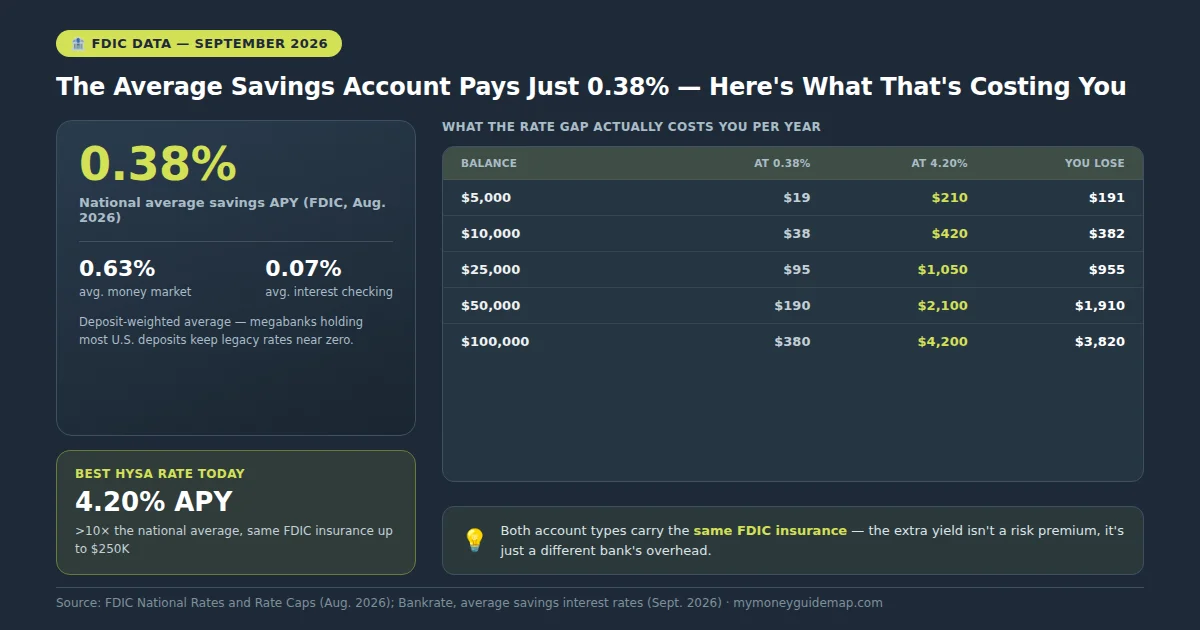
The FDIC’s official national average for traditional savings accounts sat at 0.38% APY as of August 2026, a figure widely reported across banking coverage this month and confirmed directly against the FDIC’s own National Rates and Rate Caps data. For comparison, the national average on money market accounts is 0.63% and interest checking sits at just 0.07% — every basic deposit account is still paying next to nothing. Meanwhile, the best high-yield savings accounts are advertising rates as high as 4.20% APY this September, according to Bankrate’s latest rate roundup. That’s not a small gap; it’s more than ten times the national average savings account interest rate, and it exists because the FDIC’s figure is deposit-weighted — the small handful of megabanks holding the majority of America’s deposits keep paying legacy rates close to zero, which drags the whole average down even as online banks compete hard on yield.
What the Average Savings Account Interest Rate Gap Actually Costs You
The percentage-point gap is easy to skim past, so it helps to see it in real dollars. On a $5,000 balance, a 0.38% account earns about $19 a year, versus roughly $210 at 4.20% — a $191 difference for doing nothing but choosing a different bank. That gap only grows with the balance:
| Balance | At 0.38% APY | At 4.20% APY | Difference |
|---|---|---|---|
| $5,000 | $19 | $210 | $191 |
| $10,000 | $38 | $420 | $382 |
| $25,000 | $95 | $1,050 | $955 |
| $50,000 | $190 | $2,100 | $1,910 |
| $100,000 | $380 | $4,200 | $3,820 |
For anyone keeping a full emergency fund or a house down payment sitting in cash, that last row isn’t hypothetical — a $100,000 balance parked at the national average is leaving nearly $4,000 a year on the table, every single year it stays put.
Why Millions of Savers Are Still Stuck at 0.38%
The honest answer is inertia, not risk. Both a big-bank savings account and an online high-yield account carry the same FDIC insurance up to $250,000 per depositor, per bank, so the extra yield isn’t compensation for extra risk — it’s compensation for the online bank’s lower overhead. Most people opened their savings account years ago alongside a checking account at whatever bank was closest, and rate shopping a savings account has never felt as urgent as rate shopping a mortgage or a car loan, even though the dollar amounts involved can be just as large over time. Some savers also assume moving money means losing access to it, but most high-yield savings accounts still allow free transfers back to a linked checking account within one to two business days.
Is It Worth Switching to a Higher-Rate Savings Account?
For most people holding more than a token amount in savings, yes — the math above makes the case on its own. Before moving money, it’s worth confirming three things: that the new account is FDIC-insured (or NCUA-insured for a credit union), that there’s no monthly maintenance fee eating into the higher rate, and that there’s no minimum balance requirement that doesn’t fit your situation. None of that takes more than a few minutes to check on a bank’s own rate disclosure page. If the extra yield is going toward an emergency fund specifically, keeping the money in a high-yield savings account rather than locking it in a CD still matters more than the exact rate — liquidity is the whole point of that money, and the best APY in the world doesn’t help if it takes a week and a penalty to reach it in a real emergency.
The average savings account interest rate isn’t going to fix itself, and there’s no sign the big banks holding the bulk of America’s deposits are in a hurry to close the gap. The only variable actually in a saver’s control is which bank holds the money — and for most people, that’s a five-minute account switch standing between them and hundreds of extra dollars a year.