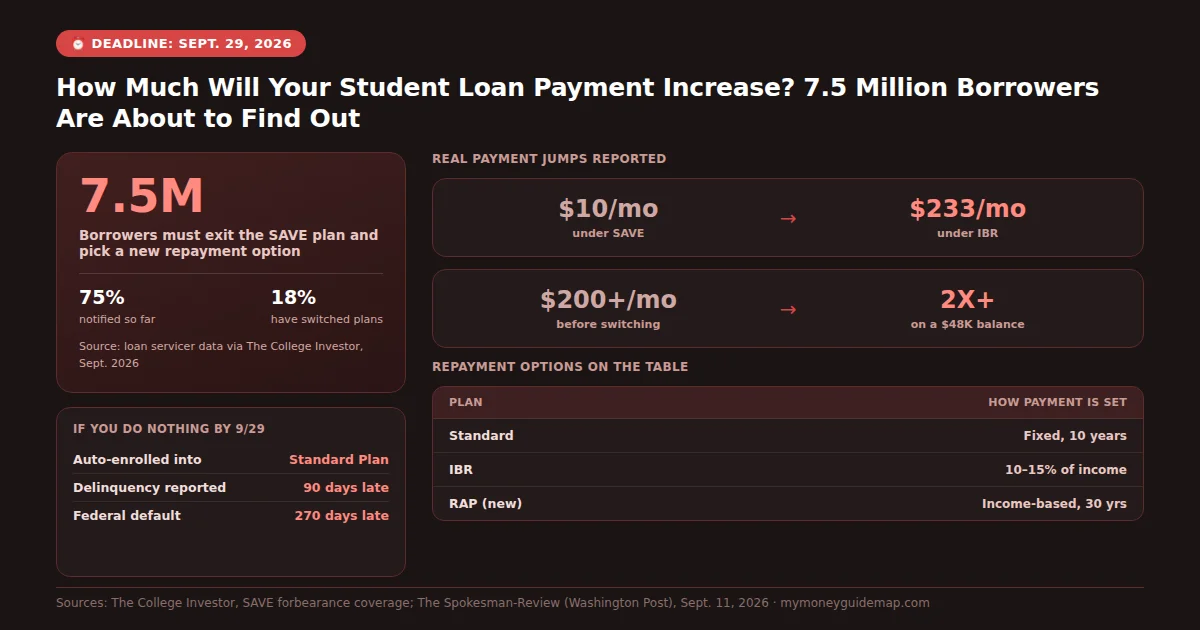
Student loan payment increases are about to hit millions of borrowers at once. Roughly 7.5 million people enrolled in the SAVE (Saving on a Valuable Education) plan have until September 29, 2026 to pick a new repayment plan — or the Education Department will automatically move them into the standard 10-year plan, typically the highest monthly payment of any option on the table.
Why 7.5 Million Borrowers Are Facing This Deadline Now
The SAVE plan was struck down in court, and the nearly 7 million borrowers who had been parked in an associated forbearance since are now being pushed out of it. Loan servicers began sending notices on July 1, 2026, starting a 90-day window to choose a new plan — a window that closes September 29 for the first wave of borrowers. As of the most recent count, 75% of affected borrowers have been notified and the rest will hear by year-end, but only 18% have actually switched plans so far; just 1.32 million of the 7.5 million have selected something new. That leaves millions of people with only weeks left before the choice gets made for them.
How Big Could Your Student Loan Payment Increase Be?
The size of the jump depends heavily on which plan a borrower lands in next, and the real-world examples are striking. Nearly half of SAVE enrollees currently qualify for $0 monthly payments, so for many the increase isn’t a bump — it’s the first real bill they’ve seen in years. One borrower paying $10 a month under SAVE is facing $233 a month under Income-Based Repayment. Another, carrying a $48,000 balance, would see a payment that was already over $200 more than double once moved off SAVE.
| Repayment Plan | How the Payment Is Set |
Among borrowers who’ve already left SAVE, half chose IBR, 16% picked the new RAP option, and 14% went with PAYE — even though PAYE and the older ICR plan are both being phased out within two years, which makes them a shakier long-term pick for anyone starting fresh. The size of a borrower’s eventual student loan payment increase also depends on how recently their income was reported, since IBR and RAP both recalculate the bill off current, not historical, discretionary income.
What Happens If You Do Nothing Before September 29
Borrowers who don’t act are automatically defaulted into the Standard Repayment Plan, which divides the entire remaining balance into fixed payments over 10 years — the option most likely to produce the biggest student loan payment increase of all. Missing payments after that has real consequences: delinquency gets reported to credit bureaus after 90 days, and federal loans go into default after 270 days of nonpayment. Making this harder, borrowers have also reported loan-simulator calculator outages, trouble accessing payment history, and conflicting notices from servicers — real system friction on top of a genuinely compressed timeline, so waiting until the last week to sort this out is riskier than it sounds.
How to Pick a Repayment Plan Before the Deadline
The first practical step is making sure contact information is current on StudentAid.gov and directly with the loan servicer, since a missed notice is often the reason people end up defaulted into the standard plan without realizing it. From there, comparing IBR, RAP, and PAYE against actual current income (not just the lowest advertised payment) matters more than it might seem — a plan that phases out within two years, like PAYE, may not be worth the short-term savings if it just means picking again soon. Anyone whose income is genuinely irregular or expected to change should weigh RAP’s 30-year, income-based structure against IBR’s shorter timeline before defaulting to whichever plan a service rep suggests first.
For most of the 7.5 million people affected, this deadline turns an abstract number into a real monthly bill, sometimes for the first time in years — and for many, that student loan payment increase will land in the same October or November paycheck as every other bill already on the calendar. That’s exactly the kind of shock that’s worth planning around rather than absorbing after the fact — if a new, higher required payment means other debts suddenly compete for the same dollars, it’s worth revisiting how those other balances get prioritized, not just how the loan servicer assigns the new plan. Whether the jump is from $10 to $233 or from $200 to over $400, the number that matters most is the one that shows up in a bank account starting in October or November, not the one in this month’s headlines.