Is no tax on overtime worth it, or does the name oversell what the deduction actually does? The new federal tax break, in effect for the 2026 tax year, doesn’t make all of your overtime pay tax-free — it only covers the “premium” portion, the extra half in time-and-a-half, according to the IRS’s own updated guidance covered by Benzinga and detailed further by the Bipartisan Policy Center. The regular hourly rate you’d have earned anyway is still taxed exactly as before.
Is No Tax on Overtime Worth It Once You See the Actual Caps?
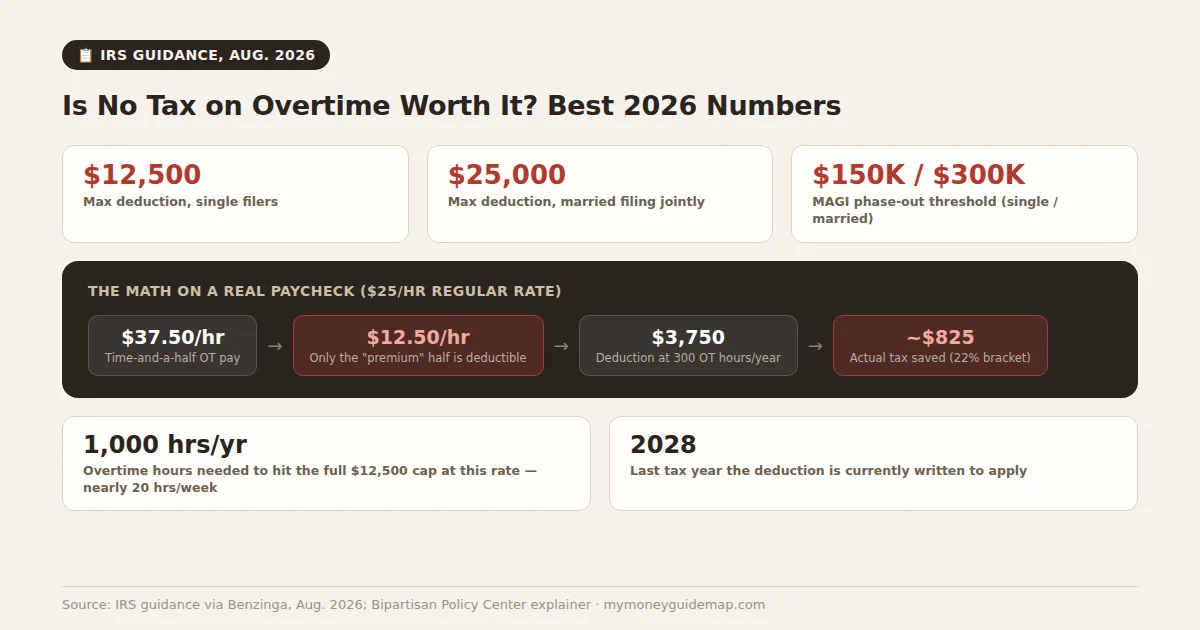
Here’s the math that matters: only overtime required under the federal Fair Labor Standards Act qualifies, and the deduction is capped at $12,500 for single filers and $25,000 for married couples filing jointly, phasing out entirely once modified adjusted gross income passes $150,000 (single) or $300,000 (married). Overtime required by a state law or a union contract, rather than the FLSA, doesn’t count — a detail that trips up plenty of workers who assume all overtime pay qualifies.
Put a real hourly example on it: someone earning $25 an hour gets time-and-a-half overtime pay of $37.50 an hour, but only the “half” — $12.50 an hour — is the deductible premium portion. Working 300 overtime hours in a year at that rate produces a $3,750 qualifying deduction. In the 22% federal bracket, that’s roughly $825 saved on your tax bill, not the $37.50-an-hour’s worth of tax relief the name might suggest.
Reaching the full $12,500 single-filer cap at that same $12.50-an-hour premium would take 1,000 overtime hours in a single year — nearly 20 hours of overtime every single week. For most workers claiming this deduction, the real savings will land closer to a few hundred dollars than the headline cap.
Who Actually Sees a Benefit Here
Is no tax on overtime worth it for someone who rarely works overtime? Not really — there’s nothing to deduct if there’s no qualifying overtime pay to begin with, and the deduction only helps once your income already clears the standard deduction thresholds of $15,750 (single) or $31,500 (married), since it reduces taxable income you’d otherwise already be taxed on. It’s also worth knowing the provision is temporary: it’s currently written to expire after the 2028 tax year, so this isn’t a permanent feature of the tax code to plan decades around.
For hourly workers who regularly log FLSA-qualifying overtime — think retail, warehouse, healthcare, or manufacturing shifts — this is a real, if modest, reduction in what gets withheld from a paycheck that’s already earned. The honest way to think about it isn’t “free money,” but a few hundred to a couple thousand extra dollars a year depending on how much overtime you actually work.
Is no tax on overtime worth it if you’re a salaried, exempt employee instead? Not at all, and this is where the deduction’s name causes the most confusion. Plenty of salaried workers put in extra hours without earning legal overtime pay in the first place, since FLSA exemption status — not simply working long hours — determines who qualifies. If your paycheck has never shown a separate overtime line, there’s nothing here to deduct, no matter how many extra hours you’re actually logging.
What To Actually Do With the Extra Money
Is no tax on overtime worth it enough to change how you budget? For most people the answer is: worth noticing, not worth restructuring your whole paycheck plan around. Because the exact dollar amount depends on hours worked and shifts year to year, it behaves less like a raise you can count on and more like an occasional bonus. Treating it the way you’d treat any irregular extra income — routing it straight into savings before it blends into regular spending — captures the benefit without requiring you to rebuild a budget around a number that could shrink or disappear after 2028. Whether or not is no tax on overtime worth it for your specific paycheck, the safest move is to treat whatever it adds as a bonus you plan around after it shows up, not a raise you count on in advance.