“How much should I actually be spending on groceries?” has a real answer, not just a guess — the USDA publishes an official grocery budget every month, built from real retail prices, broken out by exactly how many people are in your house. Most people have never looked at it, which is why a grocery bill that’s actually normal can still feel alarming at checkout.
The Four Official USDA Grocery Budget Tiers
The USDA tracks four spending tiers — Thrifty, Low-Cost, Moderate, and Liberal — and for a family of four (two adults, two kids), the current monthly figures run from $992.90 on the Thrifty plan up through $1,093.70 (Low-Cost), $1,347.20 (Moderate), and $1,628.40 (Liberal). The Thrifty plan is the strictest of the four and doubles as the basis for maximum SNAP benefits, while Liberal assumes more convenience foods, name brands, and premium proteins like salmon or grass-fed beef.
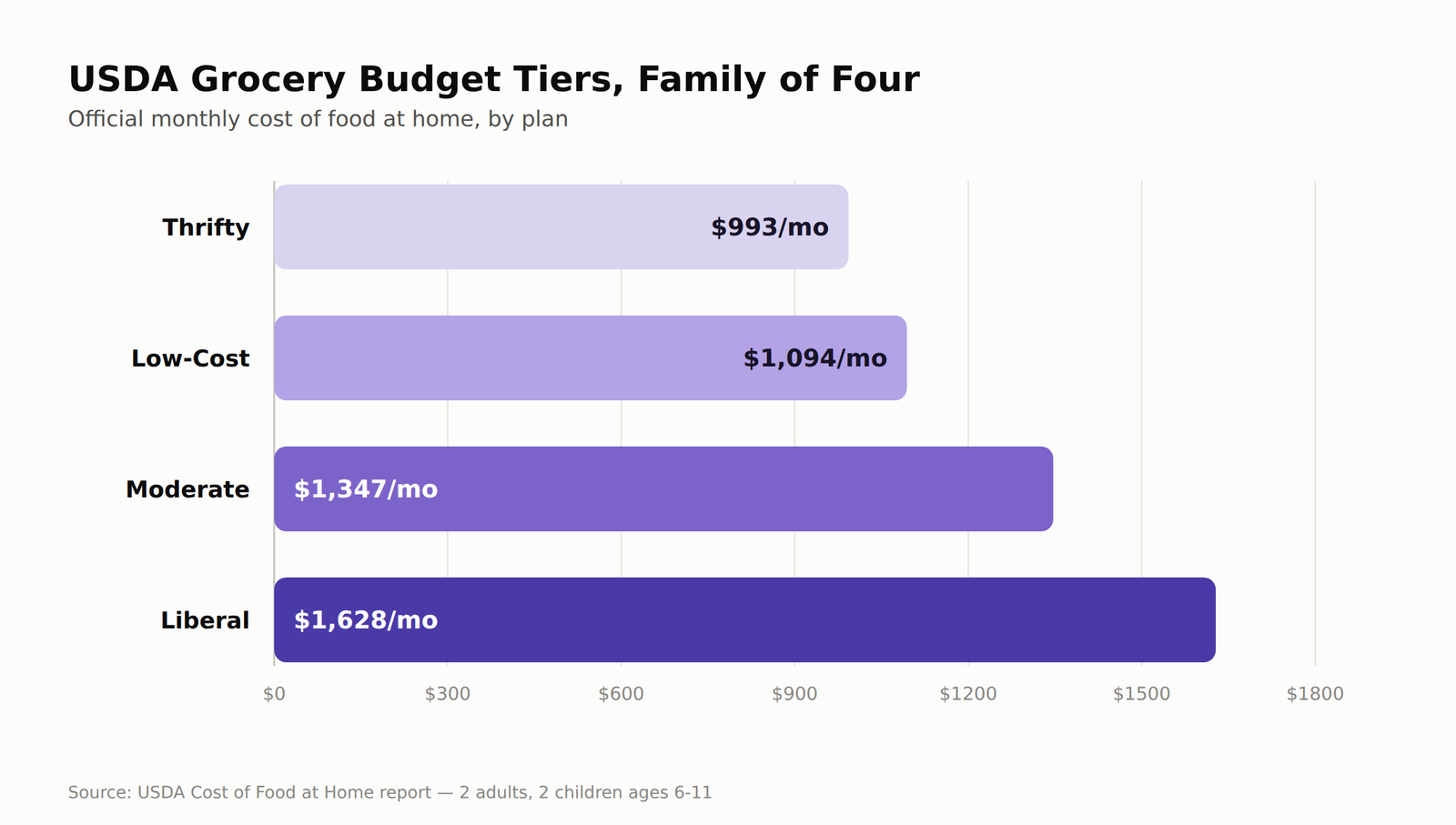
Scaling the number to your own household is simpler than it looks. A single adult eats on roughly 20% more per person than a couple does, since fixed costs like spices and condiments get spread across fewer meals — a single woman in her 20s-40s lands around $296 a month on the Thrifty plan, while two adults together run about $612. Starting from the family-of-four number and adjusting up or down by household size gets you in the right range without memorizing a separate age-bracket table.
Why Your Bill Might Be Higher Than the Chart Says
USDA’s own 2026 forecast puts overall food-at-home inflation at a mild 2.4% for the year, but that average hides enormous swings by category — beef and veal prices are up 9.4%, fresh vegetables are up 5.7%, and sugar and sweets are up 6.6%, while egg prices have actually dropped about 29.4% as flocks recover from last year’s avian flu losses. A cart that leans heavily on steak and produce is inflating much faster than the official average, while an egg-heavy breakfast routine has quietly gotten cheaper.
That spread is exactly why comparing your real receipts to the USDA tiers is more useful than comparing them to last year’s total. If your spending sits above Moderate for your household size, the gap is often concentrated in two or three categories rather than spread evenly across the whole cart, and knowing which ones lets you trim your grocery budget where it’s actually expensive instead of cutting everything by a flat amount.
A pantry audit can also reveal money leaking out in non-food categories that still ring up at the register — paper goods, cleaning supplies, and pet food often ride along with the grocery total even though USDA’s own tiers don’t count them. Keeping a running tally against your target grocery budget each week, rather than waiting for the full monthly total, makes it easier to catch an overspend while there’s still time to correct course.
Getting an honest number to compare against starts with four to six weeks of real receipts, not a guess at what a “normal” month looks like — grocery spending swings more than people expect from one week to the next depending on what’s on sale and what the freezer already has in it. A budgeting app that categorizes spending automatically makes this step far less tedious than saving paper receipts.
Once there’s a real baseline, picking a target tier (rather than an arbitrary round number) gives your grocery budget some actual grounding — dropping from Liberal-level spending to Moderate for a family of four frees up roughly $280 a month, which is real money without requiring couponing or giving up meat entirely. Whichever budgeting method structures the rest of the plan, the grocery line item works the same way: a number based on real data, checked against real receipts, adjusted a little each season as prices move.