Robo-advisor vs financial advisor is a harder call than it looks once you realize most of what’s written on it isn’t really talking to a beginner. If you’re starting with a few thousand dollars rather than a few hundred thousand, the typical breakdown runs the numbers on a $100,000 or $500,000 portfolio, which makes the fee gap look dramatic but doesn’t tell you much about what happens when you’re opening your first taxable account with $2,000 and adding $200 a month.
The mechanical difference is simple enough: a robo-advisor is software that builds and rebalances a portfolio of low-cost ETFs based on your goals and risk tolerance, charging a small percentage of your balance each year with no human involved unless you pay extra for one. A financial advisor is a person, usually charging a percentage of assets under management too, but a much larger one, in exchange for actual conversations, tax and estate planning, and someone to talk you out of a bad decision during a bad week in the market.
Robo-Advisor vs Financial Advisor: What Each One Actually Costs
Real 2026 numbers make the decision less abstract. Betterment charges 0.25% annually with no account minimum (or a flat $5 a month if your balance stays under $24,000). Wealthfront charges the same 0.25% with a $500 minimum. Vanguard Digital Advisor runs closer to 0.15%, and Fidelity Go doesn’t charge anything at all until your balance crosses $25,000, when it moves to 0.35%. Schwab Intelligent Portfolios skips the management fee entirely but requires $5,000 to open an account and holds a larger cash allocation to make up the difference.
Human financial advisors cluster in a different range. The typical AUM fee runs from 0.75% to 1.5% a year, with 1% being the most common number for a portfolio in the low six figures. That’s three to six times what most robo-advisors charge, and the fee doesn’t shrink much until your balance gets large enough to negotiate.
What That Gap Actually Costs a Beginner, Not a Millionaire
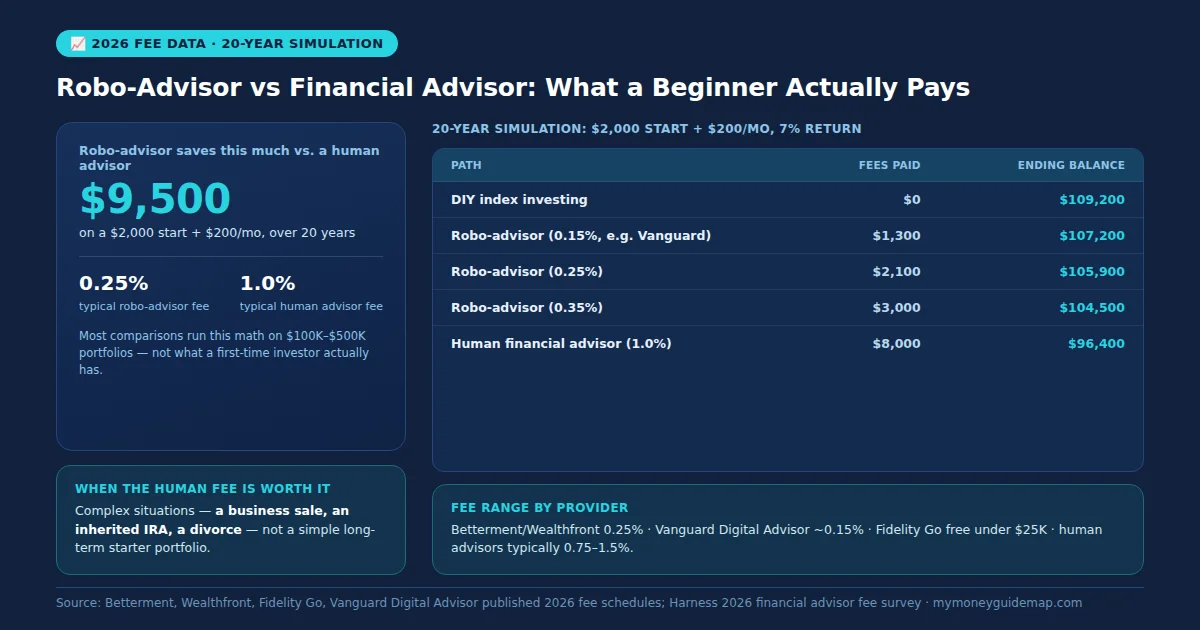
Here’s the calculation that’s missing from most robo-advisor vs financial advisor comparisons: what the fee difference does to a realistic starter portfolio, not a seven-figure one. Start with $2,000, add $200 a month, and assume a 7% average annual return over 20 years — a genuinely beginner-sized plan, not a hypothetical windfall.
| Path | 20-year fees paid | Ending balance |
|---|---|---|
| DIY index investing (no advisor) | $0 | $109,200 |
| Robo-advisor (0.25%) | $2,100 | $105,900 |
| Robo-advisor (0.35%) | $3,000 | $104,500 |
| Human financial advisor (1.0%) | $8,000 | $96,400 |
A robo-advisor costs a little over $2,000 in fees across two decades on this size of portfolio. A human advisor costs roughly $8,000 on the same contributions — about $9,500 less in your ending balance than the robo-advisor path, even though both are investing in similar low-cost funds underneath. That gap grows every year the balance compounds, which is exactly why it looks so much bigger in the $500,000 examples other sites use.
Where the Human Advisor’s Fee Actually Earns Its Keep
None of this means a financial advisor is a bad deal for everyone — it means the math specifically favors a robo-advisor for someone starting small with a straightforward goal like long-term investing or retirement. The calculation changes once your situation gets complicated: a business you’re selling, an inherited IRA with tax implications, a divorce that needs to split retirement accounts correctly, or a large employer stock position that needs a real tax strategy. In those cases, the advisor isn’t charging you to pick funds — they’re charging you to avoid a mistake that could cost far more than their fee.
A financial advisor is also worth the premium for someone who knows, honestly, that they’ll panic-sell during a downturn without a person on the other end of the phone talking them out of it. That behavioral value is real, even if it’s hard to put a number on, and no robo-advisor’s algorithm can replace a human noticing you’re about to make an emotional decision.
For a first taxable account funding a long-term goal with no complications yet, though, a robo-advisor gets you the same diversified portfolio a human advisor would build, invested in a normal brokerage account underneath, for a fraction of the annual cost. That’s the version of the robo-advisor vs financial advisor decision most beginners are actually facing, and it’s the one the bigger portfolio comparisons tend to skip past.