Does debt consolidation work, or does it just trade one debt for a slower-motion version of the same problem? That question got fresh national attention this week, when a wave of local news coverage warned that rolling credit card debt into a personal loan can backfire if the spending habits underneath it never change. Americans are now carrying $277 billion in personal loan debt, up from the quarter before, and a lot of that growth is exactly this: people borrowing their way toward a lower monthly payment rather than a lower balance.
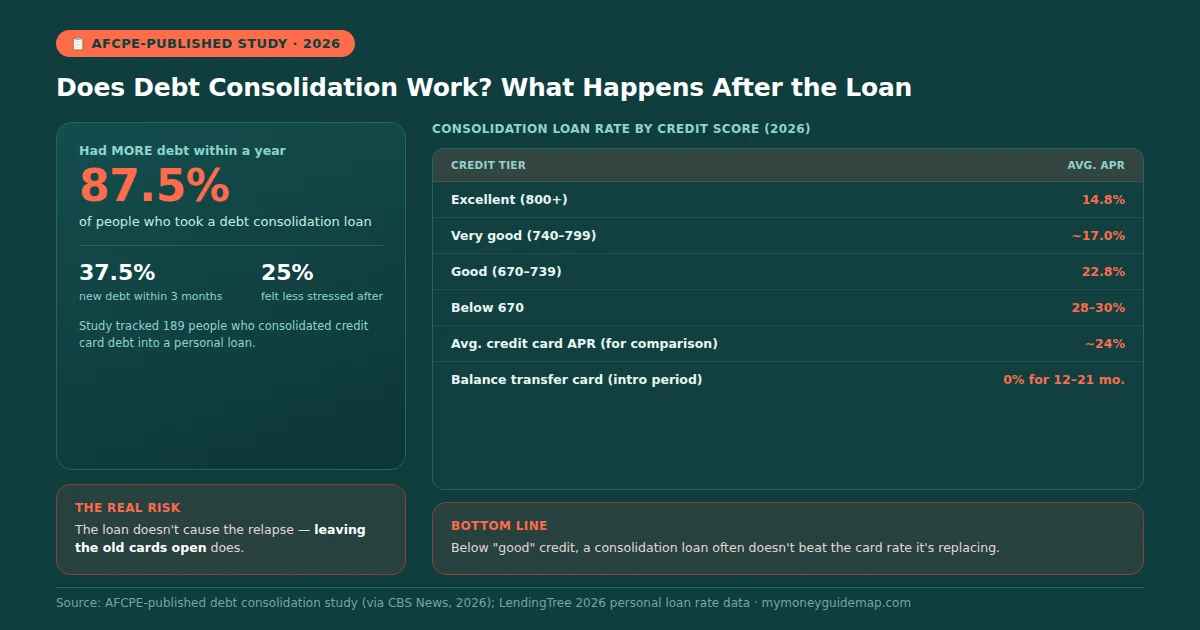
Does debt consolidation work long-term, or just short-term? That’s really a behavioral question more than a math one, and the uncomfortable part is that the warning isn’t just anecdotal. A study tracking 189 people who took out debt consolidation loans found that 37.5% had taken on new debt within three months, and 87.5% had more debt than before within a year. Only a quarter of them said they actually felt less financial stress afterward. Separate research using long-run national data found that people who consolidated were no less likely to end up in bankruptcy than people who never did. Neither of those numbers shows up in most debt consolidation guides, which tend to explain the mechanics of a loan without ever addressing what typically happens to the person holding it.
The Real Cost, By Credit Score
The math still matters, even if the psychology is the bigger risk. Average credit card interest rates are sitting around 24% right now, and a debt consolidation loan only makes sense if it actually beats that. Rates vary sharply by credit tier: borrowers with excellent credit (800+) are seeing roughly 14.8% APR, very good credit (740-799) around 17%, good credit (670-739) closer to 22.8%, and anything below that creeping up toward 28-30% — a range where consolidation barely helps, or doesn’t help at all. A lower rate only pays off if the loan term isn’t stretched out so long that the extra months of interest cancel out the savings.
A personal loan isn’t the only route, either. Balance transfer cards are the other common option, usually offering 0% APR for 12 to 21 months before jumping to a regular rate in the high teens or twenties. That introductory window can beat any personal loan’s rate outright, but it comes with a real deadline: whatever balance is left when the promo period ends starts accruing interest at the full card rate, and a 3-5% transfer fee eats into the savings from day one. Either method only pays off if the balance actually gets paid down during the cheap window instead of being treated as a reset.
Does Debt Consolidation Work? Only Under These Conditions
None of this means consolidation is always a mistake. It tends to work when three things are true at once: the new rate is meaningfully lower than what’s being replaced, the loan or promo period has a fixed end date instead of an open-ended credit line you can keep tapping, and the old cards get closed, frozen, or set aside rather than left open for round two. That last part is the one the research keeps circling back to — the loan itself doesn’t cause the relapse, easy access to more credit does.
If closing or freezing the cards feels unrealistic, that’s usually a sign the real issue is the budget, not the interest rate, and a loan won’t fix it either way. In that case, a structured payoff plan like the debt snowball or debt avalanche method tackles the same balances without adding a new loan and a fresh credit check into the mix. It’s slower on paper, but it doesn’t come with the same relapse risk the consolidation data keeps turning up.
So does debt consolidation work? It isn’t a trick and it isn’t a trap by itself — it’s a tool that only works if the habit that built the debt actually changes along with the balance. Skip that part, and the numbers say you’re more likely to end up carrying two debts instead of one.