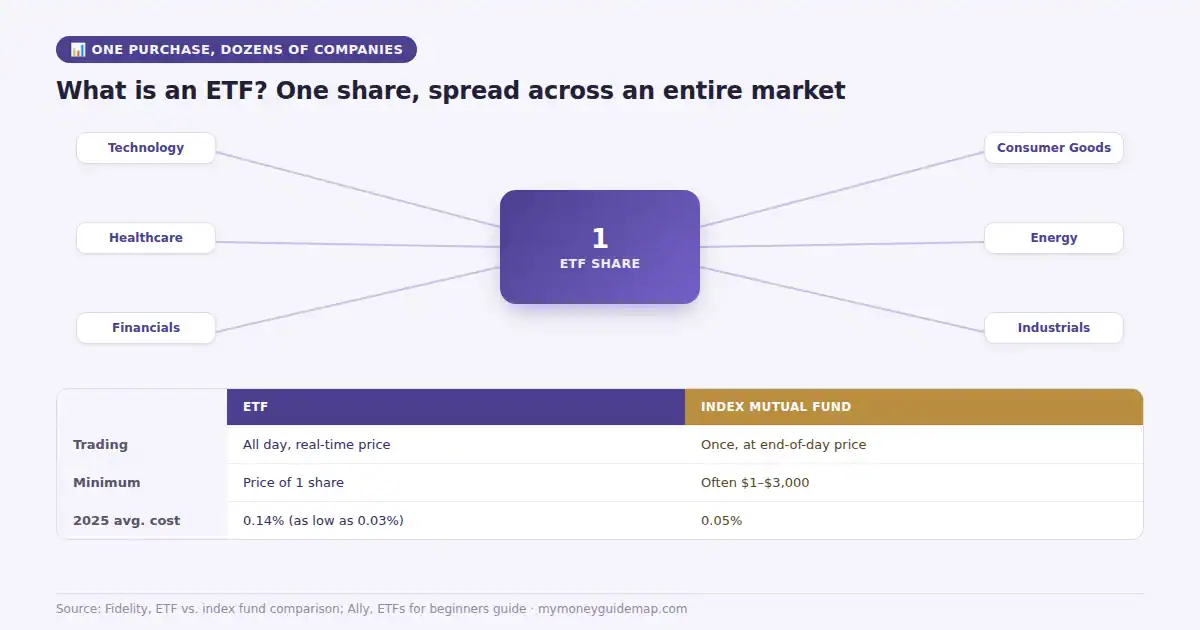
If you’ve heard coworkers or finance YouTubers talk about “just buying an S&P 500 ETF” and nodded along without really knowing what that meant, you’re not alone — what is an ETF, really, and why does everyone seem to recommend them for beginners? Short answer: an ETF (exchange-traded fund) is a single investment that holds a basket of stocks, bonds, or other assets, and trades on a stock exchange just like an individual share. Buy one, and you instantly own a small slice of everything inside it.
How an ETF Actually Works
Mechanically, what is an ETF made of? An ETF pools money from many investors to buy a collection of underlying securities — most commonly a set list of stocks that mirrors a market index like the S&P 500, though bond, commodity, and sector-specific ETFs exist too. Most ETFs are passively managed, meaning there’s no fund manager picking stocks; the fund simply tracks its target index. What makes an ETF different from a regular mutual fund is how you trade it: ETF shares trade on an exchange all day long, with prices moving in real time the same way a stock’s price does, instead of settling at one fixed price after the market closes.
ETF vs. Index Mutual Fund: The Real Differences
This is where most of the confusion comes from, since both ETFs and index mutual funds can track the exact same index. The trading mechanics are the biggest split: an ETF prices and trades continuously throughout the day, while an index mutual fund only transacts once, at the end-of-day price. Minimums matter too — most ETFs let you start with the price of a single share and nothing more, while index mutual funds commonly set minimums anywhere from $1 to $3,000. Cost is more nuanced than people assume: the cheapest core S&P 500 ETFs charge as little as 0.03% a year, but the category-wide average across all index ETFs (including pricier sector and thematic funds) was actually 0.14% in 2025, versus 0.05% for plain index mutual funds — so “ETF” alone doesn’t automatically mean cheaper, the specific fund does. ETFs also tend to be more tax-efficient, structurally avoiding some of the capital gains taxes that index mutual funds can pass on to remaining shareholders when other investors cash out.
What Is an ETF Actually Good For?
An ETF earns its popularity from one thing above all: instant diversification for very little money or effort. Buying a single ETF share can give you exposure to hundreds of underlying companies at once, so a bad day for any one stock barely moves your total. That makes ETFs a natural fit for a beginner’s first investment, for taxable brokerage accounts where the tax-efficiency edge matters most, and for anyone who wants to invest a specific dollar amount without hitting a mutual fund’s minimum. If you’re contributing automatically through a workplace 401(k), an index mutual fund is often the more practical choice instead, simply because most 401(k) platforms are built around mutual funds, not ETF trading.
The Downsides Nobody Mentions
ETFs aren’t risk-free just because they’re diversified. The fund’s share price can drift slightly away from the actual value of what it holds, especially during volatile trading. Returns are never guaranteed, even for an ETF tracking a broad, historically reliable index — the diversification protects you from any one company failing, not from the whole market falling. And while most brokerages now offer commission-free ETF trading, every ETF still charges its own ongoing expense ratio for as long as you hold it, so it pays to actually check that number instead of assuming every ETF is automatically cheap.
The Bottom Line
What is an ETF, in plain terms? It’s the easiest way to own a diversified slice of the market in one purchase, with the flexibility of stock-like trading and, usually, a lower cost than the alternative. It won’t outperform the market it tracks, and it isn’t a replacement for having an emergency fund or a plan for automating your savings before you start investing — but once those basics are covered, a broad, low-cost ETF is one of the simplest first steps into investing that most beginners will ever take.