If you’ve spent any time around personal finance content, you’ve probably noticed almost everyone eventually says some version of “just put it in an index fund.” It gets repeated so often it starts to sound like a slogan instead of an actual answer — which makes it worth actually unpacking what an index fund is, what it isn’t, and why it comes up so much.
What Is an Index Fund, Exactly?
At the simplest level, an index fund is a fund that’s built to track a specific market index — a defined list of stocks or bonds — rather than trying to beat it. If you buy a fund tracking the S&P 500, you’re not betting on any single company; you’re buying a small slice of all 500 companies in that index, in roughly the same proportions the index itself uses. The fund’s manager isn’t picking winners. They’re just replicating the list.
How That’s Different From an Actively Managed Fund
An actively managed fund works the opposite way. A manager (or a team) researches companies, forms opinions, and picks a smaller set of holdings they believe will outperform the broader market. You’re paying for that research and judgment, which shows up as a higher expense ratio — the annual fee taken out of your investment, expressed as a percentage.
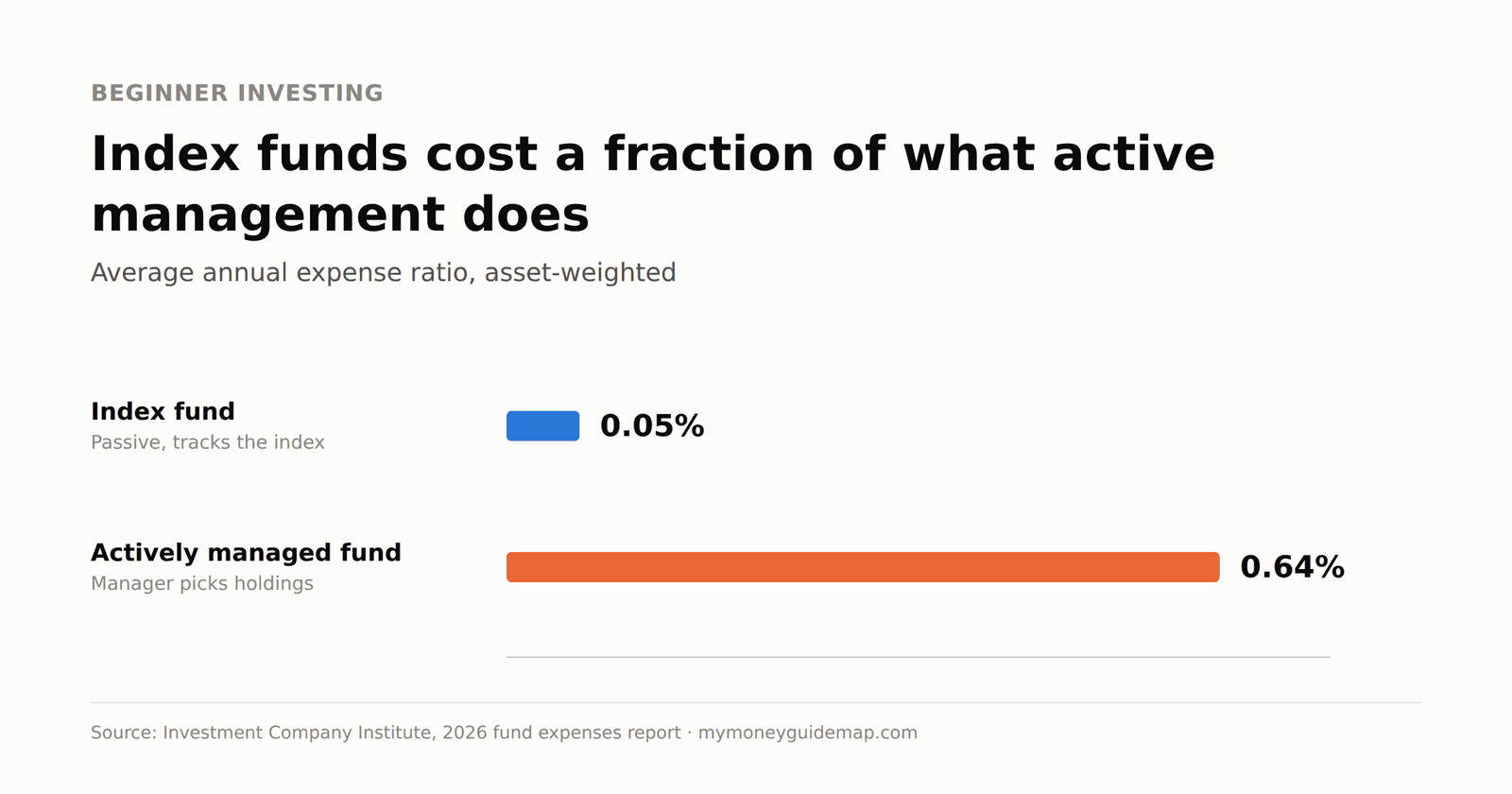
That fee gap is bigger than most people expect. According to the Investment Company Institute’s 2026 report on fund expenses, the average index equity mutual fund charges a 0.05% expense ratio, compared with 0.64% for the average actively managed equity fund. On a $10,000 balance, that’s roughly $5 a year versus $64 — not dramatic in isolation, but it compounds over decades right alongside your actual returns.
Why “Beat the Market” Is Harder Than It Sounds
The pitch for active management is that a skilled manager should be able to outperform a plain index, and sometimes, in a given year, some do. But S&P Dow Jones Indices’ SPIVA scorecard, which tracks this every year, found that 79% of actively managed large-cap U.S. equity funds underperformed the S&P 500 in 2025 alone — one of the worse years in the report’s 25-year history, though far from a one-off; the majority of active large-cap funds have underperformed the index in most years the scorecard has measured.
That’s not a guarantee about any specific fund or any future year — past results never are. It’s more that consistently picking the smaller set of managers who’ll beat the market, in advance, has turned out to be genuinely difficult, even for professionals doing it full-time. An index fund sidesteps that problem entirely by not trying to make the bet in the first place.
What an Index Fund Is Actually Good For
Because an index fund spreads your money across an entire index rather than a handful of picks, it gives you built-in diversification without having to research and buy dozens of individual stocks yourself. It’s also about as hands-off as investing gets — there’s no fund manager to evaluate, no strategy shift to keep track of, just the index doing what the index does.
That said, an index fund isn’t a savings account, and it isn’t meant to hold money you might need on short notice. Unlike the emergency fund you’d keep in a high-yield savings account, money in an index fund is exposed to the market, which means its value can and will drop, sometimes sharply, over any short stretch of time. It’s built for money you won’t need for years, not money you’re keeping on standby.
Who It Might Not Be the Right Fit For
If watching your balance dip during a market downturn is going to push you to sell at the worst possible time, that’s worth being honest with yourself about before you invest, regardless of how low the fees are. An index fund also won’t outperform the market by definition — it’s built to match it, not beat it, so anyone specifically chasing above-market returns is looking for something else entirely. And because index funds still hold stocks (or bonds, depending on the index), they’re not insured or guaranteed the way a bank deposit is.
The Takeaway
An index fund’s whole pitch is pretty unglamorous: track the index, keep costs low, don’t try to be clever. That’s exactly why it comes up so often in beginner-friendly personal finance advice — not because it’s exciting, but because the data on trying to beat the market consistently hasn’t been kind to the alternative. None of this is a recommendation to buy any specific fund; it’s just what the term actually means and why so many people default to it once they understand the mechanics.
3 thoughts on “What Is an Index Fund? A Beginner’s Explanation”