If you’ve got more than one debt sitting on your plate — a credit card, a store card, maybe a car loan — you’ve probably run into the debt snowball vs debt avalanche debate the second you decided to get serious about paying it off. It sounds like a bigger decision than it is. Really, it’s just two different orders to attack your debts in, and picking the one that actually fits how you operate can be the difference between finishing the job and quietly giving up around month four.
Here’s the short version. The debt snowball has you pay off your smallest balance first, regardless of interest rate, then roll that payment into the next-smallest, and so on. The debt avalanche has you go after whichever debt carries the highest interest rate first, regardless of how big or small the balance is. Same total dollars going toward debt every month either way — just a different order of attack.
What Each Method Actually Looks Like
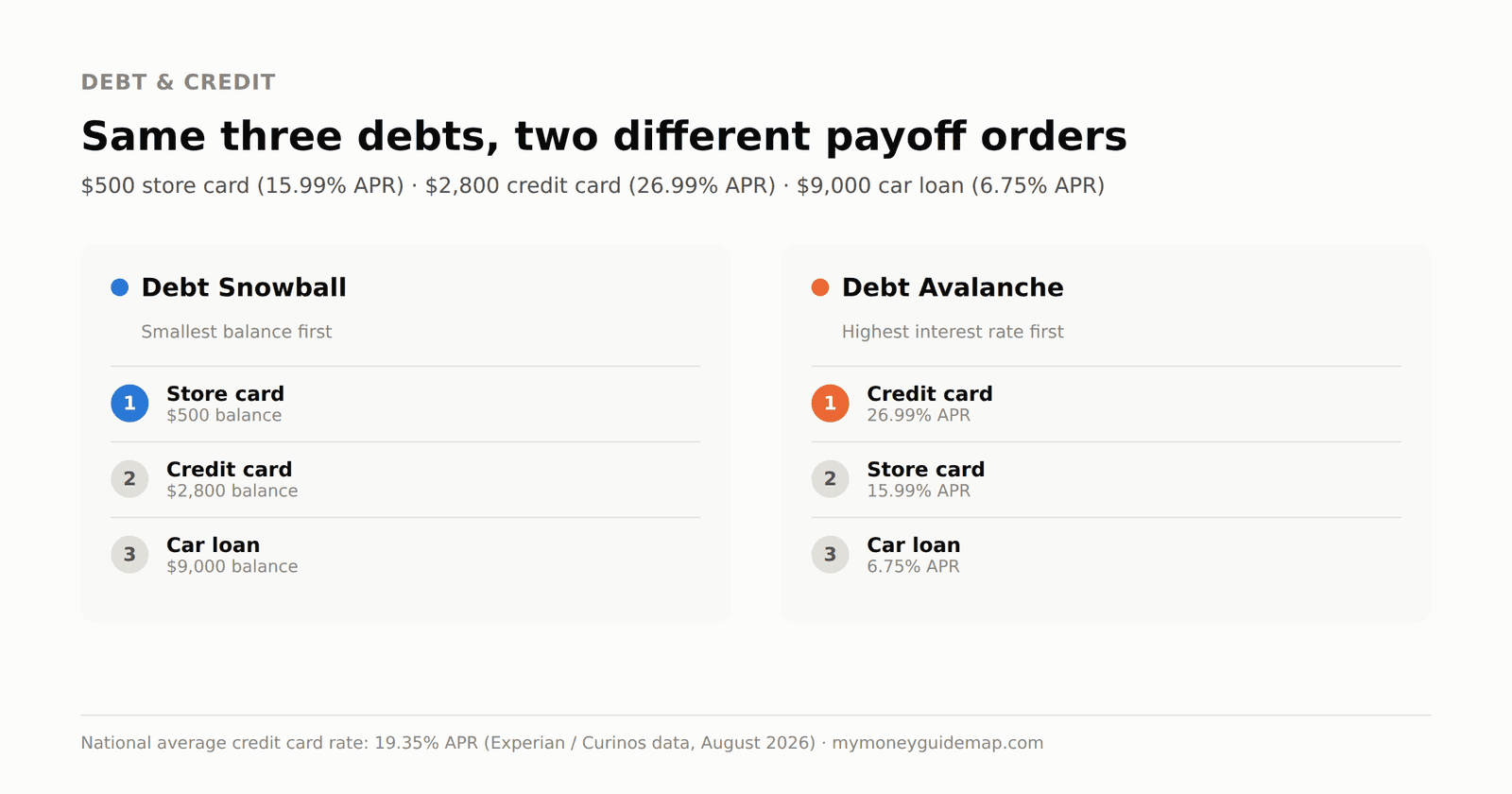
Say you’re carrying three debts: a $500 store card at 15.99% APR, a $2,800 credit card at 26.99% APR, and a $9,000 car loan at 6.75% APR. You’re paying the minimum on all three, plus you’ve found an extra $300 a month to throw at whichever one you tackle first — maybe it’s the debt-and-savings slice of a 50/30/20 budget, maybe it’s just money you tracked down by tightening up elsewhere.
Under the snowball, that $300 goes straight at the $500 store card, since it’s the smallest balance — you’d likely clear it in a couple of months. Under the avalanche, that same $300 goes at the credit card instead, since 26.99% is by far the most expensive rate of the three, even though it’ll take longer to feel like real progress.
The Math Behind the Avalanche
The avalanche wins on pure math, and it’s not close. That 26.99% card isn’t just a big number — it’s nearly 8 points above the current national average credit card rate of 19.35% (per Experian’s tracking of Curinos data as of August 2026). Every month that balance sits there untouched, it’s accruing interest faster than almost anything else in your budget, which is exactly why avalanche math says to go after it first: you save the most in interest per dollar of extra payment.
The snowball, by comparison, can genuinely cost you more in total interest over the life of your payoff plan, especially if that smallest balance also happens to carry a low rate — like the store card in the example above.
Why the Snowball Still Wins for a Lot of People
So if the avalanche saves more money, why does it lose the popularity contest? Mostly because paying off debt isn’t only a math problem — it’s a motivation problem, and most people who quit their debt payoff plan don’t quit because the math stopped working. They quit because it stopped feeling like it was working.
Ramsey Solutions, which popularized the snowball method, argues exactly this: the avalanche might be mathematically optimal, but the snowball’s quick wins — clearing that first small balance in a matter of weeks — build the kind of momentum that actually keeps people showing up month after month. A method that’s 5% more efficient on paper doesn’t help much if you abandon it in month six.
So Which One Should You Actually Use
If you’re the type who needs to see a debt disappear completely to stay motivated, the snowball is probably worth the extra interest cost — it’s buying you consistency, and consistency is what actually gets debt paid off. If you’re more numbers-driven and a shrinking balance on a spreadsheet is motivating enough on its own, the avalanche will get you there for less money overall.
Neither one is the “responsible” choice and the other the “lazy” one — they’re just optimizing for different things. And you’re not locked in forever: plenty of people start with a snowball to build momentum on a few small debts, then switch to avalanche logic once the easy wins are gone and only the bigger, higher-rate balances are left.
A Few Things That Trip People Up
The extra payment only works if it’s actually extra — this only functions on top of a budget where you already know where that $300 (or whatever your number is) is coming from every month, which is really the same exercise as giving every dollar in your budget a job before you spend it. Without that, “extra” money has a way of disappearing before it reaches the debt at all.
It’s also easy to forget that neither method does anything about new debt. If the credit card you just paid off creeps back up because spending habits haven’t changed, you’re not paying off debt — you’re just moving it around. And minimum payments on every other balance still need to happen on time throughout, regardless of which method you’re using, since a missed minimum payment does real damage to your credit that neither snowball nor avalanche math accounts for.
Pick the One You’ll Actually Stick With
The debt snowball vs debt avalanche question isn’t really a math question — it’s a “which version of me is actually going to stick with this” question. Run the numbers if you want to know exactly what each approach would cost you in interest, but don’t let the spreadsheet override what you already know about yourself. The method you’ll actually finish beats the method that’s theoretically 4% cheaper and abandoned by spring.
5 thoughts on “Debt Snowball vs. Debt Avalanche: Which One Actually Gets You Out of Debt Faster?”