If you’ve been putting off checking your credit report because you’re worried an old hospital bill is dragging your score down, here’s the real answer: whether medical debt on your credit report can still hurt you depends on which state you live in, how much you owe, and whether it’s already been paid — not on the sweeping federal ban you may have read about last year.
In January 2025, the Consumer Financial Protection Bureau finalized a rule that would have wiped roughly $49 billion in medical debt off the credit files of an estimated 15 million Americans. It never took effect. A federal court in the Eastern District of Texas vacated the rule in July 2025, ruling that the CFPB had exceeded its authority under the Fair Credit Reporting Act, which explicitly allows medical debt to be reported in coded form. So if a blog post or a friend told you medical debt on your credit report is gone for good nationwide, that’s the rule that got struck down, not the current state of things.
What Actually Determines Medical Debt on Your Credit Report Today
The three major credit bureaus still apply their own voluntary policies, separate from the failed federal rule, and these are what actually protect most people. Paid medical collections are removed from reports entirely rather than lingering as a settled account. Unpaid medical collections under $500 don’t get reported at all. And for anything above that threshold, there’s a full 12-month grace period after the bill goes to collections before it can appear on your report — time that’s meant to let insurance disputes and billing errors get sorted out before they touch your score.
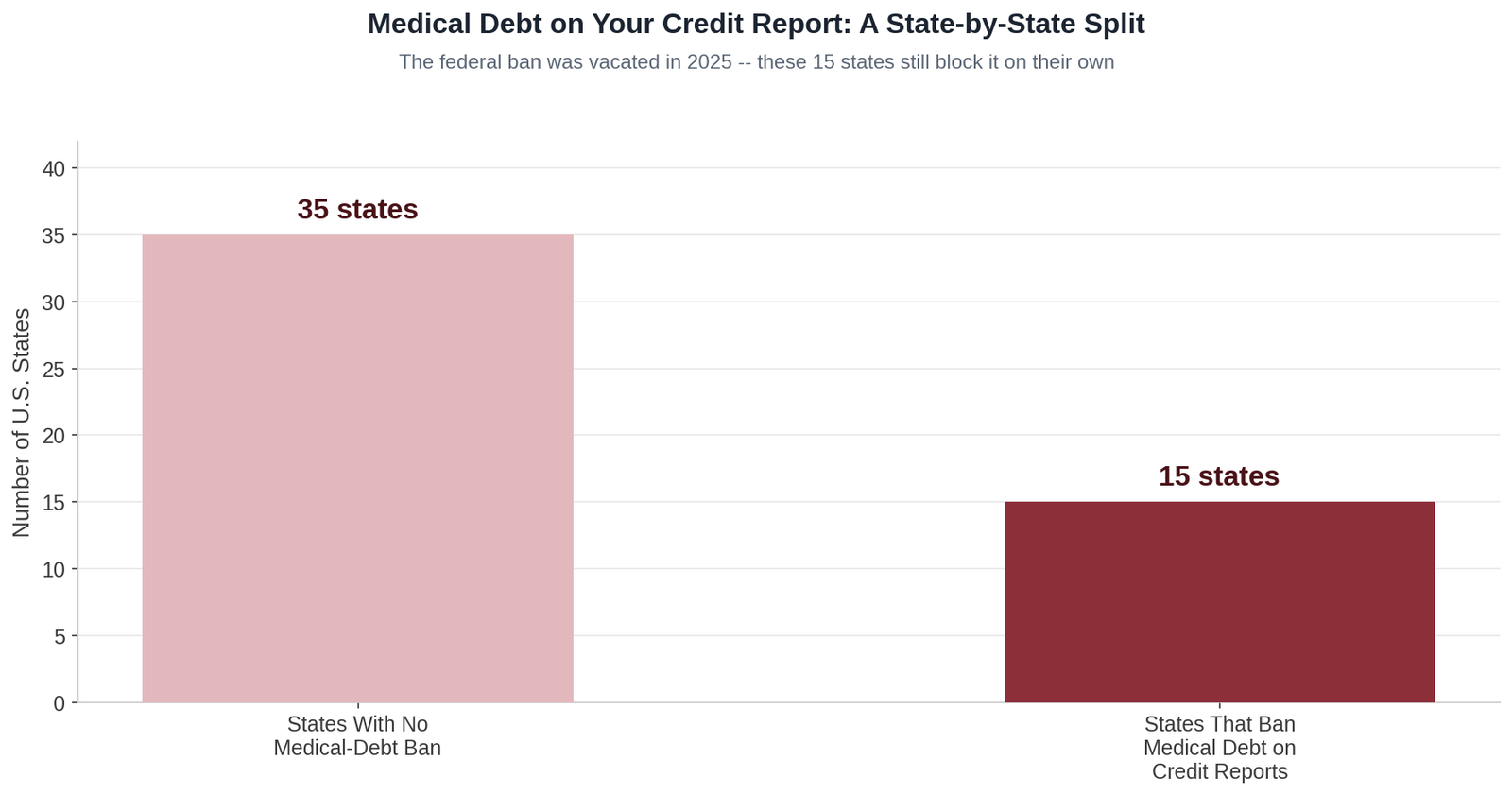
Where you live changes the picture further. Fifteen states — California, Colorado, Connecticut, Delaware, Illinois, Maine, Maryland, Minnesota, New Jersey, New York, Oregon, Rhode Island, Vermont, Virginia, and Washington — have their own laws barring medical debt from appearing on a resident’s credit report at all, regardless of the amount or payment status. Whether federal law actually preempts those state protections is still legally unsettled; no court has ruled on it directly, so for now residents of those states can rely on the stronger local rule.
That combination means the real answer to whether medical debt on your credit report is hurting your score comes down to three questions: is it paid, is it under $500, and is it less than a year old. A $1,200 unpaid ER bill from eight months ago in Texas is still invisible to lenders right now — not because of the CFPB rule, but because of the bureaus’ own 12-month grace period. That same bill at month 14 would be fair game unless a state law says otherwise.
There’s also a scoring-model layer worth knowing about, separate from whether the debt appears at all. Newer credit scoring models — FICO 9 and FICO 10, along with VantageScore 4.0 — already weigh medical collections less heavily than other kinds of collections, and ignore paid medical collections entirely. The catch is that plenty of lenders, especially mortgage lenders, still pull older FICO versions that don’t make that distinction, so the same medical collection can barely dent one lender’s view of you while meaningfully lowering another’s.
None of this erases the debt itself. A vacated credit-reporting rule doesn’t cancel what’s owed, and a hospital or collection agency can still pursue payment, send it to a debt collector, or in rare cases sue, even if the bureaus never learn about it. The protections here are specifically about what lenders can see when they pull your file, not about whether the bill still needs to be paid.
If you’re dealing with a medical bill heading toward collections, the moves worth making are the same regardless of which rule is currently in effect: request an itemized bill and check it against your insurance explanation of benefits for errors, ask the provider’s billing office about a payment plan or financial-assistance program before the account is sold to a collector, and dispute it directly with the bureau if it’s under $500, already paid, or you’re in one of the fifteen protected states — those are fixable errors, not judgment calls.
For a broader look at what’s actually sitting on your file and how to catch mistakes like this one, our guide on how to read your credit report walks through each section line by line. Medical debt on your credit report is one of the more commonly misreported categories, alongside duplicate collections accounts and old debts that should have aged off entirely.
The safest habit going forward is checking your report every few months rather than assuming a headline about a federal rule change settled the question — between the bureaus’ own $500 floor, the 12-month window, and a patchwork of state laws that could shift again, medical debt on your credit report is one of the few areas where the actual rule depends entirely on where you live and what you owe.