If your paycheck has gone up twice in the last two years and your savings balance still looks the same as it did before either raise, lifestyle creep is almost certainly the reason — not one big purchase you can point to, just a steady drift where a slightly better apartment, a few more takeout orders, and a nicer car payment quietly absorbed the extra money before it ever reached a savings account.
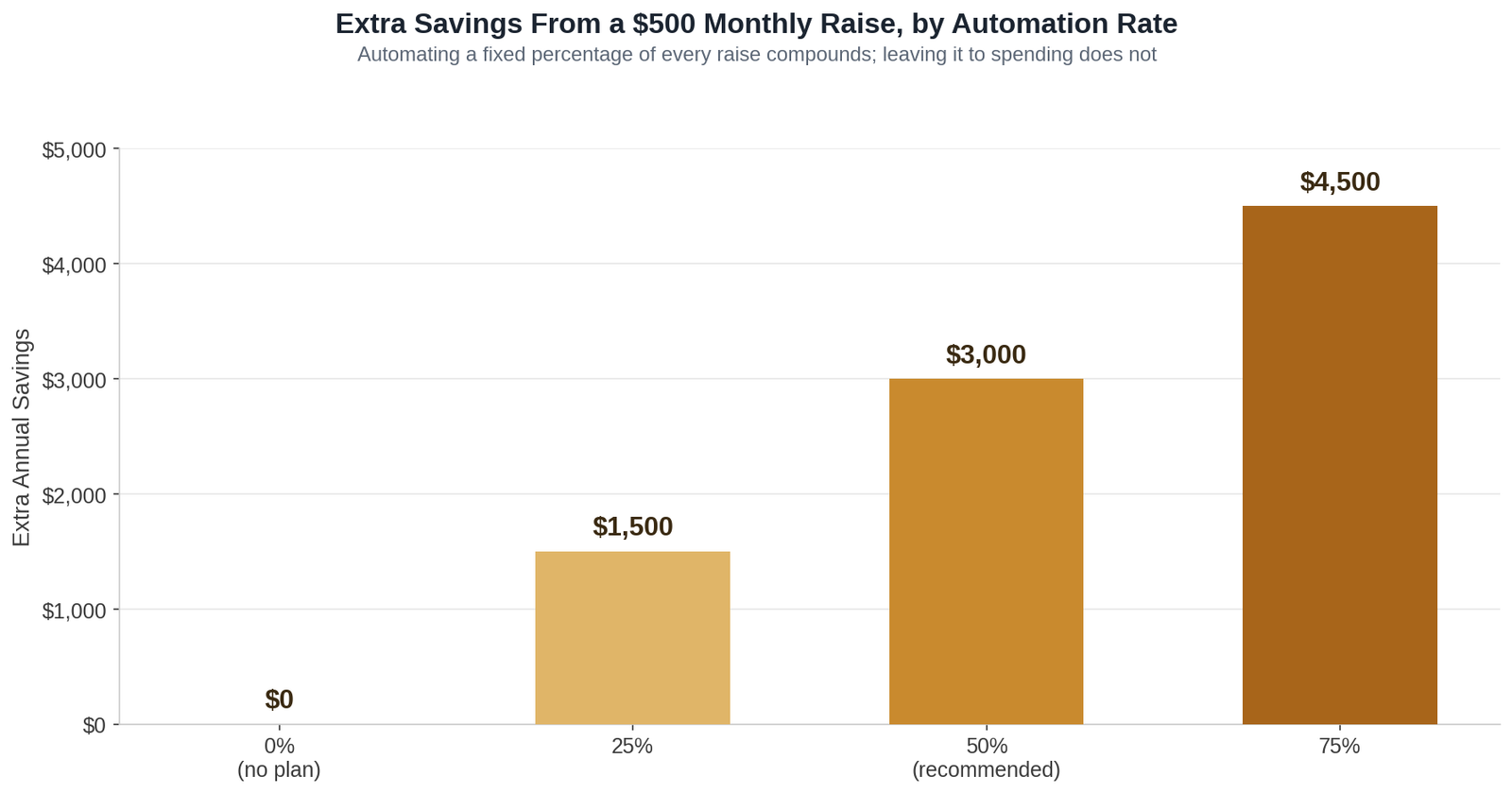
Lifestyle creep is the gradual increase in spending that tracks — or outpaces — a rise in income, so that someone earning more ends up saving the same amount, or less, than they did before the raise. A person who gets a $500-a-month raise and lets all of it flow into upgraded everyday spending is $6,000 a year further from their goals than a person who banks even half of that same raise, even though both started from an identical paycheck bump.
How Lifestyle Creep Quietly Erases a Raise
The mechanism is almost always automatic rather than deliberate. Because nothing forces a decision at the moment a raise arrives, the extra money defaults into whatever spending category is easiest to expand — a higher rent tier at the next lease renewal, a pricier grocery cart, a subscription or two that didn’t exist last year. Financial planners increasingly recommend treating that decision as mandatory rather than optional: automating at least half of any net income increase into savings the moment it happens, so a $500 raise becomes $250 redirected before it ever reaches a checking account and $250 left to actually enjoy.
This isn’t only a lower-income problem. A widely cited Goldman Sachs survey found that 40% of households earning $500,000 or more still described themselves as living paycheck to paycheck, which is lifestyle creep operating at a different order of magnitude rather than being absent. Spending tends to expand to fill whatever income becomes available unless something is deliberately set aside first, regardless of what that income actually is.
A simple way to spot lifestyle creep before it compounds for another year is to compare last year’s take-home pay against last year’s savings rate, then do the same math for this year. If income rose but the percentage actually saved didn’t, or fell, that gap is lifestyle creep showing up in the numbers rather than staying an abstract idea — and it’s far easier to correct one year in than after five years of raises have each been fully absorbed into a correspondingly higher cost of living.
Part of what makes this pattern so easy to miss is that it rarely announces itself. As one financial wellness expert put it, “you feel the need to buy something at a higher price point than you would have in the past” — the comparison point shifts along with the paycheck, so last year’s normal purchase starts to feel like it’s beneath the new budget, even though nothing about the underlying need actually changed.
The fix that tends to hold up is making the split automatic rather than relying on willpower after the money has already landed in a checking account. Redirecting a fixed percentage of income to savings — rather than a fixed dollar amount — means the savings rate scales up right alongside every future raise instead of staying frozen at an old number while spending keeps climbing on its own.
None of this means every spending increase after a raise is a problem to fix. It’s fine to upgrade a lifestyle deliberately, as long as the new baseline is one a budget can sustain rather than one that only works as long as the next raise arrives on schedule. A useful gut check is whether a 30% drop in income tomorrow would force painful, immediate changes — if it would, spending has likely outrun what the underlying income can safely support, whatever the dollar figures happen to be.
Automating that first move is exactly the same principle behind paying yourself first — our guide to the pay-yourself-first method covers how to structure that transfer so saving happens before spending gets the chance to expand into new territory.
The moment to interrupt lifestyle creep is always the same one: right when a raise, bonus, or new source of income first arrives, before a single dollar of it has a chance to become the new normal. Deciding in advance what percentage moves straight to savings — and setting that transfer up the same day the raise takes effect — is the difference between a raise that actually changes your financial position and one that just changes what an ordinary month costs.
None of this requires giving up every upgrade a bigger paycheck makes possible. It just means the upgrade gets chosen on purpose, after the savings transfer is already scheduled, instead of happening by default because the money was sitting in a checking account with nowhere else assigned to go.