If you’re looking at your brokerage account right now and wincing at a position that’s worth less than what you paid for it, tax-loss harvesting is the one piece of good news buried in that bad number — it’s the strategy that turns a paper loss into an actual tax break, and late in the year is exactly when it matters most.
The mechanics are simpler than the name suggests: you sell an investment that’s lost value, realize that loss for tax purposes, and use it to offset capital gains elsewhere in your portfolio. If your losses exceed your gains, the IRS lets you use up to $3,000 of the excess to offset ordinary income each year (married filing separately is capped at $1,500), and anything above that simply carries forward to next year rather than disappearing. A retiree with a large gain from selling a rental property and a beaten-down tech stock sitting in the same brokerage account has a genuine reason to look at this before December 31.
How Tax-Loss Harvesting Actually Lowers Your Tax Bill
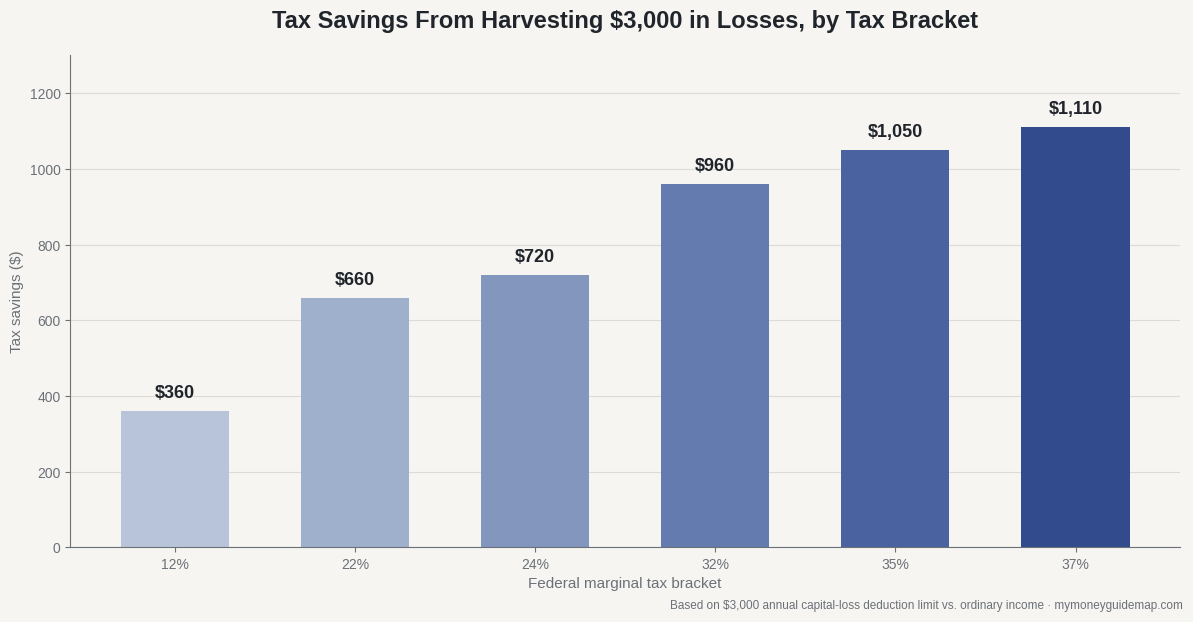
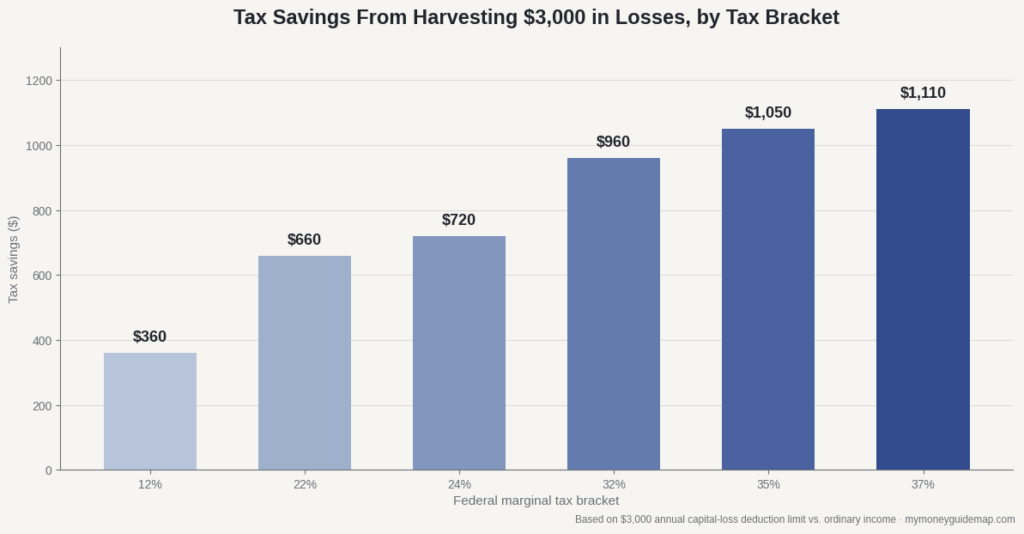
The dollar math is what makes this worth the paperwork. Someone in the 24% federal bracket who harvests $5,000 in losses and has no capital gains to offset that year can still apply $3,000 of it against ordinary income, worth about $720 in real tax savings, with the remaining $2,000 carried into next year’s return. Someone who does have $5,000 in gains elsewhere in the portfolio can offset the entire amount dollar-for-dollar, which is usually the more valuable use of a loss if you have a choice.
There’s a catch that trips up a lot of people doing this for the first time: the wash sale rule. If you buy a “substantially identical” security within 30 days before or after the sale that generated your loss, the IRS disallows the loss entirely for that tax year. Selling a losing S&P 500 index fund and immediately buying a different S&P 500 index fund from another provider can still count as substantially identical enough to trigger this, so the safer move is to wait out the 30-day window or swap into a similar-but-not-identical fund (a total-market fund instead of an S&P 500 fund, for instance) if you don’t want to be out of the market during that stretch.
One genuine quirk in current tax law: the wash sale rule doesn’t apply to cryptocurrency. Bitcoin, Ethereum, and other digital assets are classified as property rather than securities, so an investor can sell a losing crypto position and buy it right back the same day without losing the deduction — a real asymmetry between how the tax code treats crypto losses and how it treats stock or fund losses, and one that’s been discussed as a closing loophole for several years without actually closing yet.
This only works inside a taxable brokerage account. Losses inside a 401(k), traditional IRA, or Roth IRA don’t get realized for tax purposes at all, since those accounts already grow tax-deferred or tax-free — there’s nothing to harvest because there was never a current-year tax bill on the gains in the first place. If most of your investing happens inside a workplace retirement account, tax-loss harvesting isn’t a tool you’ll use much, and that’s fine; it’s a taxable-account strategy, not a universal one.
It’s also not something to force. Tax-loss harvesting works best as a byproduct of a portfolio review, not a goal in itself — selling a solid long-term holding purely to generate a loss, then scrambling to find a replacement investment, usually costs more in bad decision-making than it saves in tax. The strategy works best on a position you’d already reconsidered holding, or one where a similar substitute investment is easy to identify. Frequent, mechanical harvesting inside a small account can also rack up trading costs and complexity that eat into whatever the deduction was worth in the first place.
For anyone weighing whether a brokerage account or a retirement account is the better place to keep building wealth this year, it’s worth understanding what a brokerage account actually offers beyond this one tax maneuver — our guide to what a brokerage account is walks through the tradeoffs in more detail.
The practical deadline that matters here is the calendar, not the tax filing date: any sale has to settle by December 31 to count for this year’s return, so late December is genuinely too late to start looking. Reviewing your taxable holdings sometime in November, while there’s still time to sell, wait out the wash sale window if needed, and confirm the trade actually settled, is the realistic way to put tax-loss harvesting to use instead of just knowing the term exists.