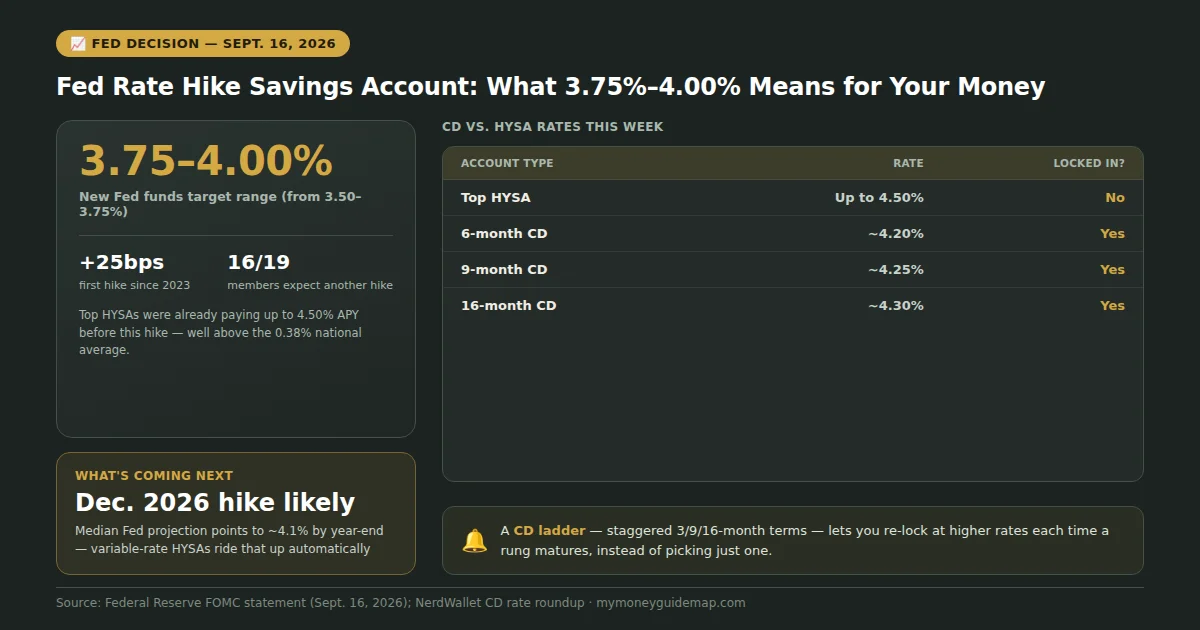
Fed rate hike savings account math changed overnight on September 16, 2026, when the Federal Reserve raised its benchmark rate by 25 basis points to a range of 3.75%-4.00% — the first increase since 2023, and a reversal after two straight years of cuts. Sixteen of nineteen FOMC members now expect at least one more hike before year-end, with the median projection landing near 4.1%. If you’ve got money sitting in a savings account, this isn’t background noise — it’s the first rate move in years that could actually grow your balance faster, and most coverage so far has explained why the Fed hiked without explaining what to do about it.
Fed Rate Hike Savings Account: What It Actually Means
Here’s the mechanic most articles skip: your bank doesn’t have to move its savings rate at all, and if it does, it won’t move it on the same day. High-yield savings accounts (HYSAs) are variable-rate products, so banks typically adjust their APY within one to three weeks of a Fed decision, and only if it’s competitively necessary. The top nationally available HYSAs were already paying up to 4.50% APY the week before this hike, well above the 0.38% national average, so a 25-basis-point Fed move gives well-priced online banks room to nudge rates up without cutting into their margin. If your account is still paying under 3%, that gap is the actual cost of not moving your money — not the Fed decision itself.
CD vs. High-Yield Savings After the Rate Hike
A fed rate hike savings account comparison is where most coverage stops short: it says “consider both” without running the actual numbers. A representative snapshot from this week shows 6-month CDs around 4.20%, 9-month CDs around 4.25%, and longer 16-month terms around 4.30% — all in the same range as top HYSAs, but locked in. The tradeoff is real: break a CD early and you typically forfeit three to six months of interest on terms under a year, and up to twelve months on longer ones, while a HYSA lets you withdraw penalty-free at any time. Both are FDIC-insured up to $250,000 per depositor, per bank, so safety isn’t the deciding factor — access is. If the Fed follows through on the additional hike it’s signaling for December, a HYSA’s variable rate rides that increase up automatically; a CD you open today does not.
The CD Ladder Strategy Nobody’s Covering
None of the major coverage of this fed rate hike savings account moment mentions laddering, even though it directly answers the CD-versus-HYSA dilemma above. A ladder means splitting your CD money across staggered terms — say, 3-month, 9-month, and 16-month CDs instead of one lump sum — so a portion matures every few months. Each time one matures, you either reinvest it at whatever the new top rate is or move it if you need the cash. That gives you most of a CD’s higher locked-in rate while keeping partial liquidity, which matters specifically right now: if December brings the hike the Fed is projecting, a short rung maturing in November lets you re-lock at the new, higher rate instead of sitting in a 2025-priced CD for another year.
What to Actually Do With Your Money Now
The honest verdict: don’t treat this Fed rate hike savings account moment as a one-time action and move on. If your current APY starts with a 2 or a 3, switching to a top-tier HYSA is worth doing regardless of what the Fed does next, since that gap compounds every month you wait. For money you won’t touch for six to eighteen months, a short CD ladder captures today’s locked-in rate while leaving room to re-lock higher if December’s hike materializes. And if building the habit of moving money into savings automatically is the part you actually struggle with, How to Automate Your Savings covers how to set that up so you’re not relying on remembering the next Fed announcement to act.
This rate hike won’t be the last move of 2026, and the accounts paying the most today won’t necessarily be paying the most in December — the only real mistake is leaving money parked somewhere that never adjusts at all.