The 30% rent rule says to spend no more than 30% of your gross income on rent, and it gets repeated so often in budgeting advice that it’s easy to assume it’s some kind of financial law. It isn’t. The number actually traces back to federal housing policy from 1937, and in 2026, most renters aren’t even hitting it.
Where Did the 30% Rent Rule Actually Come From?
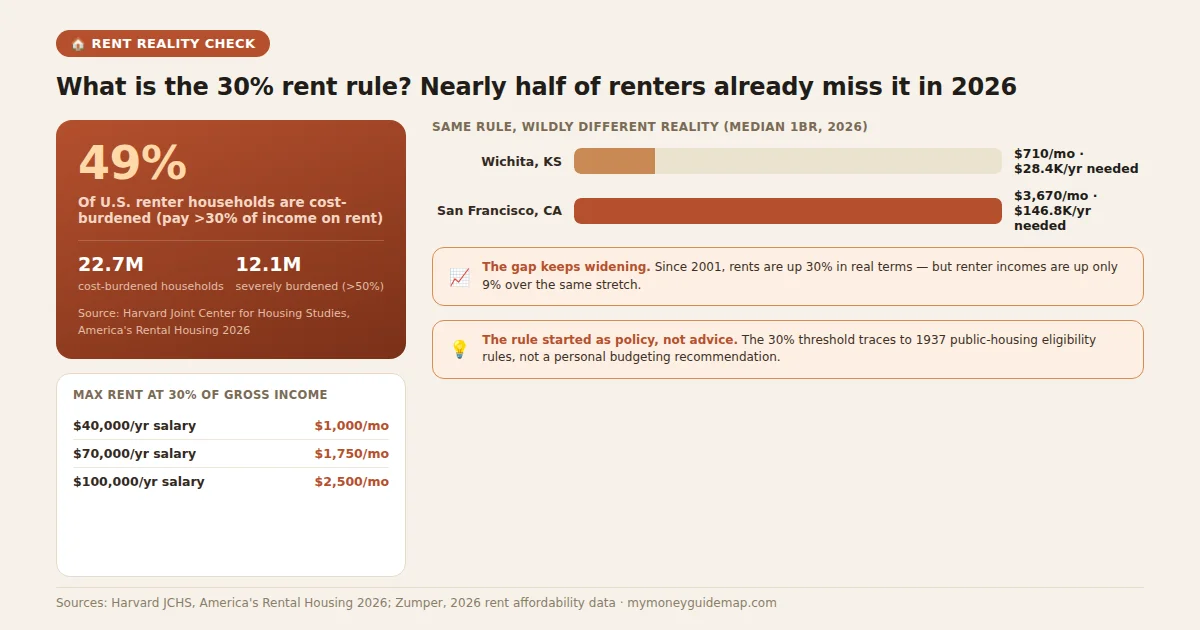
The 30% rent rule didn’t start as personal budgeting advice at all. The National Housing Act of 1937 set an income threshold for public housing eligibility at 20% of income; that threshold rose to 25% under a 1969 amendment, then climbed to its now-familiar 30% by 1981. In other words, the guideline began as a federal eligibility cutoff for subsidized housing, not a target anyone was supposed to build a household budget around — it drifted into everyday financial advice over the following decades because it was simple, memorable, and roughly in the right neighborhood for a lot of renters at the time.
How to Calculate Your Own Number
The math behind the 30% rent rule is simple: multiply your gross monthly income by 0.30. Someone earning $70,000 a year (about $5,833 a month) would land at a maximum of roughly $1,750 in rent under the rule. Here’s how that scales across a few common income levels:
| Annual Gross Income | ||
Worth noting: this formula uses gross (pre-tax) income, not take-home pay, so the actual share of a paycheck that disappears into rent is meaningfully higher than 30% once taxes come out.
What Are Renters Actually Paying in 2026?
Whether that 30% number is realistic depends enormously on where you live. In Wichita, Kansas, the median one-bedroom rents for about $710 a month, requiring roughly $28,400 a year to stay at the threshold. In San Francisco, that same one-bedroom runs about $3,670 a month — needing close to $146,800 a year to hit the same 30% mark. That’s a more than five-fold gap in required income for the identical guideline to hold across two U.S. cities.
Nationally, the picture is worse than the rule assumes. Harvard’s Joint Center for Housing Studies found that 22.7 million renter households — 49% of all renters — were cost-burdened in 2024, meaning they spent more than 30% of income on rent and utilities combined. Of those, 12.1 million (26%) were severely cost-burdened, spending over half their income on housing. The gap has been widening for decades: since 2001, rents have climbed 30% in real terms while renter incomes have grown only 9%, leaving lower-income renters with far less breathing room in their budgets than a generation ago.
Is This Guideline Still Useful, or Just a Reminder of How Far Off Most Budgets Are?
With roughly half of all renters already over the line, the 30% rent rule works less as an achievable target for many households and more as a diagnostic — if your rent is eating 35% or 40% of your paycheck, that’s not automatically a sign you’re managing money badly; it’s consistent with what’s happened to the broader rental market over the last two decades. It’s also worth noting that the rule as usually quoted only covers rent itself, not utilities, renter’s insurance, or parking. That’s part of why the 50/30/20 budgeting method treats housing as one piece of a broader 50% “needs” bucket rather than its own line — under that framework, rent alone ideally sits closer to 25–28%, leaving room for the costs that come bundled with it.