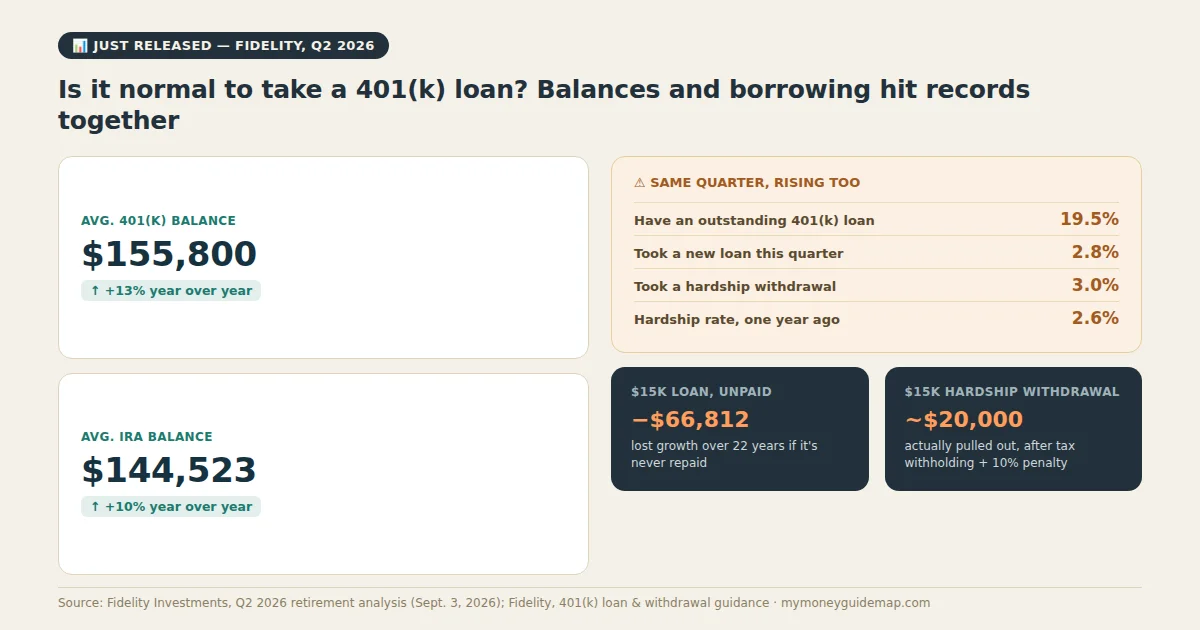
Is it normal to take a 401(k) loan, or does reaching into retirement savings mean something’s gone wrong? A new report released this week by Fidelity says both things are true at once. The average 401(k) balance hit $155,800 in the second quarter of 2026, up 13% from a year earlier, and the average IRA climbed to $144,523. But in that same quarter, 19.5% of participants had an outstanding 401(k) loan, 2.8% took out a new one, and 3% took a hardship withdrawal — up from 2.6% the year before. Balances and borrowing are both climbing together, and that combination is worth understanding before you decide whether it applies to you.
Is It Normal to Take a 401(k) Loan When Balances Are This High?
The record numbers aren’t just market gains. The combined employee-employer contribution rate averaged 14.4% this quarter, and 81.2% of participants saved enough to capture their full employer match — most people are doing the saving part right. So is it normal to take a 401(k) loan even while all of that is going well? For close to one in five people, apparently yes. A financial planner quoted in the coverage put it plainly: rising hardship withdrawals point to “greater pressure on household finances,” meaning some of this borrowing isn’t optional — it’s what’s left after other options ran out.
That’s the real story underneath the record balances: growth at the top of the account and financial strain at the bottom aren’t contradictory. They’re often happening inside the same generation, sometimes the same household, at the same time.
What a 401(k) Loan Actually Costs You
A loan against your own 401(k) sounds harmless — you’re paying yourself back, not a bank. But Fidelity’s own guidance lays out the real cost: you generally have to repay the loan, plus interest, within five years, and if you change jobs before then, you may have to repay the full balance in a very short window. Miss that, and the unpaid amount is treated as a distribution — taxed as income, plus a 10% penalty if you’re under 59½. Fidelity’s own example shows what the money would have been worth left alone: a $15,000 loan taken today could mean roughly $66,812 less in the account 22 years from now, purely from the growth you gave up while the money was out.
A hardship withdrawal is worse. It’s not a loan at all, so there’s no version where you pay yourself back — the money is simply gone from the account, permanently, and it’s taxed as ordinary income on top of that same 10% early-withdrawal penalty. Needing $15,000 in hand can mean pulling closer to $20,000 out of the account once federal withholding, state tax, and the penalty are all subtracted. It’s worth separating the two before deciding: is it normal to take a 401(k) loan versus a hardship withdrawal are really two different questions with two very different price tags attached.
When This Actually Makes Sense — and When It Doesn’t
None of this means a 401(k) loan is always the wrong call. Compared to high-interest credit card debt or a payday loan, borrowing from yourself at a modest rate you’re paying back to your own account can genuinely be the cheaper option in a real emergency, especially if you’re confident your job is stable through the repayment window. Is it normal to take a 401(k) loan for a true emergency — a medical bill, an eviction notice, a car repair you need to get to work? Fidelity’s numbers suggest it’s common enough that you’re far from alone in it.
It’s a different story when the loan is covering a discretionary expense — a vacation, a renovation that could wait, a purchase with a payment plan already available elsewhere. That’s where the five-year clock and the job-change risk stop being worth it, and where the better move is finding another way to cover it, even if that means waiting. Building a cash emergency fund separate from retirement savings is the step that keeps this decision from coming up in the first place — the record balances this quarter are proof the saving habit is there for most people; the loan and withdrawal numbers are proof it’s worth protecting with a cushion the retirement account was never meant to be.
1 thought on “Is It Normal to Take a 401(k) Loan? Best 2026 Numbers”