If you’ve outgrown your basic savings account but aren’t ready for anything that ties your money up, you’ve probably run into this question already: what is a money market account, and is it actually worth switching to? Short answer — it’s a hybrid savings product that pays more interest than a typical savings account while still letting you write checks or swipe a debit card against the balance. The longer answer depends on how much you’re saving and how often you need to touch it.
How a Money Market Account Actually Works
A money market account (MMA) is a bank or credit union deposit account, not an investment product, despite the similar-sounding name to money market mutual funds. You deposit cash, the bank pays you interest — usually a variable rate tied to the Federal Reserve’s benchmark rate — and your money stays fully liquid. What separates it from a plain savings account is the access: most money market accounts come with check-writing privileges and a debit card, something a standard savings account almost never offers. In exchange, banks typically ask for a higher minimum balance to open the account or to avoid a monthly fee, so it isn’t always the cheapest entry point if you’re starting from very little.
Money Market Account vs. Savings Account: The Real Differences
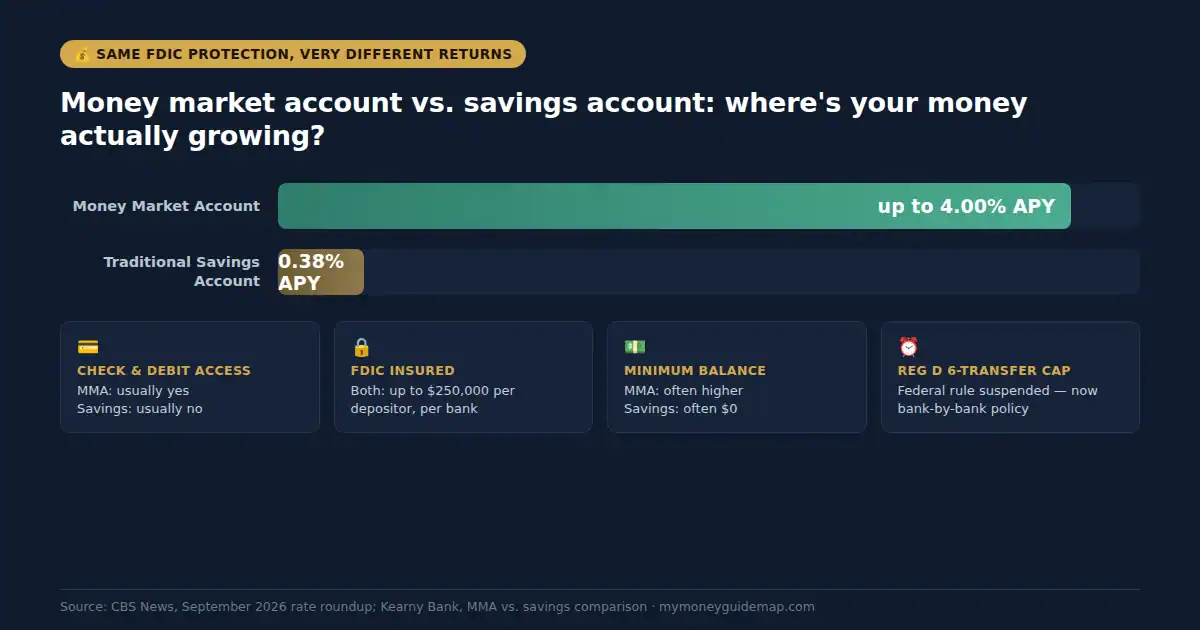
To really answer what is a money market account, it helps to compare it directly against the account most people already have: a plain savings account. The rate gap is the headline difference right now. Top money market accounts are paying in the 3.80%–4.00% APY range this year, while the average traditional savings account is stuck around 0.38% — more than ten times lower. Both account types carry the same FDIC insurance, up to $250,000 per depositor, per bank, per ownership category, so safety isn’t the deciding factor. What actually decides it is access and minimums: a savings account is simpler, usually has a lower (or no) minimum balance, and is built for pure set-it-and-forget-it saving. A money market account rewards a larger balance with a better rate and gives you check-writing or debit access for the occasional larger expense, without forcing you into a full checking account.
The Withdrawal Rule Everyone Gets Wrong
For years, money market accounts were capped at six withdrawals or transfers per month under a federal rule called Regulation D. That federal cap was suspended back in 2020, so it’s no longer a legal requirement — but plenty of banks quietly kept their own six-transaction limit anyway, often charging $5 to $15 per transaction over it. The catch is that this is now a bank-by-bank policy, not a federal rule, which means the limit (or lack of one) is genuinely different depending on where you open the account. Before you open a money market account anywhere, it’s worth checking that bank’s specific transaction policy rather than assuming the old six-per-month rule still applies everywhere — because in-branch withdrawals, ATM withdrawals, and mailed checks usually don’t count toward it either way.
What Is a Money Market Account Best For?
A money market account tends to make the most sense for money you want growing at a real rate but might still need on short notice — think a house down payment fund, a large upcoming expense, or savings beyond what your emergency fund already covers. If you’re building your very first emergency fund from a small starting balance, a no-minimum high-yield savings account is usually the easier, cheaper starting point, and you can graduate to a money market account once your balance clears the minimum comfortably. If you already keep a sinking fund for a specific goal, moving that balance into a money market account is a reasonable way to earn more on it without losing access.
The Bottom Line
What is a money market account, in practice? It’s the middle ground between a savings account and a checking account — better interest than plain savings, more flexibility than a locked-in CD, and the same FDIC protection as everything else in the bank. It won’t beat a top high-yield savings account rate by much, and it isn’t a replacement for automating your savings in the first place — but once your balance is large enough to clear the minimum, it’s one of the lowest-effort upgrades you can make to money that’s just sitting there.