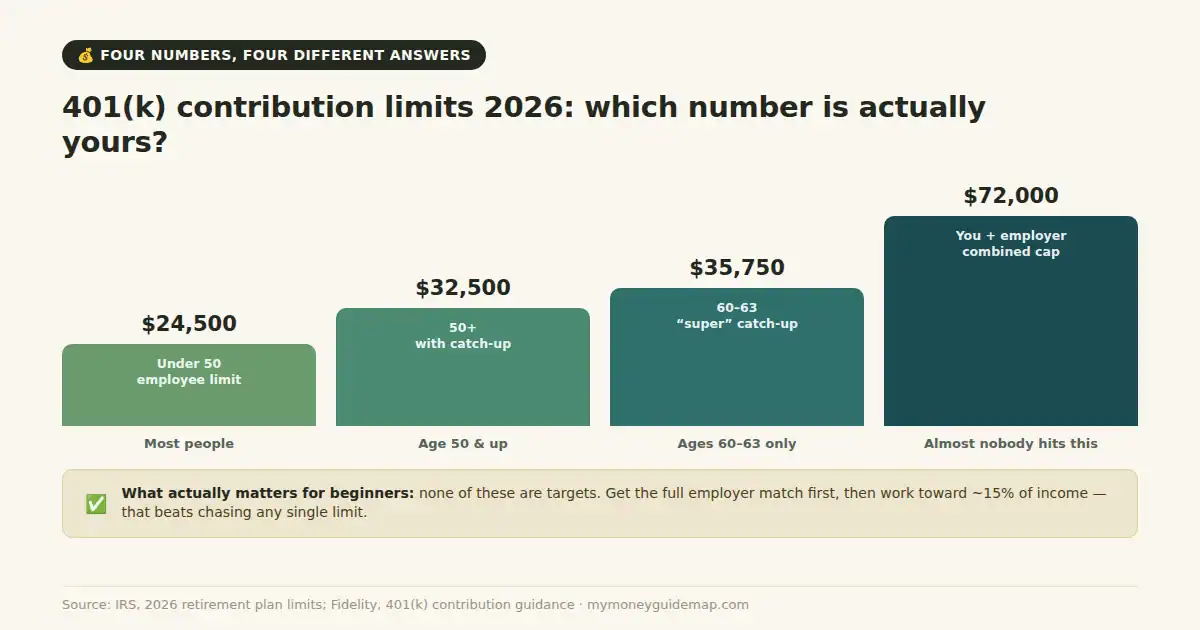
Look up 401(k) contribution limits and you’ll run into four different numbers within the first search result, with no explanation of which one actually applies to you. $24,500. $32,500. $35,750. $72,000. They’re not competing figures — each one answers a different question, and once you know which bucket you fall into, the confusion mostly disappears.
The 2026 401(k) Contribution Limits at a Glance
The IRS set the core 401(k) contribution limits for 2026 as follows: if you’re under 50, you can defer up to $24,500 of your own salary into your 401(k) this year. If you’re 50 or older, you get an extra $8,000 catch-up contribution, bringing your personal limit to $32,500. If you’re specifically between 60 and 63, a newer rule lets you contribute an even larger catch-up of $11,250 instead of the standard $8,000 — pushing your limit to $35,750, if your plan allows it. That fourth number, $72,000, is different from the other three: it’s the combined cap on everything going into your account in a year, including your own contributions and whatever your employer adds through a match.
What Actually Counts Toward the $72,000 Combined Limit
The $72,000 figure covers your employee contributions, your employer’s matching or profit-sharing contributions, and any after-tax contributions your plan allows — all added together. Most people never come close to this number, since it would require either a very generous employer match or a high-income earner making large after-tax contributions on top of the regular deferral limit. For the vast majority of beginners, the number that actually matters day-to-day is the $24,500 employee limit, not the $72,000 combined ceiling.
The Catch-Up Contributions: Age 50+ and the New 60–63 “Super” Catch-Up
The standard catch-up contribution exists because people closer to retirement often have more room in their budget and less time left to save, so the IRS lets them put in more. What’s newer is the tiered structure: turning 50 unlocks the $8,000 catch-up, but specifically landing between ages 60 and 63 unlocks a larger $11,250 catch-up instead, before dropping back to the standard $8,000 at 64. It’s a narrow four-year window worth knowing about if you’re approaching it, since it’s easy to miss that the catch-up amount actually changes twice, not once.
How Much Should You Actually Contribute?
None of the 401(k) contribution limits above are targets — they’re ceilings. Fidelity’s general guidance suggests aiming for around 15% of your income toward retirement each year, including whatever your employer contributes, which is a far more realistic goal for most beginners than maxing out $24,500. If 15% feels out of reach right now, a phased approach works just as well: start wherever you can, then increase your contribution rate by about 1% a year, or whenever you get a raise, so the jump never feels painful. The one number worth prioritizing before any other is your employer’s match — contributing at least enough to capture the full match should come before increasing contributions further, since turning down a match is turning down money that’s already yours.
It’s also worth remembering that your 401(k) limit is entirely separate from your IRA limit. Maxing out a Roth IRA doesn’t use up any of your $24,500 401(k) room, and vice versa — they’re two different buckets with two different caps, which means a beginner juggling both accounts has more total room to save than the 401(k) numbers alone suggest.
The Actual Takeaway
The 401(k) contribution limits for 2026 break down cleanly once you sort them by who they apply to: $24,500 for most people, $32,500 if you’re 50+, $35,750 in the narrow 60–63 window, and $72,000 as the combined ceiling almost nobody hits. The actual number to build a habit around isn’t any of those — it’s getting your full employer match, then working toward roughly 15% of your income over time. Consistency in hitting a percentage you can sustain beats chasing the maximum limit in any single year.
1 thought on “401(k) Contribution Limits 2026: How Much Can You Actually Save?”