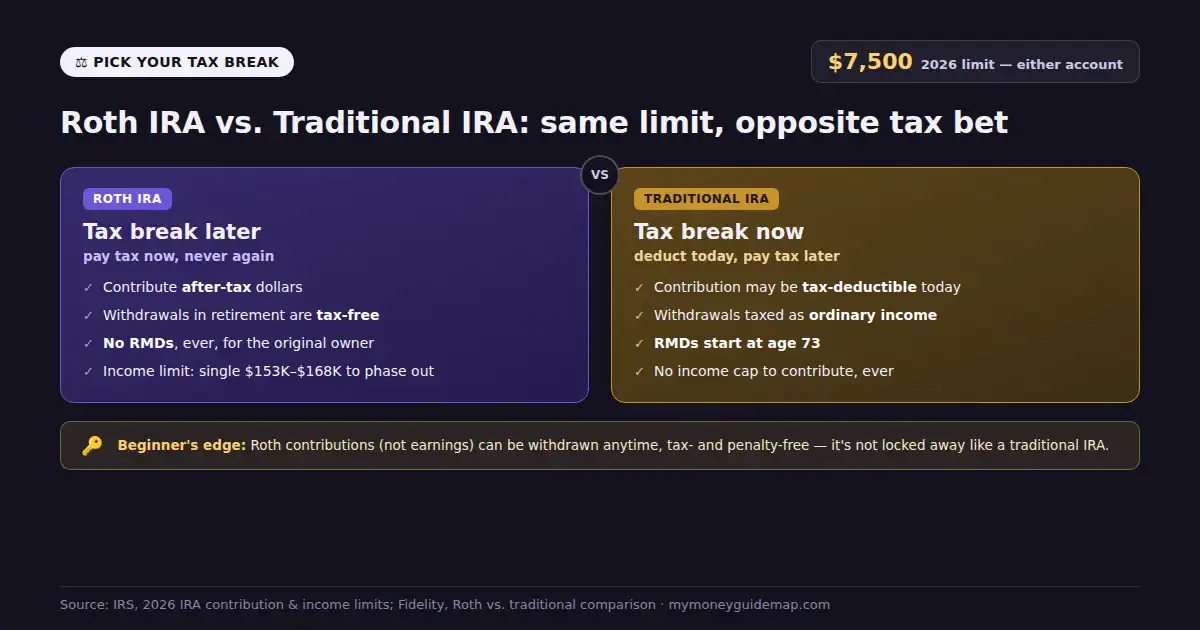
If you already know you want to open an IRA but can’t decide which kind, you’re not stuck on a small detail — Roth IRA vs traditional IRA is actually the single biggest decision in the whole process, bigger than which brokerage or which funds you pick. Both accounts let your money grow without being taxed every year, but they split on one question: do you want the tax break now, or later?
The Core Difference: When You Pay Taxes
A traditional IRA is funded with money that hasn’t been taxed yet. If you qualify for the deduction, your contribution lowers your taxable income this year, and you pay ordinary income tax when you withdraw the money in retirement. A Roth IRA works in reverse: you contribute money you’ve already paid tax on, so there’s no deduction today, but qualified withdrawals in retirement are completely tax-free — including all the growth. Every other rule in the Roth IRA vs traditional IRA comparison flows from this one choice: pay the IRS now, or pay the IRS later.
How Much You Can Contribute in 2026
The contribution limit is the same no matter which one you pick: $7,500 in 2026, or $8,600 if you’re 50 or older, thanks to a $1,100 catch-up contribution. That limit is combined across both account types — you can split contributions between a Roth and a traditional IRA in the same year, but the total across both still can’t exceed $7,500.
Does Your Income Determine Which You Can Use?
This is where the Roth IRA vs traditional IRA decision sometimes gets made for you. Roth IRAs phase out at higher incomes: for 2026, single filers lose eligibility between $153,000 and $168,000 of modified adjusted gross income, and married couples filing jointly phase out between $242,000 and $252,000. A traditional IRA has no income cap on contributing, but if you’re covered by a workplace retirement plan, the deduction itself phases out — between $81,000 and $91,000 for single filers, and $129,000 to $149,000 for a married couple filing jointly when the contributing spouse is covered. If you’re not covered by a plan at work, the full traditional deduction is available no matter your income.
What Happens When You Retire
A traditional IRA doesn’t let you leave the money alone forever — the IRS requires you to start taking required minimum distributions at age 73, whether you need the income or not. A Roth IRA has no RMDs during the original owner’s lifetime, so the money can keep growing untouched for as long as you want. For anyone thinking about leaving money to grow for decades, or passing it on, that difference compounds.
Which One Should Beginners Actually Choose?
For most people just starting out, the Roth IRA vs traditional IRA question comes down to a simple rule of thumb: if you expect to be in a lower tax bracket right now than you will be in retirement — which describes most people early in their career — a Roth IRA is usually the better bet, since you lock in today’s lower tax rate and never pay tax on the growth. If you’re in your peak earning years and the deduction meaningfully lowers this year’s tax bill, a traditional IRA can make more sense, especially if you expect a lower tax bracket after you retire.
There’s also a practical reason beginners tend to lean Roth: your contributions (not the earnings) can be withdrawn at any time, for any reason, with no tax and no penalty, since you already paid tax on that money going in. That flexibility makes a Roth IRA feel less like money you’re locking away and more like a safety net that also happens to grow tax-free — which matters if you’re still building an emergency fund alongside retirement savings and aren’t 100% sure you won’t need the cash. It’s not a reason to plan on withdrawing early, but knowing the door isn’t locked tends to make it easier to actually start.
If your income is under the Roth limits and you’re not sure which to pick, Vanguard’s guidance backs up the same general pattern: Roth tends to win for lower and middle incomes, traditional tends to win when the deduction is worth more to you today than tax-free growth will be worth later. Either way, the account is just the wrapper — what you put inside it, and how consistently you contribute, matters more than which letter is in the name. If you haven’t already, it’s worth reading up on what a Roth IRA actually is and how it compares to an employer plan like a 401(k) before deciding how to split contributions between them.
The Actual Takeaway
Roth IRA vs traditional IRA comes down to a bet on your own future tax bracket: pay tax now and never again with a Roth, or get a deduction now and pay tax later with a traditional. For most beginners with years of career growth ahead of them, that bet tends to favor the Roth — but the real mistake isn’t picking the “wrong” one, it’s not opening either account and letting the decision paralyze you into not saving at all. Once you’re contributing consistently, a strategy like dollar-cost averaging makes the account type matter a lot less than just showing up every month.
1 thought on “Roth IRA vs. Traditional IRA: Which Is Right for You?”